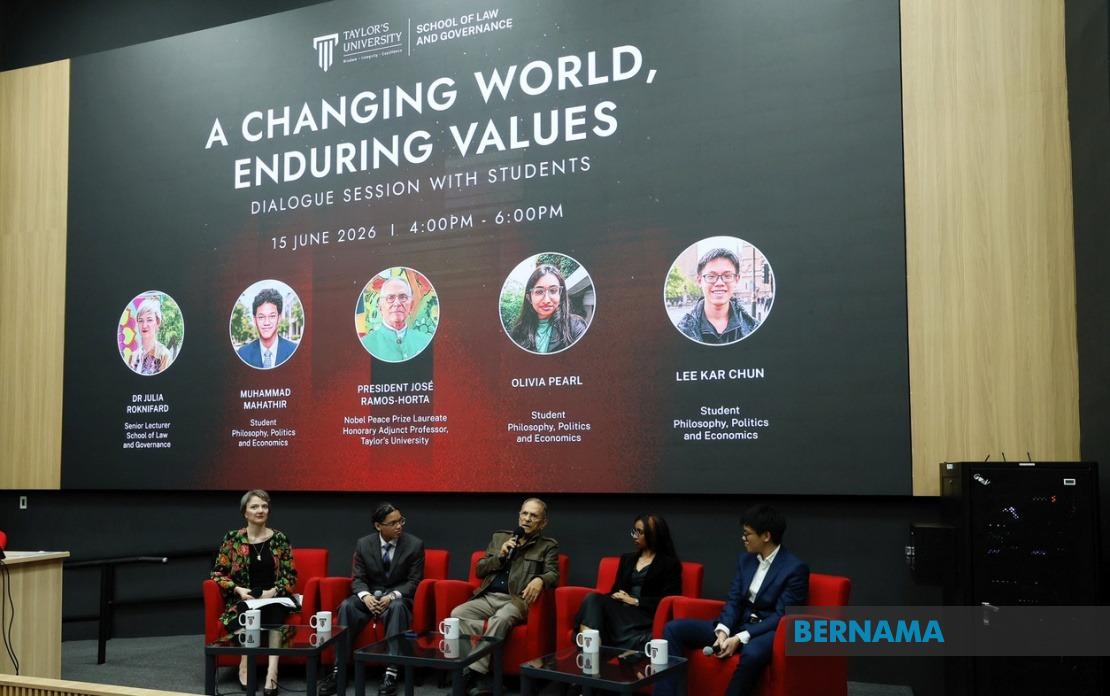
Timor-Leste President Jose Ramos-Horta has characterized relations between his nation and Malaysia as exceptionally robust, offering warm testimony to the bilateral partnership during a visit to Petaling Jaya on Monday. The Nobel Prize Laureate and former journalist, who is spending five days in Malaysia until Wednesday, expressed particular appreciation for the country's longstanding commitment to Timor-Leste's development and regional standing. Speaking after engaging with students at Taylor's University in a dialogue session, Ramos-Horta noted that Malaysia's contribution extends back decades, well before Timor-Leste's formal independence in 2002.
The Timorese leader underscored Malaysia's pivotal role in his nation's critical early years, specifically referencing the deployment of Malaysian peacekeeping forces in 1999 when Timor-Leste was navigating the transition toward sovereignty. This gesture of military and diplomatic support during a vulnerable period has left an enduring mark on how Timor-Leste views its relationship with Malaysia. Ramos-Horta's remarks reflect a nuanced appreciation for Malaysia's sustained engagement with smaller Southeast Asian neighbours, a positioning that carries significant weight within regional diplomatic circles.
Beyond historical support, Ramos-Horta highlighted Malaysia's contemporary trajectory under Prime Minister Datuk Seri Anwar Ibrahim's leadership. He observed that over the past four decades Malaysia has demonstrated consistent development, but emphasized that recent years have seen accelerated progress in both domestic economics and global influence. The president attributed this momentum to what he described as Anwar Ibrahim's statesmanship, suggesting that the prime minister's diplomatic finesse has elevated Malaysia's standing internationally and strengthened its economic position. Such commentary from a respected international figure carries weight in regional perception-building and reflects the broader esteem in which Malaysia's current leadership is held among neighbouring states.
Ramos-Horta also seized the occasion to deliver a special message to Malaysia's journalism community, timed to coincide with National Journalists' Day celebrations scheduled for Penang this Saturday. He emphasised that informed societies form the bedrock of national cohesion and resilience, arguing that journalists play an indispensable role in keeping citizens engaged with current affairs and public discourse. His message carried an implicit endorsement of press freedom and the fourth estate's function in democratic systems, values that resonate particularly across Southeast Asia where media pluralism remains contested terrain. By congratulating Malaysian journalists collectively, Ramos-Horta acknowledged the profession's contribution to the nation's democratic fabric.
A significant portion of Ramos-Horta's visit centred on Timor-Leste's ambitious plans for the region. During his dialogue session titled "A Changing World, Enduring Values", the president announced that Timor-Leste is preparing to host the ASEAN Summit in 2029, a responsibility that carries substantial organisational and infrastructural demands. Ramos-Horta expressed confidence that his nation will complete necessary facilities and development projects in time for the summit, positioning the event as a catalyst for accelerated growth within Timor-Leste. This announcement reflects the country's determination to exercise full membership responsibilities within the bloc and showcase its capabilities to regional peers.
Timor-Leste's recent accession to ASEAN represents a watershed moment in regional architecture, with the nation formally becoming the bloc's 11th member on October 26, 2025, marking the first expansion in 26 years. Ramos-Horta specifically credited Malaysia's instrumental role during its ASEAN chairmanship in facilitating Timor-Leste's full membership, an acknowledgment that underscores Malaysia's diplomatic efforts to integrate the newest member state. This process required navigating complex geopolitical and membership criteria discussions, making Malaysia's advocacy particularly meaningful for Timor-Leste's integration trajectory. The president's gratitude extends beyond ceremonial courtesy, reflecting genuine recognition of Malaysia's facilitative role in a process that strengthens ASEAN's cohesion and legitimacy.
Ramos-Horta's optimism regarding Timor-Leste's readiness to host the 2029 summit merits careful consideration within the broader context of Southeast Asian development. The nation faces substantial infrastructure deficits and capacity constraints common among newer member states, yet the president's determination to expedite development projects demonstrates regional commitment to demonstrating competence and capability. Malaysia's experience as a developed nation within ASEAN and its track record of successful summit hosting positions it as a natural reference point and potential source of technical and logistical assistance for Timor-Leste's preparations.
The convergence of statements around Malaysia's democratic credentials, press freedom, and economic dynamism paints a portrait of a nation that Timor-Leste views as a model for aspiration and partnership. Ramos-Horta's comments, delivered by a statesman of international standing, carry implications beyond diplomatic niceties. They suggest that from Timor-Leste's perspective, Malaysia represents a successful template for regional integration, democratic development, and economic advancement—attributes that Timor-Leste itself seeks to cultivate as it matures within ASEAN's institutional framework. This characterization enhances Malaysia's soft power positioning across Southeast Asia and reinforces its standing as a stabilising force within the region's architecture.