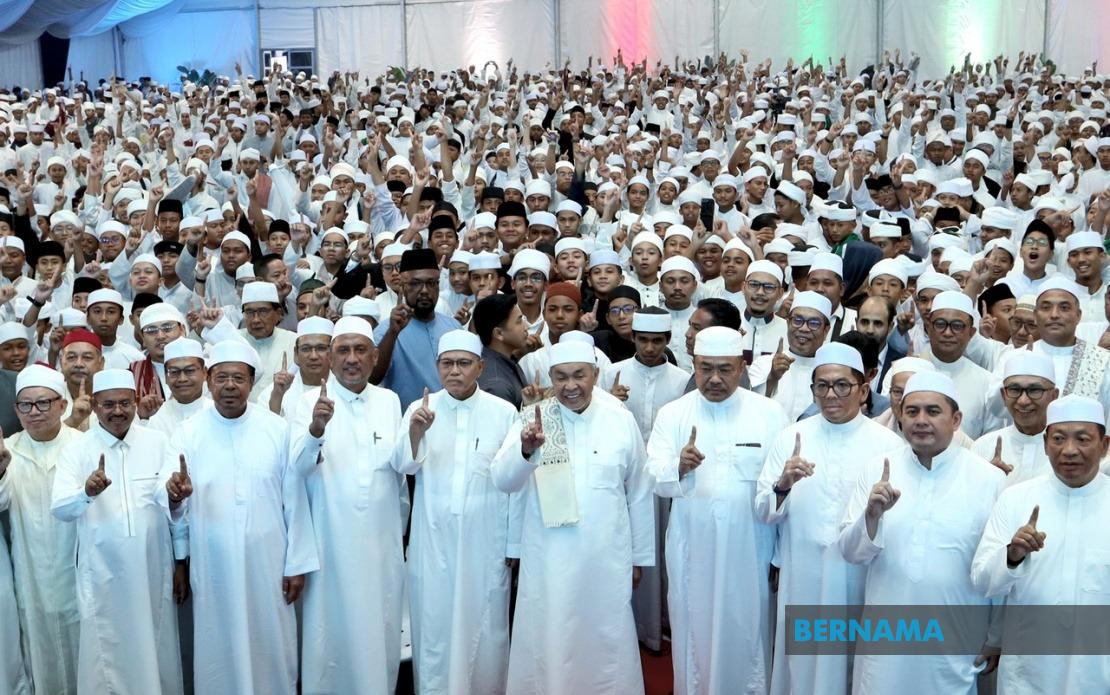
The Malaysian government has given the green light to establish a National Tahfiz Council, a significant institutional development aimed at bringing coherence and structure to Quranic memorisation education across the country. Deputy Prime Minister Datuk Seri Dr Ahmad Zahid Hamidi announced the approval, which was granted during a recent Cabinet meeting chaired by Prime Minister Datuk Seri Anwar Ibrahim. Zahid will assume the chairmanship of the council, tasked with overseeing the standardisation of tahfiz education quality, curriculum frameworks, recognition protocols and academic progression routes for students pursuing this religious educational specialisation.
The announcement was made during the Pahang State Huffaz Gathering 2026 at Yayasan Pahang, an event that drew over five thousand Quranic memorisers from across the state. The scale of attendance underscored the considerable following and participation in tahfiz education within Malaysia, particularly in Peninsular Malaysia's heartland regions. The gathering served as an ideal platform to unveil this institutional initiative to key stakeholders and demonstrate governmental commitment to formalising what has traditionally been a less-regulated educational sector within Malaysia's broader educational landscape.
The establishment of this council reflects growing recognition that tahfiz education requires systematic integration within Malaysia's formal education framework rather than operating primarily as a parallel or supplementary system. Zahid articulated a vision wherein students engaged in Quranic memorisation can transition seamlessly from madrasah institutions into university systems, combining their religious specialisation with contemporary skills and qualifications. This represents a substantial reorientation—positioning tahfiz not merely as a religious devotional practice but as a legitimate educational pathway that equips students for competitive professional careers and economic participation.
Pahang has emerged as a pioneering state in demonstrating how tahfiz education can be systematically developed into a comprehensive knowledge acquisition pathway spanning from early childhood through international-level achievement. The state, notably under the inspiration of Sultan Al-Sultan Abdullah Ri'ayatuddin Al-Mustafa Billah Shah, has established Tadika Tahfiz Negeri Pahang to cultivate enthusiasm for Quranic memorisation from the earliest educational stages. By embedding this foundation during formative years, Pahang illustrates how structured progression can transform tahfiz education from a narrowly focused memorisation exercise into a holistic educational trajectory with genuine relevance for children's long-term development and career prospects.
The government's commitment extends beyond mere institutional framework creation. The cabinet is currently reviewing implementation of the National Tahfiz Policy 2.0, which encompasses several substantive initiatives designed to modernise and professionalise the sector. These include TVET Tahfiz, integrating technical and vocational training with Islamic education; the Malaysian Tahfiz Certificate 2.0, establishing standardised credentials; the Graded Hafazan Certification system for tiered recognition of memorisation achievement; the Huffaz Financing Scheme providing financial support for students; and the Malaysian Tahfiz Recognition Standard establishing uniform quality benchmarks.
Parallel to these initiatives, the government has prioritised strategic collaborations with higher education institutions and skills training centres, creating tangible bridges between tahfiz education and university admission, vocational qualifications and professional development. These partnerships are essential for translating policy intentions into practical pathways where tahfiz students encounter neither educational nor professional glass ceilings. The institutional architecture being constructed acknowledges that contemporary Islamic education must be competitively viable within Malaysia's knowledge-based economy.
The symbolic importance of witnessing the exchange of memoranda of understanding between Yayasan Pahang, the Community Development Department (KEMAS) and Majlis Amanah Rakyat (MARA) during the gathering cannot be understated. These partnerships represent concrete mechanisms through which tahfiz education development can be strengthened and skills training opportunities expanded for students specialising in Quranic memorisation. MARA's involvement particularly signals government intent to ensure tahfiz students benefit from the same economic empowerment and entrepreneurial development pathways available to other student cohorts.
For Malaysian society more broadly, this institutional development addresses longstanding structural questions about how Islamic education integrates within national education systems and labour markets. Historically, students completing intensive tahfiz programmes faced uncertain economic prospects and limited formal recognition of their achievements within secular professional spaces. The National Tahfiz Council's establishment represents a deliberate policy correction, reflecting acknowledgment that Malaysia's education system must accommodate diverse knowledge traditions and specialisations while maintaining quality standards and ensuring graduate competitiveness.
The implications for Southeast Asia are noteworthy given that several neighbouring countries grapple with similar questions regarding Islamic education integration and modernisation. Malaysia's institutional approach—combining standardisation, skills development, partnership with secular institutions and clear progression pathways—offers a potentially replicable model for other Muslim-majority nations seeking to bridge traditional Islamic education with contemporary economic demands. The council's framework could demonstrate how religious and secular educational sectors can cooperate productively rather than exist in tension.
For students and families currently engaged with tahfiz education, the council's establishment signals genuine government recognition and investment. Young people memorising the Quran can now reasonably anticipate their religious learning will be formally credited, universally recognised and professionalised within career pathways. This institutional legitimacy may encourage greater participation while simultaneously attracting higher-calibre educators to tahfiz institutions, knowing their work contributes to recognised educational outcomes rather than remaining categorised as supplementary or optional learning.
Zahid's emphasis on student progression from memorisation to skills, and from educational institutions to professional confidence, reflects understanding that Islamic education's contemporary value lies not in preserving traditional forms unchanged but in adapting them to serve modern graduates' actual needs. The Huffaz Financing Scheme, for instance, acknowledges that financial barriers prevent many capable students from pursuing tahfiz education, treating it as a legitimate equity concern comparable to supporting students in secular educational tracks. This parity of support represents significant policy maturation.
The National Tahfiz Council's approval ultimately signals that Malaysia views Quranic memorisation education as worthy of systematic government support, quality assurance, institutional coordination and professional recognition. Rather than treating tahfiz as a private religious matter outside educational policy purview, the government has positioned it as a nationally important specialisation deserving the same systemic attention applied to technical, vocational and academic education streams. This institutional mainstreaming, combined with concrete initiatives enabling genuine progression pathways, represents meaningful advancement in how Malaysia's education system accommodates diverse knowledge specialisations and ensures equitable opportunity for all students regardless of their educational choices.