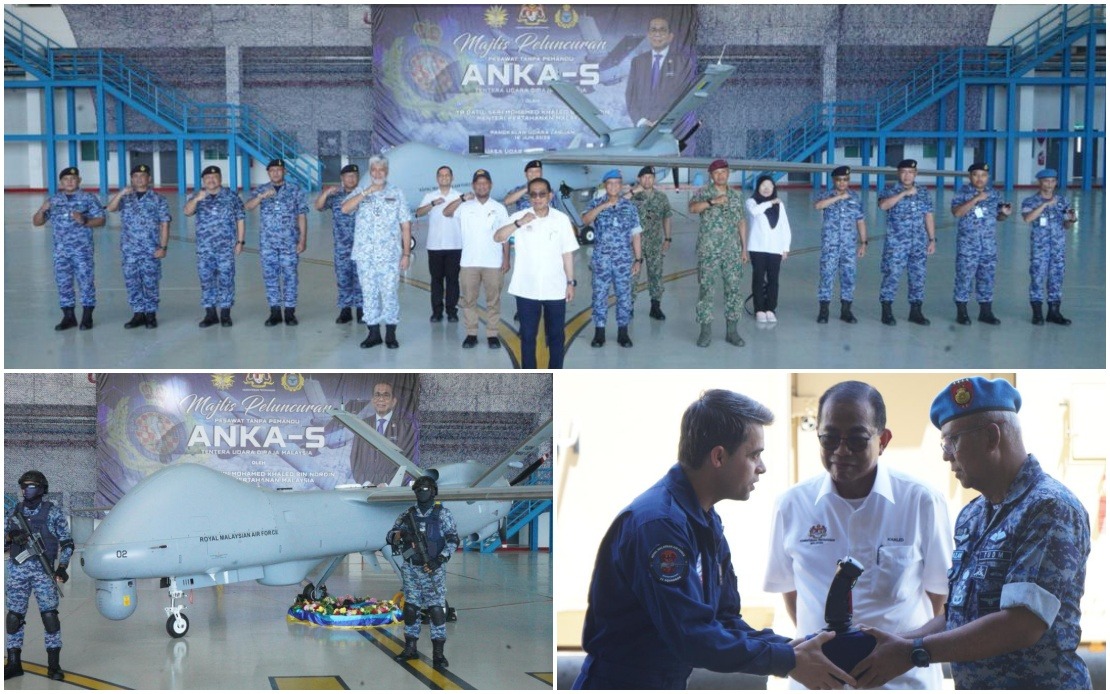
Malaysia has taken a significant step in modernising its defence infrastructure with the operational deployment of the ANKA-S Unmanned Aircraft System by the Royal Malaysian Air Force. Unveiled at the RMAF Labuan Air Base on June 16, the asset represents a watershed moment in the nation's ability to monitor and protect its strategic maritime interests, particularly across the contested waters of the South China Sea. Defence Minister Datuk Seri Mohamed Khaled Nordin underscored the importance of this development, describing it as a transformative capability that addresses longstanding surveillance gaps in one of the world's most geopolitically sensitive regions.
The acquisition of the three ANKA-S aircraft involved a substantial investment of RM423.8 million, encompassing not only the platforms themselves but also the accompanying ground control stations and comprehensive two-year personnel training programmes. This commitment reflects the government's strategic prioritisation of intelligence gathering and maritime domain awareness in an era of increasing competition for control of critical sea lanes and resources. The decision to base the initial squadron at Labuan positions Malaysia's surveillance apparatus at a geographical vantage point from which it can effectively monitor activities across the wider South China Sea region.
The ANKA-S is a medium-altitude long-endurance platform engineered to operate at altitudes exceeding 30,000 feet whilst maintaining flight duration surpassing 24 hours. These specifications translate into sustained operational coverage that was previously unavailable to Malaysian defence planners, enabling continuous monitoring cycles without the fatigue constraints associated with manned aircraft. The system's capacity to function across varying meteorological conditions further enhances its operational reliability, ensuring that surveillance coverage is not dependent upon favourable weather windows.
Beyond raw surveillance capability, the ANKA-S introduces sophisticated sensor integration that permits accurate vessel identification and movement tracking. This intelligence advantage allows Malaysian defence authorities to transition from reactive, resource-intensive patrol patterns to targeted, intelligence-driven deployments. Rather than conducting broad maritime sweeps consuming substantial fuel and personnel resources, the RMAF can now allocate its conventional assets—fighter jets and patrol vessels—directly to areas of identified concern. This represents a fundamental shift in operational efficiency and cost management within the defence apparatus.
Malaysia's operational philosophy regarding the ANKA-S deliberately eschews weaponisation despite the platform's technical capacity to carry ordnance. This calculated restraint carries important diplomatic messaging, signalling to regional and international stakeholders that Malaysia's defence posture remains fundamentally defensive rather than provocative. In a region where military modernisation frequently triggers reciprocal acquisitions and strategic anxiety, this positioning allows Malaysia to upgrade its surveillance capabilities whilst maintaining its preferred international profile as a nation concerned with protecting rather than projecting power.
The decision to station the ANKA-S at Labuan holds specific strategic resonance for Malaysia. The Labuan Federal Territory's geographical position provides optimal coverage of the approaches to the Malacca Strait and the contested maritime zones where Malaysia maintains claims and interests. From this location, the drone operations support the broader Malaysian objective of maintaining visibility over its vast exclusive economic zone and adjacent waters, where illegal fishing, smuggling, and other transgressions regularly occur. The presence of the system at Labuan therefore represents both a capability upgrade and a strategic reaffirmation of Malaysian interest in regional maritime governance.
The operational savings inherent in ANKA-S deployment carry budgetary implications worth considering within Malaysia's defence planning context. Sustained manned aircraft operations demand continuous crew rotations, maintenance cycles, and fuel consumption that impose substantial recurring costs. Conversely, unmanned systems enable extended surveillance with minimal operational overhead, allowing defence budgets to be redirected toward other modernisation priorities. This cost-efficiency argument becomes particularly pertinent given the expansive maritime areas Malaysia must monitor relative to available conventional assets.
The government has indicated that the current deployment represents merely the first phase of a broader ANKA-S acquisition strategy. A proposal for three additional aircraft is under consideration within national development planning frameworks, suggesting recognition that even with the initial three platforms, surveillance capacity across Malaysia's maritime interests remains constrained. Acquisition of a second tranche would enable more persistent coverage across multiple operational areas simultaneously, potentially extending surveillance reach beyond the South China Sea toward other critical maritime zones.
The launch ceremony, attended by senior military officials including the Chief of Navy and Chief of Air Force, underscored the whole-of-military significance attributed to the ANKA-S. The presence of these command figures reflected institutional acknowledgement that the system addresses capability gaps recognised across Malaysia's maritime and air defence communities. Demonstrations of the system's intelligence, surveillance and reconnaissance capabilities at the facility's data exploitation centre provided concrete evidence of the platform's operational functionality, moving the capability from conceptual advantage to demonstrable asset.
For regional observers, the ANKA-S deployment illustrates the broader pattern of Southeast Asian nations acquiring sophisticated surveillance capabilities to strengthen maritime domain awareness. Unlike neighbouring countries that have pursued armed drone systems, Malaysia's non-weaponised approach reflects distinct strategic preferences and diplomatic positioning. This differentiation may carry implications for how Malaysia is perceived within regional security dialogues, where surveillance enhancement is increasingly viewed as a legitimate defence modernisation objective.
The ANKA-S initiative also carries implications for interagency cooperation beyond purely military domains. Coast guard operations, fisheries enforcement, customs surveillance, and environmental monitoring all benefit from the enhanced maritime domain awareness that the system provides. The coordination mechanisms required to share intelligence across government agencies—defence, maritime enforcement, civilian aviation authorities—will necessarily evolve to accommodate the new capability, potentially strengthening overall government responsiveness to maritime incidents.
Moving forward, the challenge for Malaysia will involve maintaining operational proficiency with the technology whilst developing doctrine and tactics that fully exploit the platform's capabilities. Training local personnel to manage the ground control stations and interpret sensor data becomes critical to sustaining the capability advantage. The two-year training commitment embedded within the acquisition represents an investment in institutional knowledge transfer, ensuring that Malaysian expertise in drone operations develops organically rather than remaining dependent upon external contractors or advisors.
Ultimately, the ANKA-S deployment reflects Malaysia's sophisticated understanding of contemporary maritime security challenges. Rather than pursuing dramatic military build-ups that risk escalating regional tensions, the country has chosen targeted investment in surveillance and intelligence capabilities that directly support sovereignty protection and maritime governance. This measured, capability-focused approach aligns with Malaysia's broader security positioning as a nation committed to maintaining stability whilst protecting its interests—a balance increasingly difficult to achieve amid broader strategic competition in Southeast Asia.