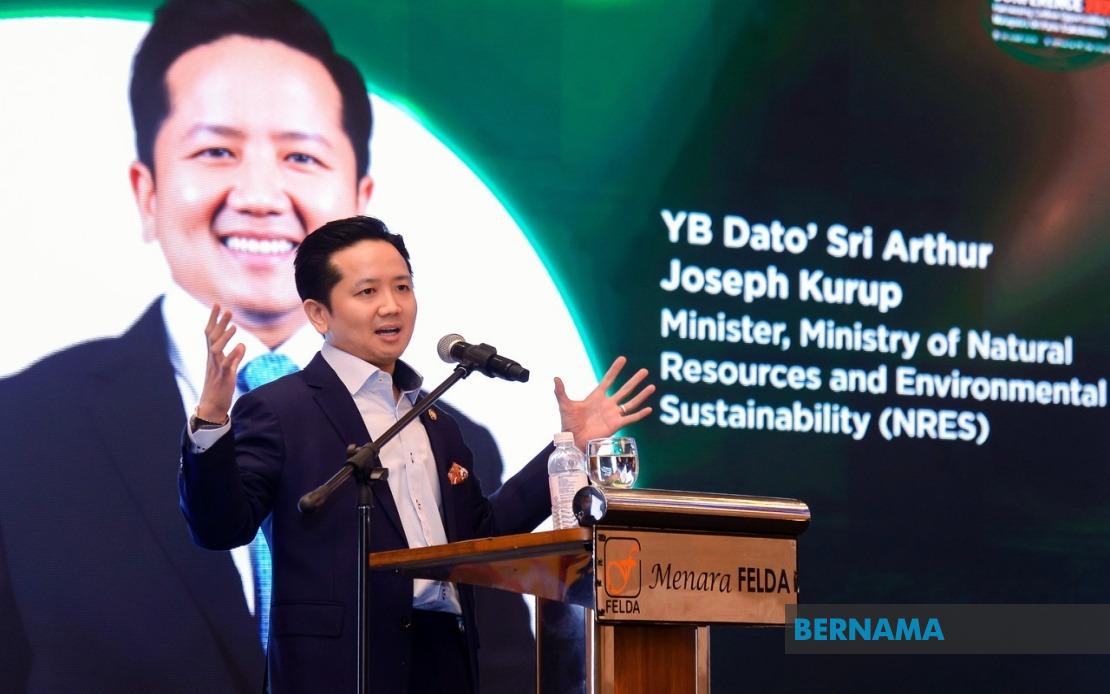
Malaysia's government remains committed to introducing a carbon tax, though officials continue to refine the details of how the system will operate and when it will take effect, according to Natural Resources and Environmental Sustainability Minister Datuk Seri Arthur Joseph Kurup. Speaking after opening the Malaysia Palm Carbon Conference 2026 in Kuala Lumpur on June 16, the minister indicated that policymakers are working through implementation logistics while keeping industry conditions and overall policy architecture in mind.
The carbon tax initiative represents a shift in Malaysia's approach to environmental management, positioning it not as a punitive regime to penalise polluters but rather as an incentive structure designed to encourage adoption of cleaner technologies and accelerate emissions reductions. This framing matters significantly for how the business community and industrial stakeholders perceive the measure. By emphasising the carrot rather than the stick, the government appears intent on building broader acceptance among sectors that would bear compliance costs. Datuk Seri Ahmad Shabery Cheek, chairman of the Federal Land Development Authority (Felda), was present at the conference, underscoring the agricultural and land-use dimensions of climate policy in Malaysia.
Arthur Kurup acknowledged that the timing of implementation remains under active review within government circles. No firm date has been announced, but the minister's language suggested the measure will eventually move from planning to execution. The phrase "in due course" reflects bureaucratic caution, indicating that while political commitment exists, practical readiness across multiple agencies and sectors continues to be assessed. This deliberative approach may frustrate climate advocates eager for swift action, yet it also suggests policymakers are attempting to avoid the implementation failures that have plagued environmental programmes in other jurisdictions.
Back in April, the minister had already signalled that the government was reconsidering the original 2024 timeline for launching the carbon tax. That delay reflected mounting concerns about introducing new fiscal burdens on industry and consumers at a time when global supply chains remained disrupted, energy markets were volatile, and geopolitical tensions threatened to worsen. The government weighed its climate commitments against immediate economic pressures facing manufacturing, construction, cement production, and steel fabrication—sectors explicitly earmarked for the initial carbon tax scope. This balancing act illustrates the genuine tension between environmental urgency and economic stability that developing countries with resource-dependent economies like Malaysia must navigate.
The government has identified several priority uses for carbon tax revenue, moving beyond simple budgetary collection to ensure the mechanism advances the broader sustainability agenda. Proposed allocations include funding for climate adaptation projects that would help communities and infrastructure cope with intensifying weather events and shifting precipitation patterns. Forest conservation initiatives would receive support, recognising that Malaysia's remaining tropical forests serve as critical carbon sinks whilst facing ongoing pressure from agricultural expansion and logging. Sustainable land management programmes would also benefit, addressing soil degradation and encouraging practices that maintain productive capacity whilst reducing emissions intensity.
This revenue deployment strategy reflects sophisticated thinking about how fiscal policy can serve multiple environmental objectives simultaneously. Rather than allowing carbon tax revenues to flow into general government coffers, channelling funds toward climate adaptation and conservation creates a feedback mechanism where polluters directly finance ecological protection. Such approaches have gained traction internationally, with countries like France and several Nordic nations demonstrating that carbon revenues can fund just transitions whilst strengthening climate resilience. For Malaysia, a nation vulnerable to sea-level rise, extreme precipitation events, and tropical cyclones, adaptation spending carries particular urgency.
The emphasis on strengthening national resilience to climate change appears throughout the government's recent policy statements. Datuk Seri Arthur Joseph Kurup framed the carbon tax not as an isolated measure but as part of comprehensive climate governance architecture. This holistic perspective acknowledges that pricing carbon alone, without complementary investment in adaptation infrastructure and nature-based solutions, leaves populations and economic assets exposed to escalating climate risks. Malaysian policymakers appear cognisant that as a tropical nation with significant coastal populations and agricultural sectors vulnerable to climate variability, climate finance must extend beyond mitigation to encompassing resilience-building.
Anticipated legislative action will advance this governance framework further. The National Climate Change Bill, which the minister indicated would be tabled in the Dewan Rakyat during 2024, promises to create stronger legal foundations for climate policy implementation. Such legislation typically establishes institutional responsibilities, sets emissions reduction targets, mandates climate risk assessment in planning decisions, and creates accountability mechanisms. For Malaysia, this represents an important step toward systematising climate action beyond individual ministerial initiatives. A comprehensive legal framework signals to investors, trading partners, and civil society that climate commitments carry genuine enforceability.
The carbon tax's inclusion of only selected industries in its initial phase reflects pragmatic sequencing. Focusing first on steel, cement, and construction aligns with international best practice, targeting sectors responsible for disproportionate emissions while possessing technical capacity to track and report carbon outputs. These industries also have clearer pathways for green technology adoption than would, for instance, agriculture or transportation. Subsequent phases could broaden the tax to encompass additional sectors, following a learning curve that establishes robust measurement systems and allows supply chains to adapt.
For Malaysian businesses and investors monitoring climate policy, the emerging framework suggests both challenges and opportunities. Compliance costs will increase for targeted sectors, but early movers adopting low-carbon technologies may gain competitive advantages as the tax eventually widens or as major trading partners implement similar measures. The government's emphasis on using revenues to fund climate adaptation could also generate commercial opportunities in green infrastructure, renewable energy deployment, and sustainable agriculture consulting. Companies aligned with climate-friendly practices may find themselves advantageously positioned as Malaysia transitions toward a lower-carbon economy.