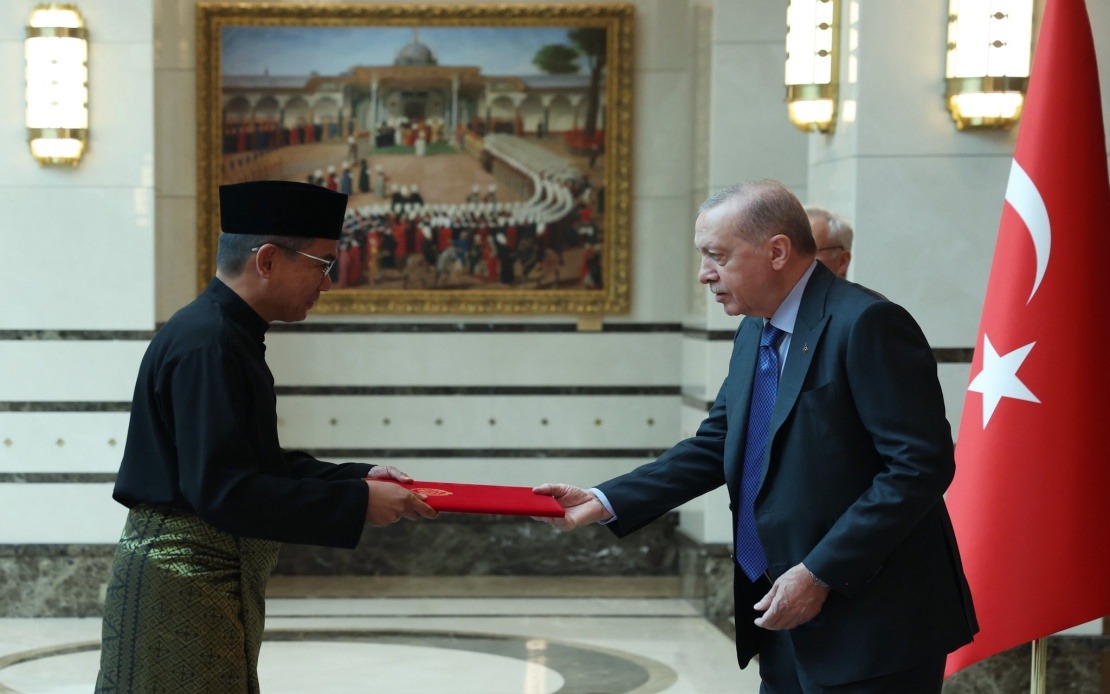
Malaysia has thrown its weight behind Türkiye's ambitions to secure ASEAN Dialogue Partner status, marking a significant show of support for the Turkish nation's expanding regional presence. The endorsement came during a formal diplomatic encounter in Ankara on June 17, when Malaysian Ambassador to Türkiye, Adlan Mohd Shaffieq, presented his credentials to Turkish President Recep Tayyip Erdoğan at the Presidential Complex. This moment, recorded in an official statement from the Malaysian Embassy, underscores Kuala Lumpur's commitment to facilitating Ankara's deeper integration into Southeast Asian affairs.
The ambassador's message reflected Malaysia's recognition that Türkiye has progressively emerged as a consequential partner for the region. Rather than treating this as merely symbolic diplomacy, the statement emphasised concrete dimensions of the relationship spanning economic cooperation, geopolitical alignment, and strengthening connections between Turkish and Southeast Asian societies. Malaysia's backing carries particular weight because, as a founding ASEAN member and bridge-builder between the Islamic world and regional blocs, Kuala Lumpur's endorsement signals broader institutional receptiveness to Türkiye's formal engagement with the association.
During the credential ceremony, Ambassador Shaffieq articulated a vision of Malaysia-Türkiye relations as resting on bedrock principles of mutual trust and reciprocal respect. He conveyed warm greetings and congratulations from His Majesty Sultan Ibrahim, King of Malaysia, and Prime Minister Datuk Seri Anwar Ibrahim, embedding the diplomatic gesture within Malaysia's highest political leadership. This personal dimension, transmitted through official channels, reflects the significance both nations attach to their bilateral partnership and hints at executive-level commitment to nurturing this relationship further.
The substance of Malaysia's support centres on recognising Türkiye's expanding footprint across Southeast Asia. The ambassador highlighted the nation's growing economic engagement with ASEAN members, its strategic perspective aligned with regional interests, and burgeoning people-to-people exchanges that transcend governmental interactions. For Malaysia, which has long positioned itself as a gateway between Asia, the Islamic world, and the broader international community, Türkiye's trajectory mirrors comparable ambitions to build influence through multidimensional engagement rather than military or coercive instruments.
Malaysia and Türkiye have cultivated a relationship rooted in shared civilisational values and pragmatic cooperation across multiple domains. The ambassador specifically identified education, defence, and the halal industry as pillars of bilateral collaboration that have matured through consistent engagement. The halal sector deserves particular attention, given Malaysia's pre-eminence in halal standards certification and Türkiye's substantial Muslim population and food production capacity. Education exchanges reflect mutual interest in developing human capital and transferring expertise, while defence cooperation signals trust in sensitive security matters.
A particularly noteworthy element of the diplomatic exchange involves the personal rapport between President Erdoğan and Prime Minister Anwar Ibrahim. Ambassador Shaffieq explicitly referenced their shared vision as a platform for deepening collaboration, suggesting that cordial personal relations between leaders can catalyse institutional cooperation across sectors. This observation carries implications for bilateral initiatives that might otherwise stall in bureaucratic channels, as presidential and prime ministerial goodwill can expedite policy implementation and resource allocation.
President Erdoğan's response to the ambassador's presentation underscored Ankara's commercial expectations regarding the bilateral relationship. He expressed confidence that trade relations between the two countries would expand and achieve a substantial target of US$10 billion. This figure represents an ambitious but achievable goal, reflecting both nations' economic potential and their determination to translate political goodwill into measurable commercial outcomes. For Malaysian businesses, particularly those in manufacturing, agriculture, and services, Türkiye represents an expanding market and a potential gateway to Eastern European and Central Asian supply chains.
The timing of this diplomatic gesture merits consideration within broader Southeast Asian geopolitical trends. As major powers extend influence into the region through varying mechanisms, ASEAN's engagement with external partners like Türkiye becomes strategically relevant. ASEAN Dialogue Partner status does not confer decision-making authority within ASEAN structures but rather establishes formal consultative channels, allowing Türkiye voice in regional discussions on security, economics, and social issues. For a nation positioned at the intersection of Europe, Asia, and the Middle East, such access enhances Ankara's capacity to project influence and pursue its interests across multiple regions simultaneously.
Malaysia's advocacy for Türkiye's ASEAN aspirations reflects Kuala Lumpur's strategic calculus regarding regional architecture. By supporting Ankara's bid, Malaysia positions itself as a connector between established Southeast Asian frameworks and rising powers seeking formalised roles. This stance aligns with Malaysia's historical diplomatic approach of expanding regional networks, strengthening ties with Muslim-majority nations, and fostering pluralistic international partnerships that avoid exclusionary bloc-building. The endorsement also reinforces Malaysia's image as an honest broker capable of building consensus among ASEAN members on contentious external relations.
Looking forward, Malaysia's formal backing likely encourages other ASEAN members to consider Türkiye's application more favourably. While ASEAN operates on consensus principles, individual member state support provides diplomatic momentum, allowing proponents of closer engagement to argue for institutional reciprocity. Should Türkiye successfully transition to Dialogue Partner status, the development would reflect evolving ASEAN attitudes toward engagement with non-regional powers and validate Ankara's regional strategy of deepening institutional ties across multiple forums simultaneously.
The broader implications for Malaysian policy encompass several considerations. First, it demonstrates Malaysia's willingness to support fellow Muslim-majority nations' international aspirations, reinforcing its identity as a leader in Islamic world affairs. Second, it signals openness to expanding Malaysia's own multilateral partnerships through supporting others' integration into regional bodies. Third, it positions Malaysia as a key interlocutor for Türkiye's Southeast Asian ambitions, potentially yielding diplomatic dividends and enhanced bilateral influence. For businesses and institutions in both nations, formalised ASEAN-Turkish relations could unlock new cooperation opportunities in education, trade, and technology sectors.
As Malaysia and Türkiye continue strengthening their partnership, the convergence of diplomatic support for regional integration, shared economic interests, and cultural affinity suggests sustained momentum in bilateral relations. The credential presentation symbolised not merely formal courtesy but substantive commitment to collaborative growth. Should Türkiye achieve Dialogue Partner status through Malaysia's assistance and broader ASEAN support, it would validate a diplomatic strategy emphasising soft power, institutional integration, and network-building as mechanisms for advancing national interests in an increasingly multipolar international system.

