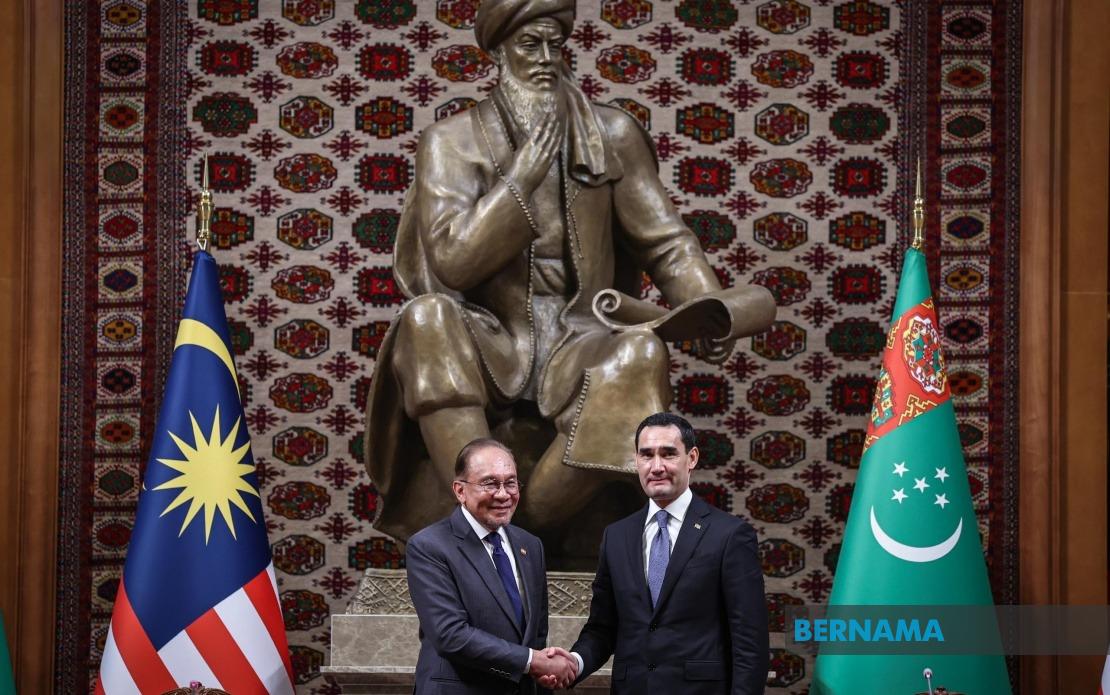
Prime Minister Datuk Seri Anwar Ibrahim has announced that Malaysia and Turkmenistan have committed to deepening their bilateral relationship through a more methodical and forward-looking partnership framework. The commitment emerged following high-level discussions between Anwar and Turkmenistan President Serdar Berdimuhamedov at the Presidential Palace in Ashgabat on Friday, during which the two leaders and their delegations explored avenues for enhanced cooperation across multiple sectors. Both nations have pledged to implement all agreed initiatives with rigour, openness and efficiency, ensuring that collaborative efforts deliver tangible benefits to their respective populations.
The depth of Malaysia's engagement with Turkmenistan reflects a broader strategic calculus. While Turkmenistan remains less prominent in Malaysian foreign policy discourse than some regional or major powers, the Central Asian nation holds significance as an energy-rich economy with growing interest in Southeast Asian markets and vice versa. For Malaysia, establishing robust institutional frameworks with Turkmenistan aligns with efforts to diversify partnerships beyond traditional trading partners and to position itself as a bridge between Asia and Central Asia. The structured approach endorsed by both sides suggests recognition that sustainable cooperation requires formal mechanisms, transparency, and commitment at the highest levels of government.
The bilateral meeting generated the exchange of four key documents designed to catalyse cooperation. An Air Services Agreement between the two governments addresses connectivity, a perennial challenge for nations seeking closer economic and people-to-people ties. Two additional memoranda of understanding were signed between Malaysia's Institute of Diplomacy and Foreign Relations and Turkmenistan's Institute of International Relations, as well as between Malaysia's Ministry of Transport and Turkmenistan's State Service. A fourth MoU, linking the Academy of Sciences Malaysia with the Academy of Sciences of Turkmenistan, opens avenues for research collaboration and knowledge exchange. Together, these instruments establish institutional channels through which the partnership can flourish across diplomatic, transport and scientific domains.
The scope of cooperation outlined by Anwar encompasses sectors strategically important to Malaysia's economic diversification agenda. Energy cooperation tops the list, reflecting Turkmenistan's status as a significant hydrocarbon producer and Malaysia's interest in securing diverse energy sources. Trade and investment frameworks form the commercial backbone of the partnership, with both nations recognising mutual opportunities for business expansion. The halal industry and Islamic banking sectors represent areas where Malaysia holds established expertise and competitive advantage, positioning these as potential growth engines. Education and research collaboration can facilitate knowledge transfer and build human capital in both societies, while tourism and science and technology initiatives promise to deepen cultural and intellectual exchanges.
Anwar's presence in Ashgabat underscores the political priority Malaysia's government attaches to this relationship. The Prime Minister travelled with a substantial delegation including Datuk Seri Johari Abdul Ghani, Minister of Investment, Trade and Industry, and Akmal Nasrullah Mohd Nasir, Minister of Economy, signalling that economic considerations carry weight alongside diplomatic courtesies. This composition reflects a whole-of-government approach in which trade, investment and development objectives are integrated into the diplomatic mission. For Turkmenistan, hosting the Malaysian Prime Minister provides an opportunity to signal its openness to engagement with Southeast Asia and to explore commercial partnerships that might offset geopolitical pressures or diversify its economic dependencies.
The visit marks Anwar's inaugural official journey to Turkmenistan since assuming office as Malaysia's 10th Prime Minister in November 2022, a gap that emphasises the nascent nature of this intensified partnership. The timing of the visit, undertaken at Berdimuhamedov's invitation, suggests that Turkmenistan has sought to elevate relations with Malaysia as part of its own diplomatic outreach to Asia. For Malaysian observers, the trip illustrates the government's intent to broaden the nation's international engagement beyond traditional spheres of influence. Central Asia, often overlooked in Southeast Asian discourse, represents untapped potential for economic and cultural cooperation, particularly given Malaysia's strengths in Islamic finance, halal certification and technology sectors.
The joint statement signed by Anwar and Berdimuhamedov crystallises the shared vision of both governments. By formalising commitments through such documents, the two nations create accountability mechanisms and provide clarity to their respective business communities about the direction of relations. Such statements typically outline principles guiding cooperation, acknowledge historical ties and affirm intentions to expand partnership scope. The deliberate emphasis on structured, progressive and complementary partnership language suggests both leaders wish to move beyond ad hoc engagement toward systematic, long-term collaboration.
From Malaysia's perspective, this partnership fits within a broader strategy of engaging Central Asian nations and diversifying its diplomatic footprint. As Malaysia seeks to strengthen ties with countries beyond ASEAN and traditional partners, Turkmenistan offers economic opportunities and a gateway to regional networks. For Central Asia, Malaysia represents access to Southeast Asia's developed financial systems, expertise in Islamic banking and halal industries that are increasingly relevant to Muslim-majority nations in the region. The complementary nature of the partnership, as Anwar emphasised, suggests that cooperation creates mutual advantages rather than zero-sum competition.
The institutional arrangements established through the memoranda of understanding create durable frameworks for cooperation that can survive potential shifts in political leadership or temporary economic fluctuations. Linking academies of sciences, establishing transport cooperation protocols, and creating diplomatic coordination mechanisms ensures that bilateral engagement operates on multiple channels. This layered approach reduces risks of partnership deterioration and builds resilience into the relationship. For Malaysian institutions, these agreements open doors to collaborative research, international visibility and participation in broader scientific endeavours linking Asia with Central Asia.
Implementation will prove crucial to determining whether this partnership realises its stated ambitions. The emphasis placed by both leaders on transparent, disciplined execution reflects awareness that frameworks alone do not guarantee results. Business communities in both nations will scrutinise whether Air Services Agreements translate into actual flight routes, whether trade and investment provisions produce commercial activity, and whether educational initiatives facilitate genuine knowledge exchange. The next phase will involve government agencies and private sector entities working to convert pledges into tangible projects and measurable outcomes.
Looking forward, this partnership may serve as a template for Malaysia's broader Central Asian engagement. Should cooperation with Turkmenistan yield positive results across energy, trade, investment and cultural domains, it could encourage similar initiatives with other nations in the region. For Malaysian policymakers, establishing beachheads in Central Asia diversifies the nation's economic partnerships and reduces reliance on traditional trading relationships. Similarly, for Turkmenistan, a successful partnership with Malaysia could pave the way for deeper engagement with other Southeast Asian economies, opening markets for its products and services while providing investment opportunities in the region.