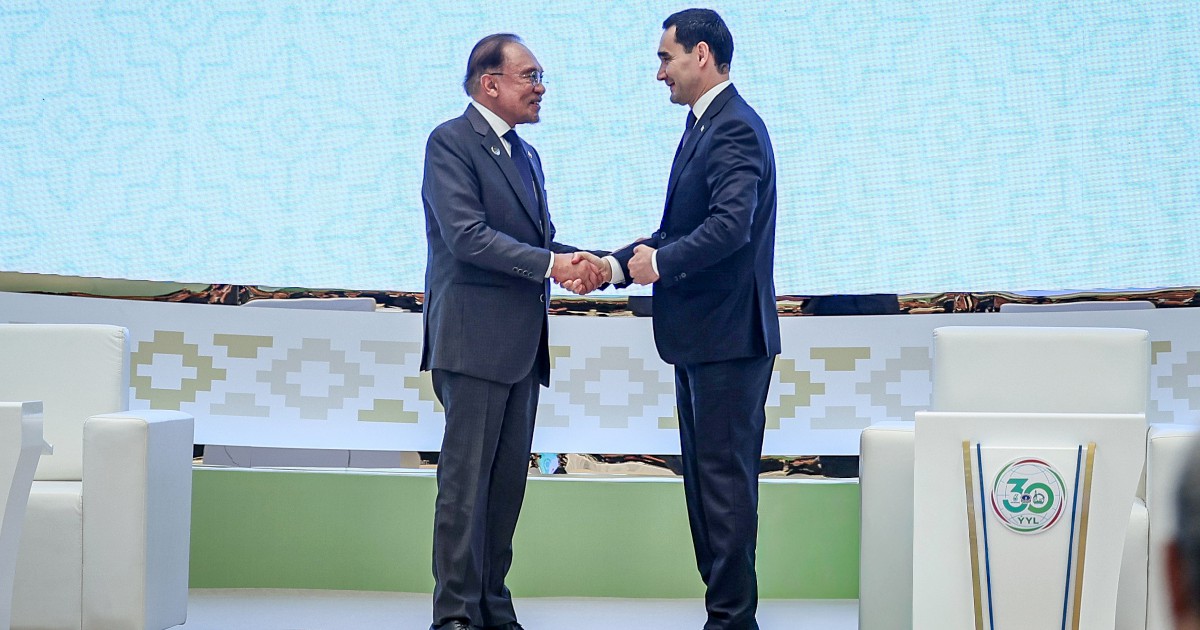
Malaysia and Turkmenistan have committed to substantially broadening their partnership across multiple strategic sectors, marking a significant expansion of bilateral relations following Prime Minister Datuk Seri Anwar Ibrahim's official visit to the Central Asian nation. The agreement represents a deliberate shift toward deepening economic and energy ties that could position both countries advantageously within their respective regions and along emerging trade corridors.
Energy cooperation stands as the cornerstone of this renewed partnership. For Malaysia, engagement with Turkmenistan provides access to one of the world's significant hydrocarbon producers and offers diversification opportunities beyond traditional energy partnerships. Turkmenistan's substantial natural gas reserves and established energy infrastructure present viable channels for Malaysian companies to explore participation in downstream operations and technology transfers. The Central Asian nation's strategic position along multiple trade routes also means energy cooperation extends beyond mere resource procurement to encompassing logistics, refining capabilities, and alternative energy development.
The broader economic framework addresses multiple interdependent sectors that typically drive meaningful bilateral relationships. Trade and investment mechanisms form the foundation upon which sustainable growth is built, enabling Malaysian businesses to establish footholds in Central Asia while creating pathways for Turkmen enterprises to penetrate Southeast Asian markets. Given Malaysia's established role as a regional financial hub and Turkmenistan's position as a developing economy, complementarities exist in financial services, business advisory, and capital formation that remain largely untapped.
Transportation linkages hold particular significance for both nations' long-term objectives. Enhanced connectivity through improved maritime routes, air cargo capacity, and potentially overland corridors via China and other intermediaries could reduce transaction costs for bilateral trade. Malaysia's port infrastructure and logistics expertise align well with Turkmenistan's need to diversify trade routes beyond Russian and Chinese corridors. Such developments would benefit not only bilateral commerce but also position both countries as critical nodes within broader Asian trade networks.
Educational exchanges form another pillar of the agreement, reflecting both nations' understanding that human capital development drives sustainable prosperity. Malaysian institutions, particularly those offering technical and engineering programmes, could absorb more Turkmen students seeking advanced qualifications in fields relevant to energy, petrochemicals, and infrastructure development. Reciprocally, Malaysian students and researchers could gain exposure to Central Asian perspectives on regional dynamics, geopolitics, and historical contexts that inform Asian development trajectories.
Technology cooperation addresses a critical gap in Turkmenistan's modernisation agenda. Malaysia's expertise spans telecommunications, digital infrastructure, financial technology, and renewable energy applications—all areas where the Central Asian nation requires contemporary solutions. Malaysian technology firms, many with experience in developing markets with similar infrastructure constraints, could facilitate knowledge transfer and innovation adoption. Such collaboration also opens avenues for joint research initiatives in areas like smart grid development and sustainable resource management.
From Malaysia's strategic perspective, this engagement responds to the nation's diversification imperative and regional positioning objectives. As Southeast Asia navigates increasingly complex geopolitical terrain, deeper partnerships with Central Asia hedge against over-reliance on any single regional bloc while simultaneously demonstrating Malaysia's capacity for bridging continental economic systems. Turkmenistan similarly benefits from access to Southeast Asian markets and technology, reducing dependency on neighbouring powers and establishing direct bilateral channels.
The timing of Prime Minister Anwar Ibrahim's visit carries weight given Malaysia's broader diplomatic recalibration under his leadership. His administration has emphasised international engagement and economic partnerships as mechanisms for driving domestic growth. Turkmenistan, while geographically distant, represents an untapped market with purchasing power driven by hydrocarbon revenues and growing infrastructure requirements. The energy cooperation dimension particularly aligns with Malaysia's strategic interests in securing long-term supply chain security and developing downstream capabilities that create value-added employment domestically.
Implementing this agreement will require establishing formal institutional mechanisms, likely through joint committees addressing each sectoral pillar. Success depends on both governments providing regulatory clarity, facilitating business visa processes, and ensuring consistency in policy frameworks that encourage private sector participation. Malaysian companies entering Turkmenistan will need support navigating the country's unique governance structures and business practices, while Turkmen enterprises expanding into Malaysia require guidance on regulatory requirements and market entry strategies.
The agreement also carries implications for Malaysia's engagement with the broader Asian infrastructure development agenda. Enhanced connectivity with Central Asia supports the diversification of trade routes and reduces concentration risk associated with reliance on traditional maritime channels through contested waters. For Turkmenistan, access to Malaysian expertise in financial services and technology creates alternatives to established partnerships while reducing economic isolation concerns.
Longer-term potential exists for triangular cooperation involving other Southeast Asian nations, potentially creating a framework wherein Malaysian-Turkmen collaboration serves as a pilot for broader Central Asia-Southeast Asia integration. Such developments could unlock significant economic value, particularly in developing alternative trade corridors and establishing joint ventures in third markets where both nations perceive complementary advantages.
The partnership agreement ultimately reflects both nations' strategic recognition that advancing shared interests requires multifaceted collaboration extending far beyond traditional state-to-state frameworks. By constructing comprehensive partnerships spanning energy through education, Malaysia and Turkmenistan create resilience against sector-specific volatility while building constituencies within each nation that benefit from sustained cooperation. Such deep engagement, particularly from leadership visits that signal high-level commitment, establishes foundations for partnerships that can weather short-term political fluctuations and generate compounding economic benefits.