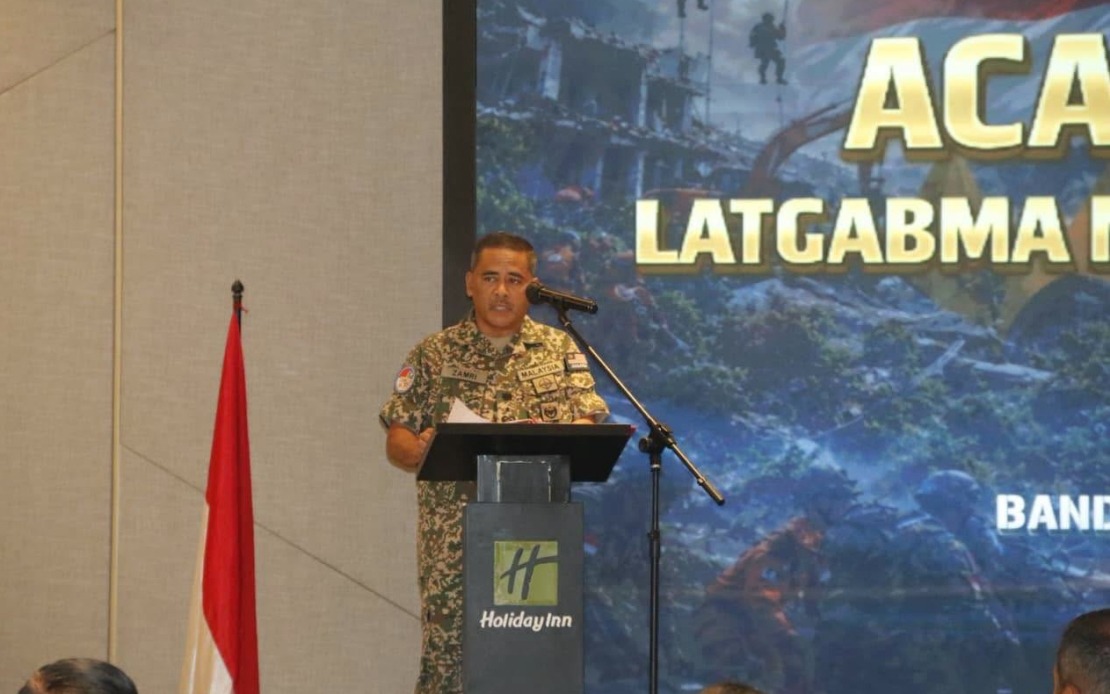
Malaysia and Indonesia have deepened their strategic defence partnership through a comprehensive 13-day joint military exercise now underway in Lampung, Sumatra. The LATGABMA MALINDO DARSASA 12AB/2026 exercise, conducted under the framework of the Malaysia-Indonesia Joint Training Committee, brings together 719 personnel from various military and civilian agencies of both countries. This multilateral engagement represents far more than routine bilateral cooperation—it reflects the enduring fraternal relationship and mutual security commitments that have anchored Southeast Asian stability for decades.
The exercise, coordinated through the Joint Forces Headquarters at Al-Sultan Abdullah Camp in Kuala Lumpur, marks the latest iteration of a training partnership that has operated continuously since 1984. Conducted on a three-year rotational basis through channels including the General Border Committee, the initiative alternates between Malaysian and Indonesian territories. The most recent edition took place in Pekan, Pahang in 2023 with an anti-terrorism focus, while the current exercise pivots toward humanitarian assistance and disaster management—a strategic choice reflecting evolving security challenges across the region.
Brigadier General Datuk Zamri Othman, Commander of the 1st Infantry Brigade and chief of the MAF Exercise Planning Group, emphasised that the exercise transcends conventional military drills. Rather, it functions as a crucible for testing integrated operational doctrines spanning land, maritime, and air domains while simultaneously building institutional confidence between personnel from both armed forces. This confidence-building dimension carries particular significance in an era when military-to-military relationships often determine the success of broader diplomatic initiatives. By rotating command responsibilities and deepening mutual understanding of operational protocols, Malaysia and Indonesia are constructing institutional frameworks that can respond swiftly and effectively to shared crises.
The choice of Lampung Province as the exercise venue reflects strategic thinking grounded in geographical and disaster management realities. Situated at the convergence of three active tectonic plate belts, Lampung faces recurring earthquake and tsunami hazards that have generated substantial humanitarian challenges throughout Indonesia's modern history. Conducting realistic disaster-response training in this location ensures that participating personnel gain experience in genuinely complex environments rather than abstract scenarios. This approach to military preparation—grounding exercises in actual geographic and climatic conditions—enhances the practical applicability of skills acquired during training.
The exercise architecture encompasses three distinct training phases. The academic component, termed the Staff Exercise or STAFFEX phase, walks participating officers and planners through ten critical scenarios including initial disaster response, mass casualty management, infrastructure collapse, medical emergencies, international assistance coordination, cyber attacks, information warfare, mass evacuation, stabilisation operations, and transition planning. By first examining these scenarios through classroom and map-based analysis, participants develop conceptual frameworks before applying them in field conditions. This pedagogical sequencing allows commanders to think through complex problems collectively before facing the pressures of live training.
The field training exercise phase, designated Force Integration Training, brings Malaysian Armed Forces personnel together with Indonesian National Armed Forces units, along with civilian disaster-management agencies including the National Search and Rescue Agency (BASARNAS), Disaster Preparedness Cadets (TAGANA), the Indonesian Red Cross (PMI), and the Regional Disaster Management Agency (BPBD). This integrated approach reflects contemporary understanding that major disasters overwhelm purely military response capabilities. By training civil-military teams together, both countries ensure that their institutions can coordinate effectively when earthquakes, tsunamis, or other calamities strike. The practical exercises include rope rescue techniques, rappelling operations, emergency medical response, and field hospital establishment—all essential competencies for humanitarian operations.
Beyond combat readiness, the exercise incorporates substantial civic action components that generate tangible benefits for Indonesian communities hosting the training. The Engineering Civil Action Programme undertakes repair of two uninhabitable houses in Kampung Sukamaju and concrete road construction in Kampung Keteguhan, while the Medical Civic Action Programme operates at the Community Health Centre providing general health screenings, distributing free spectacles, and conducting blood donation drives. These initiatives embed military training within frameworks of community service, demonstrating to local populations that defence cooperation generates practical improvements in living conditions. For Malaysia and Indonesia, such initiatives also reinforce the humanitarian dimensions of military professionalism.
The exercise further reflects the emerging prominence of cyber threats within regional security architecture. The Cyber Exercise component addresses technical attack vectors including reconnaissance, enumeration, credential attacks, man-in-the-middle techniques, spoofing, and feed manipulation. As both nations digitise government, military, and critical infrastructure systems, the capacity to defend against sophisticated cyber intrusions has become as strategically important as conventional force readiness. Training military personnel to recognise and counter cyber threats ensures that both Malaysia and Indonesia can protect essential systems during crises when cyber attacks might be leveraged alongside kinetic operations.
The exercise involves 463 TNI personnel, 150 MAF personnel, two representatives from Malaysia's National Disaster Management Agency (NADMA), 25 members of the Indonesian National Police (POLRI), and 79 participants from various Indonesian civilian agencies. This composition underscores the fundamentally integrated nature of modern security operations. Police, military, and civilian disaster-management personnel bring distinct expertise and operational perspectives that, when combined systematically, create more comprehensive response capabilities than any single institution could generate alone. For Malaysian observers, the exercise demonstrates how neighbouring nations approach institutional coordination during emergencies.
Brigadier General Zamri's comments regarding the deteriorating non-traditional security environment frame the exercise within broader strategic context. Maritime crime, smuggling networks, terrorism, cybercrime, and natural disasters—the threats he enumerated—do not respect international boundaries. A vessel engaged in human trafficking in the Malacca Strait, a cyber intrusion targeting energy infrastructure, or a major tsunami originating near Indonesia's subduction zones inevitably draw Malaysia into response operations. By conducting joint training now, both countries position themselves to manage such transboundary crises more effectively when they inevitably emerge.
This exercise cycle, running on three-year intervals through bilateral institutions established decades ago, represents a form of defence institution-building that contributes to regional stability without generating the diplomatic friction often associated with military modernisation or arms acquisition announcements. For other Southeast Asian nations, the Malaysia-Indonesia model offers lessons regarding how military partnerships can deepen without provoking suspicion among neighbours or creating destabilising alliance structures. The exercise's emphasis on disaster response and humanitarian operations positions it as fundamentally stabilising rather than competitive in character.
The LATGABMA MALINDO DARSASA framework also provides Malaysia with insights into Indonesian disaster-management capabilities and operational procedures. As the region's largest archipelago and most earthquake-prone nation, Indonesia accumulates expertise through necessity. Malaysian participation allows knowledge transfer regarding disaster response in high-consequence environments. Similarly, Indonesian personnel gain exposure to Malaysian approaches to civil-military coordination and resource management. This bidirectional learning ensures that both nations can adapt techniques proven effective elsewhere within the region.
Looking forward, the exercise's success will likely influence subsequent iterations and potentially inspire deeper defence cooperation across domains including naval operations, air defence, and intelligence sharing. The three-year cycle provides natural checkpoints for evaluating effectiveness and identifying areas requiring enhanced focus. Given the accelerating complexity of regional security challenges—from climate-driven disasters to state-sponsored cyber operations—the systematic, institutionalised approach exemplified by LATGABMA MALINDO DARSASA may become a template for other bilateral partnerships seeking to achieve meaningful integration without surrendering institutional autonomy.

