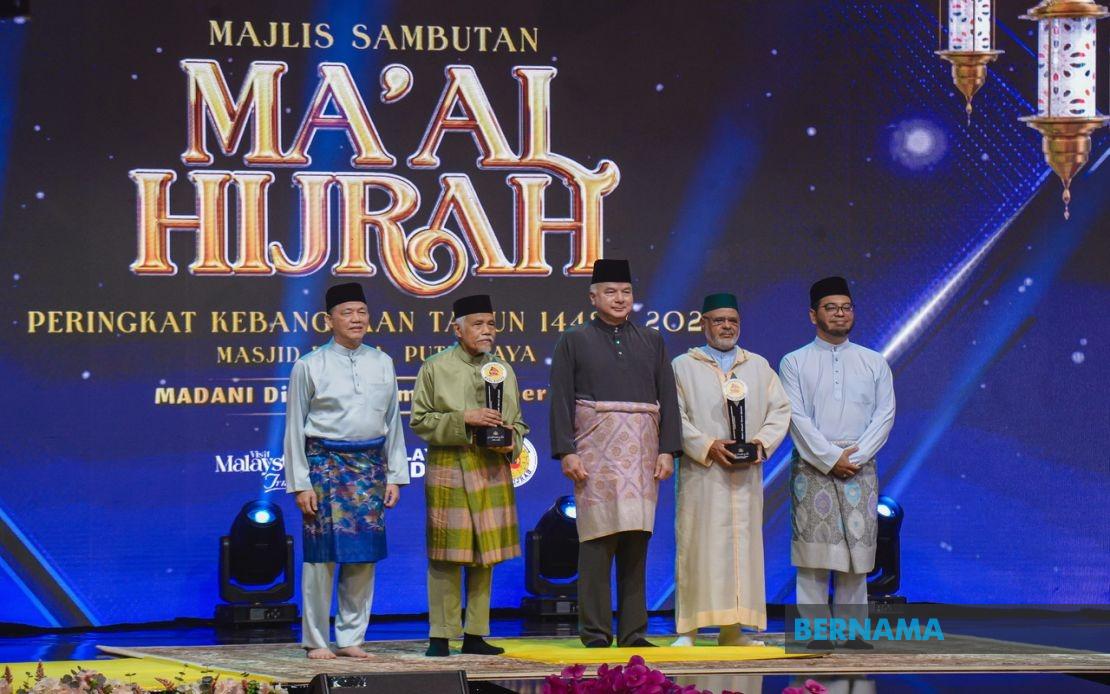
Across Malaysia, the observance of Maal Hijrah 1448H served as a moment for reflection on the concept of hijrah—spiritual migration and positive transformation—with ceremonies drawing thousands of participants and high-level government officials to celebrate renewal within the Muslim community. The nationwide celebrations, held on June 17, underscored how the Islamic calendar's new year remains deeply embedded in Malaysia's national fabric as a call for moral progress, institutional improvement and collective advancement of the ummah.
The event, organised under the theme "MADANI Dihayati, Ummah Diberkati" (MADANI Embraced, Ummah Blessed), reflected the government's continued emphasis on the MADANI framework—a governance philosophy centred on prosperity, dignity and unity. This year's Maal Hijrah observance deliberately positioned spiritual renewal alongside pragmatic discussions of leadership quality and public administration, recognising that Islamic principles must translate into concrete improvements in how institutions serve citizens. The integration of Quranic recitations, religious discourses and awards ceremonies created a comprehensive cultural experience that moved beyond symbolic commemoration into substantive dialogue about national values.
Deputy Prime Minister Datuk Seri Fadillah Yusof and Minister in the Prime Minister's Department (Religious Affairs) Dr Zulkifli Hasan graced the main ceremony, their presence signalling the government's commitment to recognising the importance of religious affairs in the national agenda. The attendance of approximately 5,000 participants across the various venues demonstrated sustained public engagement with Islamic observances, despite competing modern demands on community time and attention. This level of participation suggests that Maal Hijrah retains its resonance as a meaningful occasion for Malaysians seeking connection to their faith and national identity simultaneously.
The presentation of national and international awards became the ceremonial centrepiece, with Sultan Nazrin of Perak honouring Prof Emeritus Datuk Dr Osman Bakar, rector of the International Islamic University Malaysia, with the National Tokoh Maal Hijrah Award. This recognition of IIUM's leadership acknowledged the institution's role in advancing Islamic scholarship and producing graduates who contribute to regional and global development. The international dimension received emphasis through the awarding of the International Tokoh Maal Hijrah Award to Dr Ahmad Al-Raysuni, a prominent Moroccan Islamic jurisprudence scholar, reflecting Malaysia's positioning as a centre of Islamic thought connected to broader Muslim intellectual networks across Africa and beyond.
Recognition extended to community-level leaders whose contributions often remain invisible in national discourse. Community activist Datuk Ag Sharin Alimin, drawing on his background as a former director of the Sabah Islamic Religious Affairs Department, exemplified the bridge between government service and grassroots activism. Similarly, Datuk Masnah Matsalleh's honour as the female category recipient acknowledged women's essential but frequently underrecognised contributions to administrative excellence and community welfare. These awards reflected an understanding that national progress depends on distributed leadership across gender lines and administrative hierarchies.
Parallel celebrations in Sabah underscored how Maal Hijrah observances permeate Malaysia's diverse geography. Chief Minister Datuk Seri Hajiji Noor's involvement in welcoming distinguished guests, including Tun Musa and his wife Toh Puan Faridah Tussin, demonstrated how state-level leadership actively participates in religious observances as expressions of governance priorities. The presence of approximately 1,000 attendees at regional ceremonies ensured that the spiritual message reached communities beyond the capital, preventing celebrations from becoming symbolically concentrated in Kuala Lumpur while leaving peripheral regions disengaged.
One particularly moving dimension involved honouring 95-year-old Quranic teacher Jusoh @ Muda Ismail, whose recognition connected living Islamic scholarship to continuity across generations. As the adopted son and student of the late Tuan Guru Haji Mat Lintar, a renowned Quranic scholar, Jusoh embodied the transmission of sacred knowledge through personal relationship and lived example rather than mere institutional transfer. His award, presented by Ahmad Samsuri, validated the role of individual scholars in maintaining Islamic intellectual traditions at the community level, a contribution that formal educational institutions alone cannot replicate.
The emphasis on hijrah as a pathway to positive change carries particular resonance for Southeast Asian Muslims navigating rapid modernisation while seeking to preserve religious identity. The concept transcends its historical meaning—the Prophet Muhammad's migration from Mecca to Medina—to encompass contemporary aspirations for individual and collective transformation. For Malaysian audiences, this framing suggests that progress and faith need not exist in tension; rather, spiritual development and institutional improvement represent complementary dimensions of national advancement. The MADANI framework's integration with Maal Hijrah discourse reinforces this message at policy level.
The theme's emphasis on quality leadership deserves particular attention in the Malaysian context, where governance effectiveness directly influences citizen welfare across healthcare, education and economic opportunity. By connecting religious observance explicitly to leadership standards, the celebrations acknowledged that Muslims' spiritual commitments must manifest in ethical public service, transparent administration and genuine responsiveness to constituent needs. This represents an implicit critique of leadership failures while projecting an aspirational vision of how Islamic values should shape governmental practice.
For regional observers, Malaysia's sustained commitment to integrating religious observances into national life demonstrates a distinct approach to pluralism—one that neither marginalises Islam nor permits religious considerations to undermine democratic governance and minority protections. The celebration's scale and official participation indicate that religious identity remains constitutive of Malaysian nationhood while coexisting with institutional structures designed to protect diverse communities. This balancing act, imperfect though it remains, offers lessons for other Muslim-majority democracies grappling with analogous tensions.
The awarding of international recognition to a Moroccan scholar within Malaysia's Maal Hijrah framework illustrates how Southeast Asian Islamic thought remains embedded in broader Muslim intellectual currents. This cosmopolitan dimension prevents the celebration from becoming parochial while affirming Malaysia's participation in transnational Islamic networks that span continents and civilisational traditions. Such connections enhance Malaysia's soft power while providing citizens with awareness that their faith community extends far beyond national borders, fostering solidarity transcending ethnic and linguistic particularities.
As Malaysia approaches mid-year, the Maal Hijrah celebrations serve as a calendar marker for spiritual recommitment and institutional stock-taking. For policymakers, the emphasis on leadership quality signals that religious observances will increasingly function as occasions for evaluating governance performance against ethical benchmarks derived from Islamic principles. For citizens, these gatherings reaffirm that belonging to the Muslim ummah encompasses both personal piety and collective responsibility for societal improvement. The celebrations thus function simultaneously as backward-looking commemoration and forward-looking agenda-setting, challenging Malaysians to translate spiritual renewal into tangible progress across economic, social and political domains.