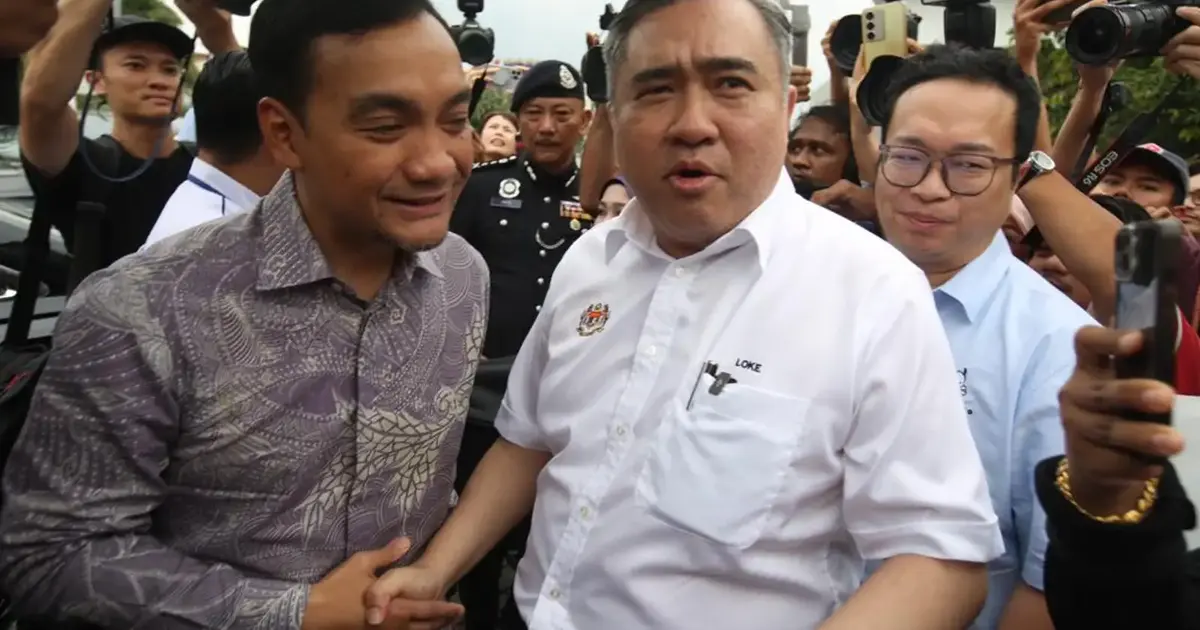
Transport Minister Anthony Loke and Johor Menteri Besar Onn Hafiz Md Salleh presented a facade of political cordiality at their first face-to-face meeting following a publicised disagreement that had played out across digital platforms. The two leaders, representing different political coalitions in Malaysia's fractious landscape, demonstrated the delicate balance required when bridging partisan divides at official functions.
The meeting took place at a transport ministry event, where both figures worked to maintain decorum befitting their respective offices. However, beneath the veneer of cooperation, the underlying tensions remained evident through carefully calibrated remarks rather than open confrontation. This approach reflects the broader challenge facing Malaysian politics, where national development projects and state-level governance often require collaboration between leaders who harbour significant political differences.
Onn Hafiz, presiding over Johor as the nation's economic engine, seized the opportunity to make a pointed comment during his remarks at the event. The Menteri Besar noted that he had been compelled to reorganise his official schedule on relatively short notice to attend the transport ministry's gathering. This observation, while ostensibly factual, carried undertones of mild rebuke directed at the manner in which the invitation had been extended. The comment served as a gentle reminder of his standing and the demands on his time, suggesting that such events warranted greater advance notice to allow for proper coordination of state-level responsibilities.
Loke's positioning as Transport Minister places him at the intersection of federal policy implementation and state-level cooperation. The ministry's portfolio covers critical infrastructure connecting Malaysia's regions, making productive working relationships with state administrations essential for project execution. The Pakatan Harapan-affiliated minister must therefore navigate the complex political terrain where his coalition governs peninsular Malaysia at federal level whilst facing opposition-controlled or differently-aligned state governments in critical economic zones including Johor.
The Johor factor underscores the complexity of Malaysia's political architecture. The state remains crucial to national economic performance, particularly regarding trade corridors, port infrastructure, and logistics networks that Loke's ministry oversees. Any deterioration in federal-state relations risks hampering development initiatives that benefit the broader Malaysian economy. This practical interdependence creates pressure for both leaders to maintain workable relationships regardless of partisan preferences.
The earlier online dispute between the two had reflected broader tensions within Malaysian politics, where figures from opposing coalitions increasingly utilise social media platforms for direct political messaging. Such exchanges, while public, traditionally remain bounded by the professional expectations that govern in-person interactions. The cordial atmosphere maintained at their meeting suggests both leaders understood that permitting digital friction to escalate into personal antagonism would serve neither their individual political interests nor their respective responsibilities.
Onn Hafiz's observation about schedule rearrangement cannot be dismissed as purely ceremonial commentary. It positioned him as someone whose time carries significant weight and implied that the federal ministry's protocol required refinement. Such subtle calibrations of status and respect form the currency of Malaysian political interactions, where direct confrontation is often avoided in favour of layered messaging that the broader political community readily comprehends.
The transport portfolio encompasses infrastructure projects with state-level implications, particularly in Johor where the Menteri Besar oversees development agendas that frequently intersect with federal transport initiatives. Port Klang's operations, the East Coast Expressway, and various connectivity projects require coordination across multiple governance levels. The ability of Loke and Onn Hafiz to maintain functional relations, despite political differences, determines whether such projects proceed smoothly or encounter bureaucratic friction stemming from partisan tensions.
For Malaysian observers and Southeast Asian readers tracking political dynamics in the region's largest economy, this interaction illustrates how mature political systems manage disagreement without permitting it to metastasize into governance dysfunction. Malaysia's coalition-dependent political model frequently requires such pragmatic separations between partisan competition and administrative necessity. The contrast between their online exchange and their in-person cordiality demonstrates politicians performing the demanding balance between principle and pragmatism.
The broader significance extends beyond personal relations between two figures. It reflects Malaysia's ongoing navigation of consensus-building across political divides, a challenge that becomes increasingly acute as economic pressures and infrastructure demands require coordinated responses. Whether such surface-level civility will translate into substantive cooperation on transport and connectivity initiatives affecting Johor and surrounding regions remains to be observed through subsequent ministerial-level interactions and project implementation outcomes.
Moving forward, the relationship between Loke and Onn Hafiz will likely continue oscillating between diplomatic courtesy and pointed commentary, mirroring larger patterns within Malaysian coalition politics. Their ability to compartmentalise disagreement from administrative cooperation will influence how effectively transport infrastructure projects progress across jurisdictional lines. For a nation dependent on regional connectivity and economic coordination, the success of such professional relationships carries ramifications extending well beyond individual political reputations.

