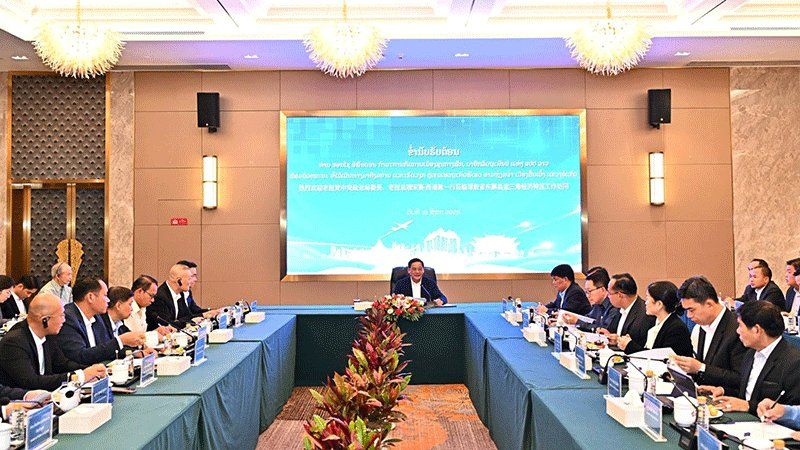
Prime Minister Sonexay Siphandone has stepped up pressure on administrators of the Golden Triangle Special Economic Zone to enforce tougher regulatory standards and pivot towards more accountable, environmentally conscious development models. During an inspection visit to the sprawling facility in Bokeo province's Tonpheung district on Tuesday, the Lao leader outlined a comprehensive overhaul of management practices, signalling growing frustration with the zone's operational performance over nearly two decades of existence.
The zone, which spans 10,000 hectares across the strategically vital tri-border region where Laos, Myanmar, and Thailand converge, has accumulated approximately US$10 billion in cumulative investments since its establishment in 2007. Despite this substantial capital inflow, performance metrics reveal a troubling gap between contractual commitments and actual delivery. Only 60 per cent of activities promised in investor agreements have materialised, exposing fundamental deficiencies in administration and project execution that the Prime Minister now intends to rectify through legislative and administrative measures.
The zone's geographic position, adjacent to China's southern frontier and commanding access to the Mekong River, confers substantial competitive advantages for businesses seeking proximity to massive consumer and labour markets across Southeast Asia. This positioning has attracted companies operating across diverse sectors including manufacturing, real estate, hospitality, financial services, and tourism infrastructure. Yet the variance between planned and actual investment outcomes suggests that strategic location alone cannot compensate for weak governance frameworks or inadequate enforcement mechanisms.
Prime Minister Sonexay identified several priority reforms during his working visit. Most critically, he demanded enhanced oversight of cross-border worker movements and improved coordination with neighbouring administrations to manage labour flows more systematically. The zone currently hosts more than 10,000 registered workers, with additional daily fluctuations from cross-border commuters and visitors. This dynamic workforce requires robust regulatory infrastructure to ensure compliance with labour standards and wage provisions, areas where Sonexay detected significant compliance gaps.
Financial transparency emerged as another central concern. The Prime Minister issued direct instructions that all transactions encompassing trade activities, investment flows, wage payments, and service charges must route through the formal Lao banking system rather than operating through informal channels or direct barter arrangements. This directive reflects broader concerns about capital flight, tax evasion, and the zone's contribution to national revenue collection. By mandating banking-system intermediation, authorities gain visibility over transaction flows and can enforce relevant tax obligations more effectively.
The administration faces particular challenges in border management. Sonexay directed zone authorities to implement stricter protocols governing entry and exit procedures, recognising that porous boundaries undermine both security and revenue collection. The current resident population comprises 400 government officials stationed across various administrative functions, more than 10,000 registered workers, and additional contingents of investors, business operators, and daily tourists. Coordinating movement across this population demands systematic documentation and real-time monitoring capacity that current systems apparently lack.
Sonexay highlighted strategic economic sectors warranting intensified promotional effort and investment attraction. Tourism, manufacturing, agricultural processing, transportation logistics, educational services, and public health infrastructure represent growth vectors aligned with broader Southeast Asian development trajectories. The zone's underdeveloped tourism potential remains particularly conspicuous given its cultural position at the junction of three nations and proximity to the Mekong's scenic tributaries. Enhanced airline connectivity emerged as an explicit priority, suggesting that current transport linkages remain insufficient for attracting regional and international visitor traffic.
Institutional strengthening constitutes the third reform pillar. The Prime Minister demanded modernisation of the zone's concession agreement framework, bringing contractual terms into alignment with evolving national legislation and international best practices. Simultaneously, he called for enhanced operational capacity within the zone's Management and Administration Committee, the oversight body responsible for day-to-day governance. These institutional reforms respond to the demonstrated implementation gap and suggest that contractual architecture and administrative competency have not evolved in tandem with the zone's expansion and complexity.
Regional cooperation mechanisms require reinforcement. Beyond enhanced airline connectivity, Sonexay emphasised the necessity for deeper engagement with Myanmar and Thai counterparts on regulatory harmonisation, workforce management, and cross-border investment facilitation. The Golden Triangle's tripartite geography creates natural incentives for coordinated development strategies, yet political tensions and governance disparities among the three nations have historically impeded such cooperation. The Prime Minister's emphasis on multilateral engagement suggests recognition that unilateral Lao regulatory improvements require complementary measures from neighbouring administrations.
The Prime Minister instructed zone developers to intensify efforts in attracting both capital investment and visitor traffic, stressing the imperative to maintain a dynamic, economically vibrant environment that sustains competitive advantage and encourages business expansion. This dual focus on investment promotion and tourism development reflects an understanding that the zone's long-term viability depends on sustained economic momentum and diversified revenue generation.
For Malaysia and other Southeast Asian observers, the Golden Triangle's experience offers instructive lessons regarding special economic zone governance. The gap between contracted and realised outcomes suggests that regulatory frameworks, transparency mechanisms, and enforcement capacity require continuous calibration as zones mature and expand. Sonexay's interventionist approach—combining institutional reform, cross-border coordination, and sectoral targeting—aligns with regional best practices while acknowledging that geographic advantage alone cannot substitute for effective administration and adaptive management strategies in rapidly evolving cross-border economic complexes.

