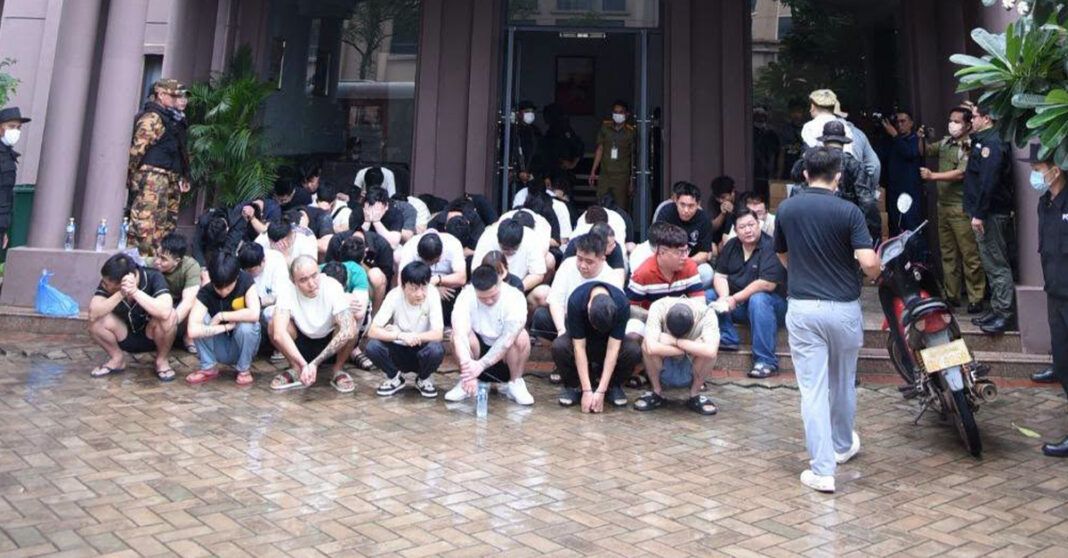
On 8 August, police in Vientiane conducted a significant enforcement operation that resulted in the detention of 261 suspects allegedly involved in running a coordinated telecommunications fraud and online gambling scheme. The raid targeted a facility located within Vientiane's Thatluang Lake Special Economic Zone, a strategically important development area that has increasingly become a focal point for illicit operations. The scale and composition of those apprehended underscore the transnational nature of cyber-enabled scam networks now operating across Southeast Asia, drawing criminal elements from multiple countries to consolidate their operations in jurisdictions perceived as offering operational advantages.
The suspects detained in the operation represented a diverse geographic footprint spanning seven different nationalities. Chinese nationals constituted the dominant group, accounting for 153 of those taken into custody, reflecting the outsized role that Chinese criminal syndicates have played in orchestrating transnational fraud schemes across the region. Vietnamese nationals represented the second-largest contingent with 61 individuals, while Thai citizens numbered 36. Smaller cohorts included five Taiwanese nationals, two Malaysian nationals, two South Koreans and two Myanmar citizens. The presence of Malaysian nationals within this operation is particularly relevant for Malaysian readers and authorities, highlighting how organised crime networks continue to recruit participants from across the region and how scam infrastructure operates with remarkable cross-border fluidity.
The material evidence recovered during the operation provides stark illustration of the operational scale of such ventures. Police seized nearly 500 desktop computers and laptops, along with 2,355 mobile phones—equipment that would have been configured to execute thousands of simultaneous fraudulent contacts with potential victims across multiple continents. Such infrastructure requirements demand substantial capital investment and logistical coordination, reinforcing that these are not ad hoc criminal enterprises but rather sophisticated organised networks with access to significant resources. The sheer volume of devices indicates the operation was designed to sustain high-volume targeting operations, with the technological capacity to coordinate fraud across different time zones and regions simultaneously.
Authorities have confirmed that the building used to house the scam operation belongs to Lao Thatluang Investment Development Co., Ltd., raising questions about the extent to which legitimate commercial entities in special economic zones are being exploited by criminal networks or whether ownership structures deliberately mask illicit activity. Investigators indicated they are actively pursuing identification and apprehension of the scheme's primary architects and secondary participants, signalling that those detained during the initial raid may represent lower-level operatives rather than decision-makers within the criminal hierarchy. This investigative phase is crucial, as tracking proceeds and identifying financial beneficiaries often proves more challenging than identifying the workers manning the fraud infrastructure.
The August 8 raid forms part of an intensifying nationwide crackdown by Laotian authorities against scam networks that have proliferated across the country. This broader enforcement initiative reflects mounting pressure from governments throughout Southeast Asia and internationally to combat the transnational fraud ecosystem that has flourished in recent years. For Malaysian authorities and businesses, the operation demonstrates that neighbouring jurisdictions are implementing enforcement responses to criminal networks that may have connections to Malaysia, either through recruitment, targeting of Malaysian victims, or financial flows routed through Malaysian banking channels.
Two days following the initial raid, Laotian authorities demonstrated their commitment to regional cooperation by deporting 41 Thai suspects to Thailand via the 1st Lao-Thai Friendship Bridge on 10 August. This followed an earlier deportation of 32 Thai nationals through the same crossing on 6 August, indicating coordinated bilateral efforts to remove nationals of neighbouring countries pending their prosecution in their home jurisdictions. The cumulative Thai deportation total reached at least 73 individuals, reflecting both the concentration of Thai nationals within these scam operations and the prioritisation of repatriation agreements between Laos and Thailand.
These deportations stemmed from an earlier enforcement operation conducted on 18 July targeting the ST Vegas complex located in Dongphosy village, Hatsayfong district, Vientiane. That raid had netted 589 suspects in total, representing one of the region's largest single-operation busts of alleged scammers. The suspect composition in the ST Vegas operation reflected a different demographic profile, with Thai nationals representing the dominant arrested group, supplemented by Lao, Vietnamese and Cambodian nationals. The difference in national composition between the July and August operations suggests that while scam networks operate on a genuinely international basis, particular facilities and operations may specialise in recruiting from specific geographic sources or targeting particular victim populations.
The succession of major raids across a brief timeframe indicates that Laotian law enforcement has identified telecommunications fraud and online gambling operations as priority targets warranting sustained and coordinated action. The resource commitment evident in these operations—from personnel deployment to equipment seizure and international deportation coordination—demonstrates that authorities recognise the transnational fraud ecosystem as a threat not only to Laotian citizens but to the broader regional stability and international reputation of Southeast Asia. Each successful operation generates intelligence that facilitates subsequent enforcement actions, creating momentum against criminal networks that may have previously viewed certain jurisdictions as safe operational bases.
For Malaysian stakeholders, these developments carry several implications. Malaysian victims may constitute a significant portion of those targeted by fraud operations based in Laotian special economic zones, given Malaysia's economic position and the digital literacy and banking access of its population. Malaysian financial institutions may be implicated in laundering proceeds from these schemes, requiring enhanced vigilance in transaction monitoring. Additionally, Malaysian nationals involved in these operations—whether as operators, technical specialists or recruitment agents—face potential prosecution and repatriation similar to their Thai and Vietnamese counterparts. Regional cooperation frameworks may be strengthened as a result of these high-profile operations, potentially creating new avenues for information-sharing and coordinated enforcement that benefit all Southeast Asian nations seeking to combat the transnational fraud threat.

