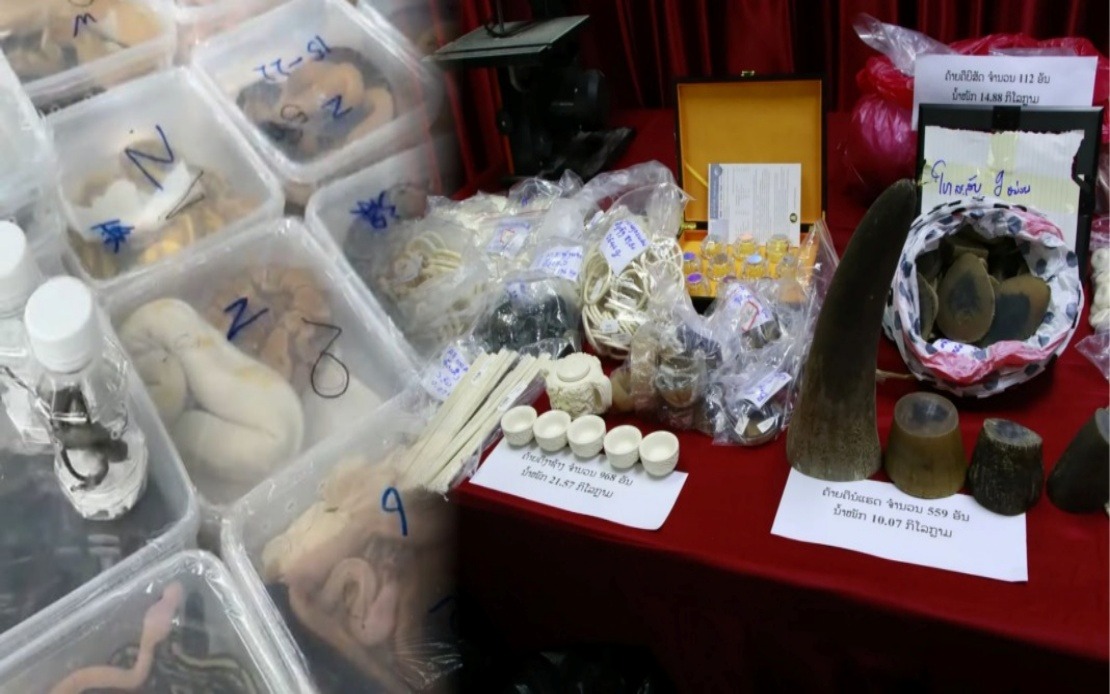
Laotian authorities have exposed a thriving wildlife trafficking network operating across Southeast Asia's most vulnerable borders, rescuing nearly 300 endangered animals and seizing substantial quantities of illegal wildlife products in coordinated operations last week. The discovery underscores the persistent challenge of wildlife crime in the Mekong region, where porous borders and established smuggling routes continue to fuel demand for protected species and their derivatives across international markets.
The enforcement breakthrough occurred in two separate operations conducted by the Lao Wildlife Enforcement Network across Luang Prabang and Champasak provinces. In Luang Prabang, authorities seized approximately 60 kilogrammes of suspected illegal wildlife materials, including items fashioned to resemble ivory, animal gallbladders extracted for traditional medicine purposes, processed pangolin scales, and rhinoceros horn fragments. The confiscations also encompassed elephant skin powder, bear gallbladder intended for medicinal use, preserved hornbill heads, and sealed containers of herbal preparations suspected to contain endangered animal ingredients. These items were discovered during operations in the province that attracts hundreds of thousands of foreign visitors annually, suggesting traffickers exploit tourism infrastructure to move contraband through established transportation networks.
Four days following the Luang Prabang seizures, wildlife officials achieved a more dramatic result when rangers stationed at the Vang Tao International Checkpoint in Champasak Province intercepted a shipment of 294 live animals being transported across the border into Thailand. The confiscated specimens included various turtle species, multiple python varieties, green snakes, gold-ringed cat snakes, and numerous lizards, indicating an operation targeting reptile markets where demand remains consistently high. The checkpoint's position at the crossing between Champasak and Ubon Ratchathani Province makes it a natural chokepoint for smuggling operations moving inventory between the two countries, yet the sheer number of animals successfully intercepted suggests enforcement capacity has finally begun matching the scale of trafficking activity.
These operations represent just the latest manifestations of a broader regional problem that has accelerated substantially in recent years. Weeks before the Luang Prabang and Champasak seizures, Thai authorities arrested a woman operating a traditional medicine and souvenir shop in Nakhon Phanom, located in Thailand's northeastern region directly adjacent to Laos. Investigators recovered more than 100 protected animal remains at the premises, with evidence suggesting the inventory originated from smuggling operations based in Laos. The incident reveals how traffickers exploit legitimate retail businesses, blending illegal wildlife products with conventional merchandise to obscure their origins from casual customers and evade regulatory oversight.
The enforcement focus intensified further when authorities disrupted another trafficking operation on May 16, apprehending smugglers attempting to move 130 kilogrammes of elephant ivory fragments and animal carcasses along the Thai-Lao border. The coordinated action, documented by Traffic Southeast Asia, demonstrated increasing coordination among enforcement agencies to intercept high-value shipments before they traverse international boundaries. Elephant ivory commands premium prices in regional markets, particularly in countries where demand persists for decorative objects and traditional medicine ingredients, making even small successful seizures economically significant victories for conservation efforts.
Laos's geographic position renders it exceptionally vulnerable to becoming a trafficking hub within the wider Southeast Asian context. The country shares borders with Cambodia, China, Myanmar, Thailand, and Vietnam, creating multiple access points for wildlife destined to reach regional demand centres or transit routes to distant markets. Wildlife experts consistently identify geographic location as a critical vulnerability factor, with Laos occupying a position that makes it simultaneously a source of endemic species, a transit corridor for animals originating in neighbouring countries, and a market destination for traffickers supplying local demand for traditional medicine ingredients and exotic pets.
The scale of the underlying black market reflects the extraordinary profitability driving criminal networks to accept substantial enforcement risks. According to the United Nations Office on Drugs and Crime's World Wildlife Crime Report 2024, global illegal wildlife trade generates approximately US$10 billion annually, placing it among the most lucrative criminal enterprises alongside human trafficking, narcotics smuggling, and conventional arms dealing. This valuation understates the reality for individual traffickers, who can realise exponential profit margins by purchasing animals or products at collection points and selling them in distant markets where end-user prices reflect luxury positioning and rarity premiums.
The UNODC analysis identifies corruption as a fundamental enabler of wildlife trafficking operations, particularly in regions where enforcement budgets remain inadequate and opportunities for bribery proliferate. Trafficking networks exploit underfunded border posts, isolated checkpoints, and the competing priorities of law enforcement agencies stretched across multiple mandate areas. The recent successes in Laos suggest evolving enforcement cooperation and capacity development, yet the continued discovery of shipments indicates that current efforts remain substantially below the scale required to disrupt trafficking as a business model.
For Malaysia and other Southeast Asian nations, the Laotian enforcement actions carry particular significance. The region's interconnected demand for traditional medicine ingredients, exotic pets, and decorative wildlife products creates markets that incentivise transnational trafficking networks. Malaysian law enforcement agencies increasingly encounter wildlife products originating from this Mekong trafficking corridor, suggesting that disrupting supply chains at source becomes as important as intercepting contraband at destination borders. The species types seized in Luang Prabang and Champasak—particularly reptiles and traditional medicine components—align with products regularly detected entering Malaysian markets through established smuggling routes.
The wildlife enforcement community recognises that sustainable results require sustained commitment beyond individual seizure operations. Laos has invested in developing enforcement capacity, establishing specialised units like the Lao Wildlife Enforcement Network, and improving cross-border coordination with Thai and other neighbouring agencies. These institutional developments provide more durable foundations for disrupting trafficking than temporary enforcement surges could achieve. However, enforcement capacity alone cannot eliminate trafficking demand, particularly given the cultural and medicinal traditions sustaining markets for wildlife products across the region.
Longer-term conservation outcomes depend on demand reduction initiatives that convince consumers to abandon traditional medicine preparations and decorative products incorporating endangered species. Parallel efforts addressing poverty and livelihood alternatives for communities involved in wildlife capture and initial-stage trafficking may reduce the supply-side participation that enables large-scale operations to function. The recent Laotian successes demonstrate that enforcement can disrupt trafficking chains and recover animals for rehabilitation or reintroduction, providing essential progress against species extinction pressures affecting the Mekong's biodiversity.

