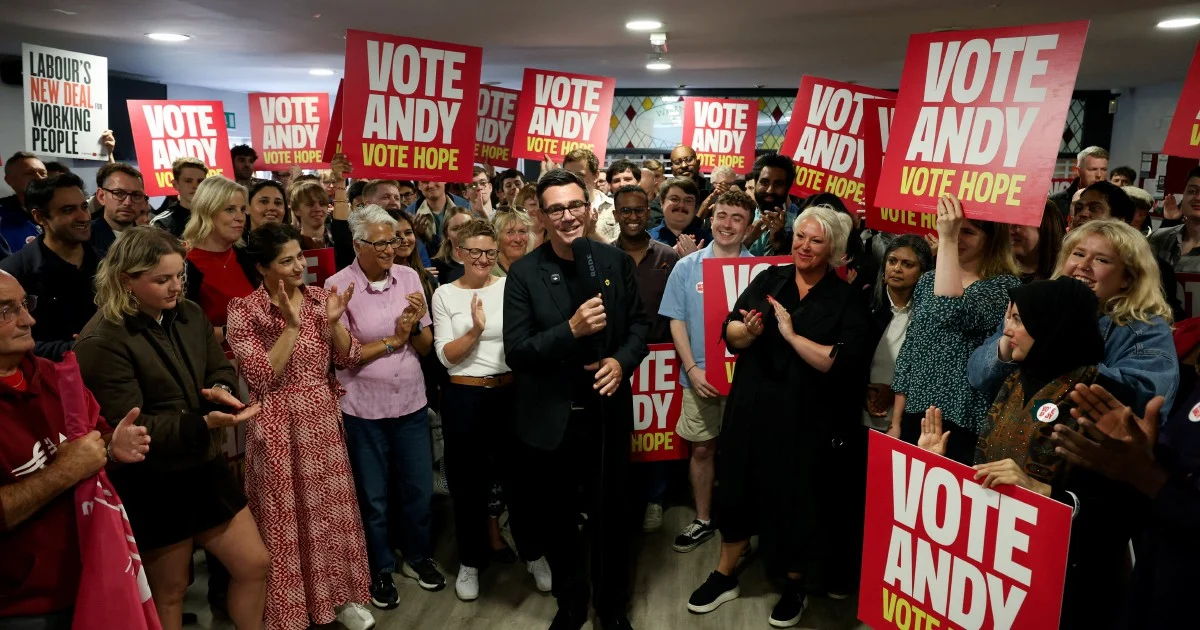
Andy Burnham's pathway to potentially challenging Keir Starmer for the British premiership appears to be widening, though perhaps not entirely through his own political machinations. As Thursday's election looms, the Labour politician's bid to secure the Makerfield seat—essential groundwork for any credible leadership challenge—is being materially aided by the spectacular internal divisions tearing through Britain's right-wing populist movement. Rather than representing a triumph of his policy platform or public appeal, Burnham's strengthened position reflects a broader fragmentation within opposition ranks that has inadvertently consolidated his electoral advantages.
The dynamics playing out in Makerfield illustrate a phenomenon reshaping British politics at a crucial moment. Two competing populist right-wing movements are locked in fierce competition for voters and resources, each viewing the other as a fundamental threat to their vision of British governance. This internecine conflict has created a peculiar strategic advantage for centrist and centre-left candidates like Burnham, who find themselves running in an environment where their principal opponents are simultaneously battling each other. The mathematical reality is straightforward: when opposition support fractures across multiple parties with overlapping voter bases, unified centre-left candidates benefit disproportionately from first-past-the-post electoral mechanics.
For Malaysian readers following British politics, this scenario offers instructive parallels to multi-party systems where vote-splitting among ideologically similar parties has determined electoral outcomes. The principle—that fragmentation on one side of the political spectrum can deliver victories to the other—transcends national boundaries and electoral systems, though it operates with particular severity under first-past-the-post arrangements where the largest vote-getter claims the seat regardless of whether they achieve an absolute majority.
Burnham's profile within Labour circles has grown considerably in recent years, particularly among MPs and activists seeking alternatives to incumbent leadership. His tenure as Mayor of Greater Manchester cultivated a reputation for competent regional administration and willingness to challenge Westminster orthodoxy, qualities that appeal to a broad spectrum within the Labour Party. However, translating these advantages into a genuine leadership challenge requires first establishing an unshakeable power base in his parliamentary constituency—a foundation that would have proved considerably more contested in an election where right-wing opposition votes consolidated behind a single candidate.
The broader implications for British politics extend well beyond this single constituency contest. Starmer's government has governed within a context of fractious opposition unable to effectively coordinate, a situation that has provided unexpected breathing room for controversial policy decisions. Should the right-wing fragmentation persist, Labour's parliamentary majority would remain relatively secure despite modest polling numbers, permitting the government to implement an ambitious legislative agenda without the constant threat of opposition-led amendments or confidence votes. For Southeast Asian observers accustomed to more fragmented parliaments, this concentration of power despite relatively tepid electoral mandates represents a distinctive feature of British two-party dominated governance.
Burnham's Makerfield challenge must nonetheless be understood as part of a wider narrative about generational change within Labour's senior ranks. Starmer's premiership, though electorally victorious, has not entirely satisfied party members seeking more visionary leadership or dramatically differentiated policy platforms from the governing approach. Burnham represents a potential focal point for dissatisfaction, offering an alternative figure with independent power bases and regional credibility that could appeal to MPs and party activists seeking fresh direction. An easy victory in Makerfield would substantially enhance his standing for any future leadership contest.
The role of right-wing factional conflict in enabling this outcome deserves careful examination. Rather than representing ideological clarity or voter preference for Burnham's vision, his improved electoral prospects primarily reflect organizational chaos within opposition movements. This raises uncomfortable questions about democratic health in contexts where opponents undermine each other's viability, potentially leaving the public with governing options that lack robust challenge and scrutiny. When opposition fragmentation becomes a feature rather than a bug in electoral competition, governments face reduced pressure to demonstrate responsiveness to public concerns.
Regional governments throughout Southeast Asia have observed similar dynamics, where ruling parties occasionally benefit from opposition divisions rather than genuine popularity surges. The lesson appears universal: electoral systems rewarding largest vote-getters create environments where fragmentation matters as much as persuasion. Burnham's pathway to leadership potentially represents a case study in how structural advantages can compound personal political appeal, creating trajectories toward power that depend partly on opponent weakness rather than demonstrated exceptional capability.
Thursday's election in Makerfield will likely deliver Burnham a comfortable victory, a result that could meaningfully reshape internal Labour dynamics over the following months. Whether his ascent ultimately depends more on right-wing fragmentation or genuine party enthusiasm for his candidacy will likely remain contested within Labour circles. What seems certain is that the peculiar accident of populist right-wing infighting has materially improved conditions for his political advancement, a reminder that electoral outcomes emerge not only from positive voter choices but equally from the miscalculations and internal conflicts of political rivals.

