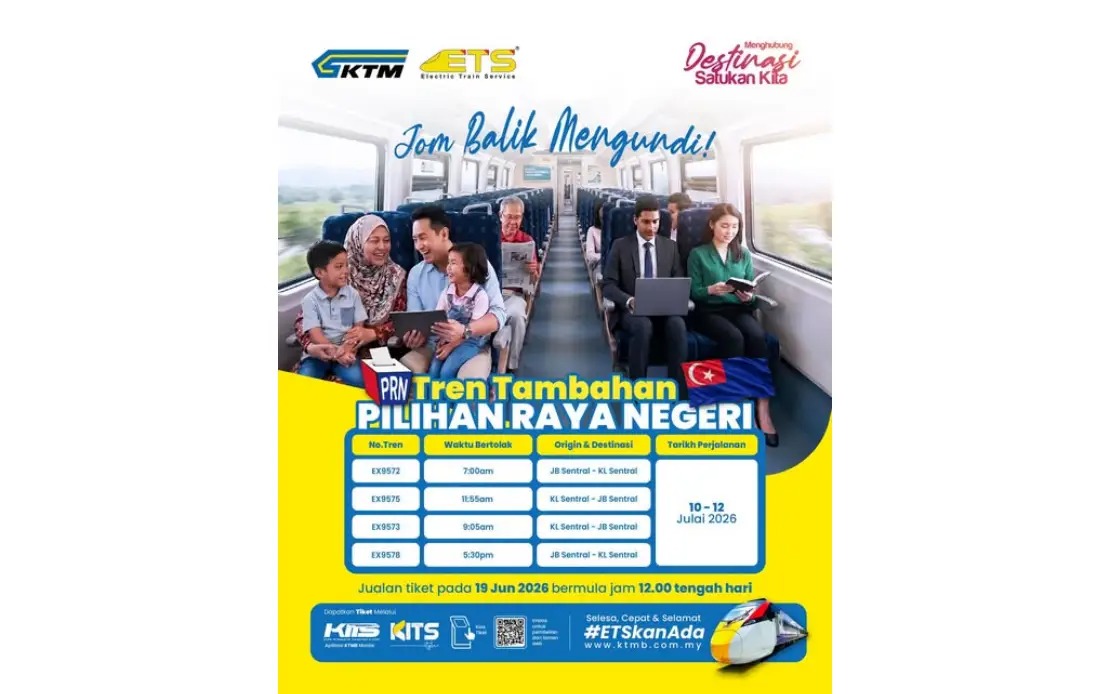
Keretapi Tanah Melayu Berhad (KTMB) is responding to expected travel demand from voters heading south for the Johor state election by deploying additional ETS train capacity over a three-day window. The announcement comes as the state prepares for polling day on July 11, following the State Legislative Assembly's dissolution on June 1. This logistical move underscores the scale of internal migration typically observed during electoral contests in Malaysia, particularly in states where large portions of the working-age population have relocated to urban centres elsewhere in the country.
The railway operator confirmed that enhanced services will operate between July 10 and 12, effectively bracketing the election day to accommodate both pre-vote arrivals and post-vote departures. Ticket sales commenced at noon on the announcement date, made through KTMB's established digital and physical distribution channels. Passengers can book via the KTMB Mobile app, the KITS Style app, the official online ticketing portal at online.ktmb.com.my, or directly at KTMB ticket kiosks nationwide. This multi-channel approach reflects the increasing digitisation of transport bookings among Malaysian travellers, though it simultaneously maintains traditional counter services for those less comfortable with mobile platforms.
The decision to increase capacity demonstrates how electoral processes in Malaysia intersect with infrastructure planning and service delivery. Johor, as the nation's second-most populous state and a major economic hub with significant outmigration to Kuala Lumpur and other centres, typically witnesses substantial homecoming traffic during state and federal elections. Many registered voters who work or study elsewhere maintain residential eligibility in Johor and must physically return to their constituencies to cast ballots, as Malaysian electoral law does not permit remote voting.
The timing of the announcement—made via social media—reflects KTMB's contemporary approach to public communication, allowing rapid dissemination to a broad audience. The transport operator's explicit framing of the initiative as enabling voters to "head home to vote" (as stated in their promotional messaging) acknowledges the emotional and civic dimensions of electoral participation. This language choices positioning train travel as facilitating democratic engagement rather than merely commercial transport.
From a practical standpoint, the additional ETS services address genuine capacity constraints that might otherwise frustrate voters attempting to reach Johor. The ETS network, which connects major population centres along the western corridor and into southern destinations, typically experiences surge demand during holidays and special occasions. An election cycle functions similarly—creating a concentrated, predictable spike in travel that requires advance planning. By announcing supplementary services early and opening bookings immediately, KTMB signals recognition of this demand while encouraging passengers to secure seats rather than risk overcrowding.
The expansion of rail services for electoral purposes also carries broader implications for Malaysian transport infrastructure. It demonstrates how public transport operators factor political events into their scheduling and resource allocation. Similar coordination has occurred in previous election cycles, with various operators offering promotional fares or additional capacity. However, such measures remain reactive rather than structural—addressing election-specific surges through temporary fixes rather than permanent capacity increases.
For Southeast Asian observers, Malaysia's approach to election-related transport logistics reflects relatively sophisticated planning within a stable democratic framework. Unlike some regional counterparts facing security concerns or logistical chaos during electoral periods, Malaysia's transport authorities can focus on straightforward capacity management. The availability of modern train infrastructure like the ETS, coupled with functioning digital booking systems, positions Malaysian voters with considerable advantages compared to citizens in less developed transport networks.
The Johor election itself carries significance beyond the state's borders. As a major economic powerhouse and strategic location adjacent to Singapore, developments in Johor governance influence broader Malaysian politics and regional dynamics. Enhanced transport accessibility for voters—whether intentionally or incidentally—can affect turnout patterns, as reduced travel friction may encourage participation among voters requiring significant effort to reach polling stations.
Looking at implementation, KTMB's announcement provides practical clarity: voters know precisely when services operate, where to book, and through which platforms. The three-day window (July 10-12) balances capacity with operational feasibility, avoiding excessive disruption to regular commercial scheduling while ensuring sufficient additional carriages for the anticipated surge. The decision to maintain multiple booking channels—digital and physical—acknowledges the diversity of Malaysia's travelling public, from tech-savvy urbanites to voters less engaged with smartphone applications.
The railway operator's capacity boost also functions as implicit acknowledgment that democratic participation, while a fundamental right, requires tangible logistical support. Without accessible transport, voters facing travel burdens might abstain or encounter difficulties reaching polling stations. By removing or reducing this barrier, KTMB contributes to the functional integrity of the electoral process, even if this support remains secondary to the more visible work of election administrators and political actors.
As Malaysia continues navigating regular electoral cycles at state and federal levels, such transport coordination will likely remain routine. The Johor precedent suggests that major carriers recognise their role in facilitating democratic participation, translating civic responsibility into operational planning. Future elections may see even more sophisticated coordination, potentially involving advance demand forecasting and dynamic pricing models. For now, the straightforward announcement of additional ETS services represents a practical, accessible approach to managing election-related travel pressures while maintaining service quality for all passengers.

