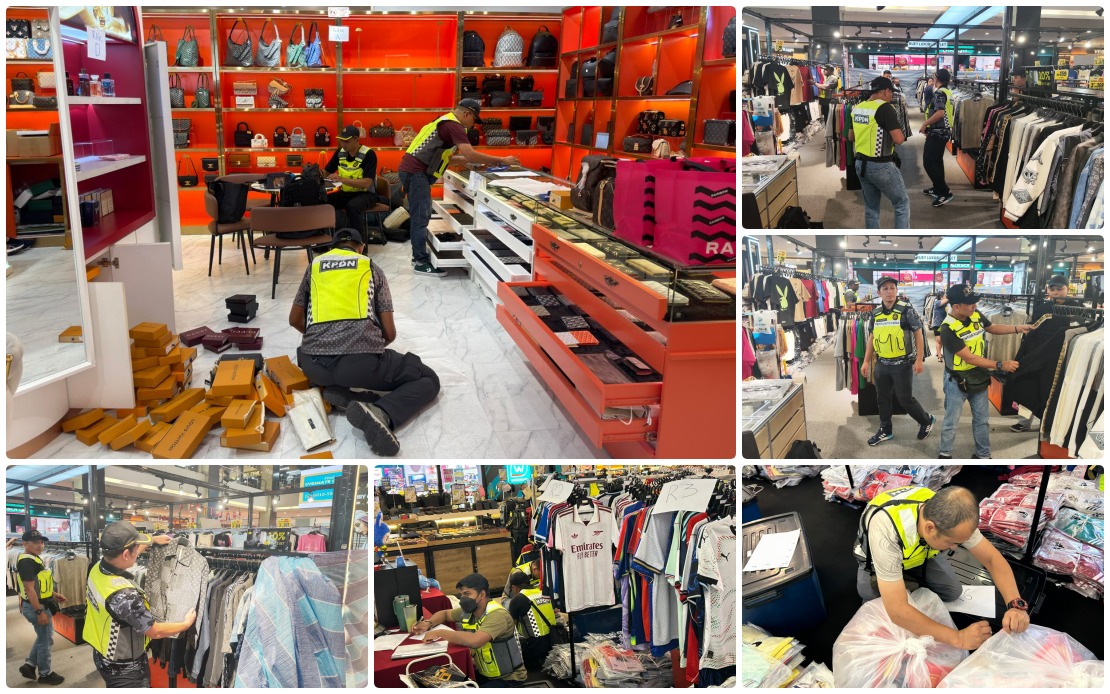
The Ministry of Domestic Trade and Cost of Living (KPDN) has intensified its fight against intellectual property violations with a significant raid targeting the distribution of counterfeit branded merchandise across Johor Bahru. On June 15, enforcement teams descended on three separate commercial locations, uncovering an operation suspected of trafficking in fake luxury goods worth RM600,000. The coordinated action, executed by the Putrajaya Enforcement Division, represents the culmination of sustained intelligence-gathering spanning more than a month into the trading practices of retailers flagged for suspicious activity.
Datuk Azman Adam, the enforcement director-general of KPDN, outlined the scope of the investigation in a statement released June 19. The raiding teams discovered premises that displayed and marketed various branded merchandise bearing the registered trademarks of established international companies without authorization from the legitimate trademark proprietors. The operation represents a proactive approach to tackling what authorities describe as a persistent challenge to consumer protection and fair trade practices in Malaysia's retail sector.
The seizure encompassed a diverse array of counterfeit items spanning multiple product categories. Among the confiscated goods were clothing, handbags, wallets, belts, and perfumes, alongside supporting business documentation that investigators believe could provide crucial leads into the broader distribution network. According to Datuk Azman's statement, preliminary inspections and verifications conducted jointly with representatives of the trademark complainants established sufficient grounds to believe that violations of Section 102(1)(c) of the Trademark Act 2019 had occurred. This section specifically prohibits the possession, custody, or control of counterfeit goods with intent to trade.
The investigation has already resulted in the detention of four local individuals, comprising the premises owners and caretakers directly involved in managing the business operations. Their apprehension is expected to provide investigators with crucial insights into the organizational structure, supply chains, and distribution mechanisms underpinning what authorities believe may be a larger counterfeit goods network. The detention of management-level personnel suggests that investigators are pursuing a comprehensive understanding of how these operations functioned and who else may have been involved in the supply chain.
The legal consequences outlined for those convicted of trademark infringement under the 2019 Act demonstrate the severity with which Malaysian authorities treat such violations. Individual offenders face substantial penalties for first-time offences, including fines reaching RM10,000 per counterfeit item or imprisonment stretching up to three years, with both penalties potentially applied concurrently. Repeat offenders face substantially harsher consequences, with fines escalating to RM20,000 per item and imprisonment terms extending to five years. These graduated penalty structures reflect legislative intent to deter both initial offenders and recidivist operators from engaging in counterfeit trade.
Corporate entities and commercial bodies operating counterfeit schemes face distinct penalty frameworks that underscore the heightened expectations placed on organized business operations. Companies convicted of first-time violations may incur fines of RM15,000 per item, doubling to RM30,000 per item for subsequent offences. The absence of imprisonment provisions for corporate entities indicates that financial penalties are considered the primary enforcement mechanism for organizations, though individual shareholders, directors, and managers remain subject to personal criminal liability. This two-tier approach encourages corporate compliance by establishing that organizational structures cannot shield individual perpetrators from criminal responsibility.
The timing and scale of this operation reflect broader enforcement priorities across Southeast Asia, where counterfeit goods trafficking has become an increasingly sophisticated challenge. Malaysia, positioned as a regional trade hub with extensive port infrastructure and logistics networks, has faced particular pressure from organizations trafficking in fake luxury merchandise. The concentration of three separate raids within a single metropolitan area suggests that Johor Bahru may have emerged as a significant distribution hub, potentially serving as a transshipment point for counterfeit goods destined for broader regional markets. KPDN's focus on this location indicates awareness that organized counterfeit operations often establish physical presence in strategically located commercial centers.
Datuk Azman Adam's statement emphasized KPDN's commitment to intensifying enforcement operations and maintaining an uncompromising stance against trademark infringement and consumer deception. This positioning reflects both institutional resolve and recognition of the economic significance of intellectual property protection. Counterfeit goods divert revenues from legitimate manufacturers and distributors, undermine brand reputation, and expose consumers to potentially hazardous products lacking proper quality assurance and safety standards. The statement's emphasis on the ministry's refusal to compromise positions intellectual property enforcement as a fundamental component of consumer protection strategy.
The investigation raises questions about how sophisticated counterfeit distribution networks have become within Malaysian commerce. The presence of operations spanning multiple premises and allegedly serving as distribution nodes to other retailers suggests considerable operational complexity. This networked approach to counterfeit distribution represents a significant evolution from isolated instances of counterfeiting, indicating instead the presence of organized, profit-driven enterprises with established supply chains and customer bases. Understanding how these networks operate, source merchandise, and distribute products to end retailers is crucial for developing increasingly effective enforcement strategies.
For Malaysian consumers and legitimate retailers, this operation carries important implications. The presence of counterfeit goods in established commercial channels undermines consumer confidence in product authenticity and safety. Legitimate businesses operating in the fashion, luxury goods, and personal care sectors face competitive pressure from unauthorized operators with substantially lower cost structures, as counterfeit manufacturers avoid research and development expenses, quality control investments, and regulatory compliance costs. KPDN's enforcement action benefits ethical retailers by removing unfair competition while reinforcing the value proposition of authorized distribution channels.
The investigation also highlights vulnerabilities in supply chain oversight that permit counterfeit goods to reach retail premises. The month-long intelligence gathering preceding the raids suggests that detecting these operations requires sustained monitoring of trading patterns and market presence. Consumers shopping at major supermarkets, which authorities identified as retail channels for these counterfeit goods, may have unwittingly purchased fake items believing they were acquiring legitimate products. This exposure underscores the necessity for continued vigilance across retail networks and the importance of consumer education regarding authentication methods and risks associated with counterfeit merchandise.
Moving forward, the outcome of investigations into the four detained individuals will likely provide valuable intelligence regarding counterfeit distribution networks operating within Malaysia. Whether this operation represents an isolated incident or signals the presence of a more extensive organized network remains to be determined through investigative processes. Regional cooperation mechanisms, including collaboration with customs authorities, port operators, and counterparts in neighboring countries, will be essential for disrupting international supply chains feeding counterfeit goods into Malaysian markets. The RM600,000 seizure value demonstrates the economic significance of these operations, providing further incentive for sustained enforcement efforts.