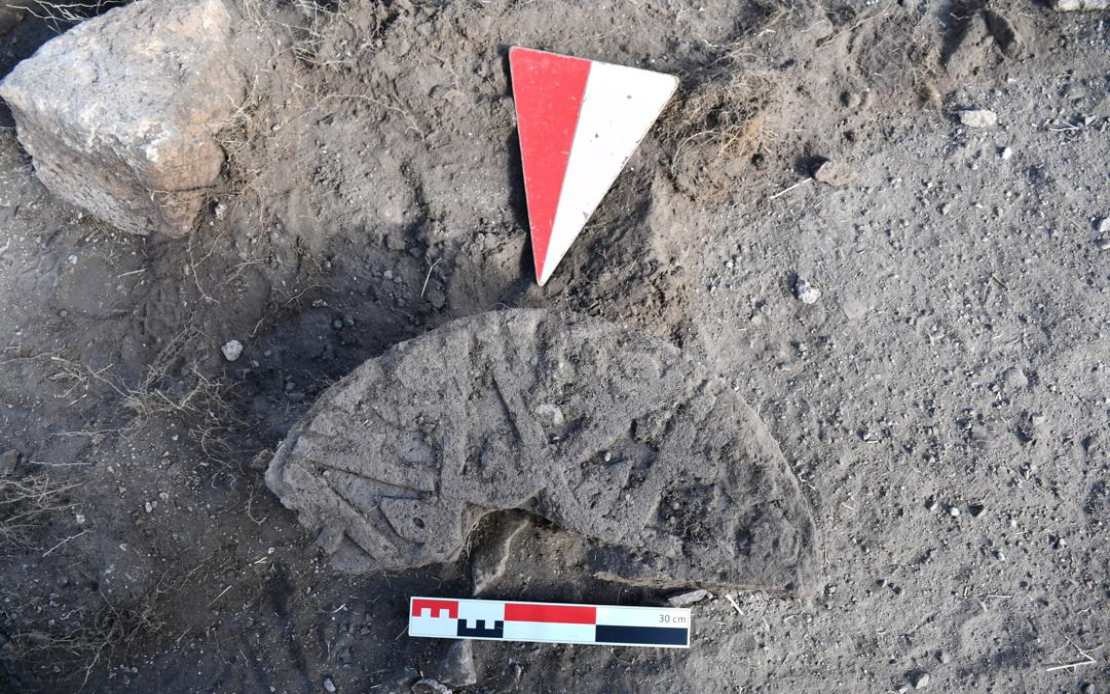
Turkish authorities have announced the discovery of a remarkable stone artefact at the ancient site of Ani in eastern Türkiye, bearing multiple inscriptions of Prophet Muhammad's name in Kufic script. The find, revealed by Culture and Tourism Minister Mehmet Nuri Ersoy through social media, marks a significant addition to understanding the religious and cultural heritage of the region during the medieval Islamic period.
The stone, unearthed during ongoing excavations at a Seljuk cemetery that has been systematically studied since 2021, contains the Prophet's name rendered six times in the intricate Kufic script style prevalent in early Islamic calligraphy. This density of inscription suggests the artefact held considerable religious or commemorative significance for those who commissioned or used it. Three of these six inscriptions are particularly elaborate, forming part of a decorative band that encircles an eight-pointed star motif—a design element that would have held both aesthetic and symbolic meaning in Seljuk-era architecture and craftsmanship.
The discovery provides tangible evidence of Islamic devotional practices and artistic traditions during the Seljuk period, when the Turkish sultanate exercised considerable influence over Anatolia and the broader eastern Mediterranean region. The careful integration of calligraphic inscriptions with geometric patterns reflects the sophisticated approach to sacred ornamentation that characterised Seljuk monuments, many of which survive across modern-day Türkiye as testaments to the era's cultural sophistication.
Ani's location on the Turkish-Armenian border has shaped its tumultuous historical trajectory. During the tenth and eleventh centuries, the city served as the capital of the Bagratid Armenian kingdom, positioning it as a major hub along the ancient Silk Road trade networks that connected East Asia with Europe and the Mediterranean world. This strategic positioning made Ani a cultural crossroads where Armenian, Byzantine, Persian, and Islamic influences intersected and intermingled, leaving layered archaeological and architectural records across centuries.
The site's political control shifted repeatedly as regional powers expanded and contracted their domains. Byzantine forces asserted authority over portions of the region, followed by the Seljuk Turks, who eventually yielded control to the Ottomans as their empire expanded northwestward into Anatolia. Each successive power left its imprint on the urban landscape, creating the palimpsest of ruins visible today. The discovery of this Seljuk-era inscription demonstrates that even after Armenian political sovereignty ended, the site remained economically and culturally significant under subsequent rulers.
Ani's archaeological importance extends beyond its political history. The site preserves material evidence of how different religious and cultural communities coexisted and competed for influence across the medieval eastern Mediterranean. The presence of inscriptions in Arabic script within what was once an Armenian city illustrates the complex religious demography and cultural syncretism characteristic of medieval Anatolia, where Armenian Christians, Muslim Turks, and other communities inhabited and shaped the same urban spaces.
The recognition of Ani as a UNESCO World Heritage Site in 2016 underscored international acknowledgement of its universal value as a repository of human heritage. This designation provides a framework for systematic protection and scholarly investigation, enabling researchers to conduct methodical excavations that yield discoveries like this recently unearthed stone. The ongoing cemetery excavations represent precisely the kind of careful, long-term archaeological work necessary to recover nuanced understanding of how people lived, worshipped, and expressed their identities across historical transitions.
For Malaysian and broader Southeast Asian audiences, Ani's story resonates as a case study in how trade networks, religious transmission, and cultural exchange shaped medieval societies. Like Southeast Asian port cities that experienced waves of Indian, Chinese, Arab, and European influence, Ani exemplifies how crossroads communities developed distinctive syncretistic cultures. The region's experience offers comparative insights into how religious minorities maintained identity while navigating majority rule, themes relevant to contemporary Southeast Asian pluralism.
The Kufic script itself carries particular resonance for Islamic scholarship across the Muslim world. This ancient Arabic calligraphic style, which fell out of everyday use centuries ago, retained sacred status for Quranic and commemorative inscriptions. The appearance of Kufic script on a Seljuk monument at Ani suggests deliberate continuity with early Islamic traditions, even as Seljuk artists developed their own distinctive aesthetic vocabulary. This archaeological evidence complements historical documents and architectural remains in charting how Islamic identity and practice evolved and became rooted across Anatolia during the medieval period.
The excavation at Ani continues to yield discoveries that refine and complicate conventional historical narratives. Rather than viewing the site as a static monument to Armenian greatness or as a ruin marking civilisational loss, the ongoing archaeological work reveals Ani as a living city where successive communities left their marks, adapted existing structures, and created new cultural expressions. This stone inscription, with its repeated invocation of the Prophet's name carved into geometric patterns, stands as a tangible reminder that history comprises multiple overlapping stories, each worthy of recovery and understanding.

