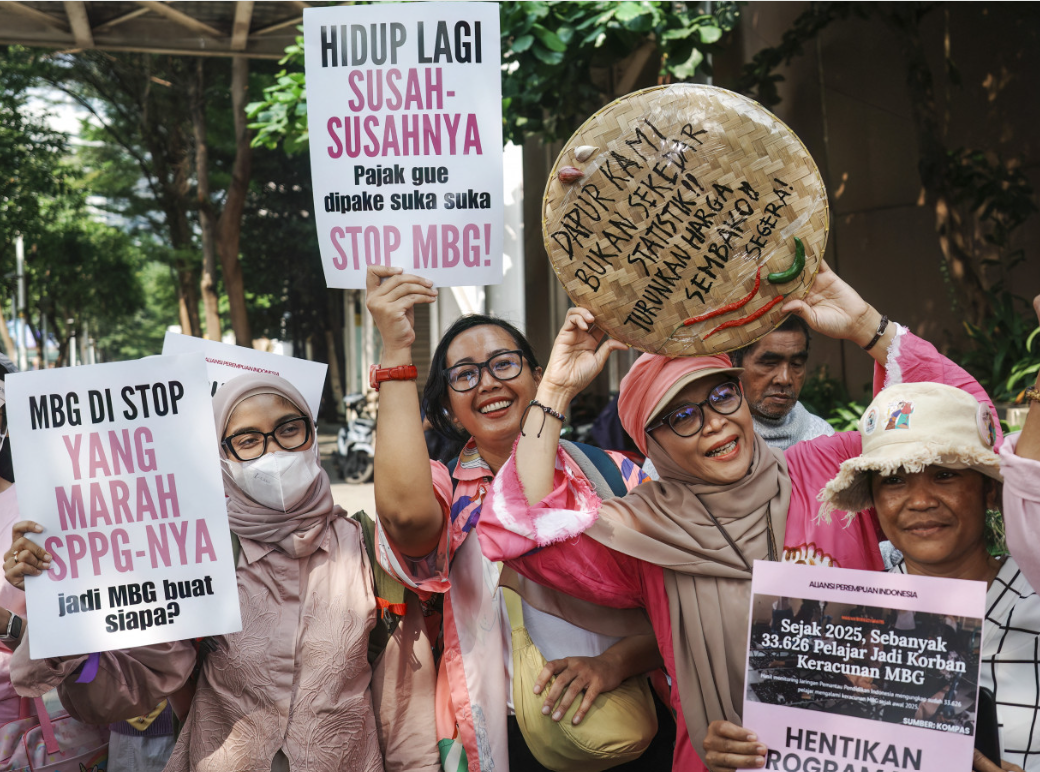
President Prabowo Subianto's free nutritious meal programme, designed as a cornerstone initiative to combat childhood stunting across Indonesia, faces mounting pressure from an unexpected quarter: the families it aims to help. Growing numbers of beneficiaries are now suggesting they would willingly forgo the government assistance rather than continue accepting meals they consider inadequate or potentially harmful to their children's development, signalling a deeper crisis of confidence in how the initiative is being executed at the ground level.
The controversy crystallised when Nesti Nagari, a 29-year-old mother in Kediri, East Java, shared images on social media of the meal provided to her eight-month-old infant—a lump of unidentifiable white paste that she found unsuitable for consumption. Her post quickly resonated with thousands, accumulating over 11,000 likes as other parents recognised the quality concerns she was highlighting. Rather than feed the meal to her child, Nagari gave it to her chickens and subsequently refused further portions. The incident reflects not merely an isolated quality lapse but rather a systematic problem affecting meal preparation across the sprawling network responsible for the programme's implementation.
Nagari's position extends beyond simple dissatisfaction with a single meal. She openly stated that she possesses the means to prepare nutritious food for her child independently and would support either a temporary suspension of the programme for comprehensive evaluation or even its outright termination if such action allowed the government to redirect resources toward other pressing priorities, particularly education and healthcare infrastructure. This sentiment—that quality improvement should take precedence over continued distribution—represents a significant shift in how beneficiaries view the programme's utility and the government's capacity to manage such a large-scale intervention.
Diah Farika, a breastfeeding mother in Semarang, Central Java, has emerged as another vocal critic after participating in the scheme since May. She documented systematic quality issues across multiple meal deliveries, including nutritionally inadequate portions and unripe fruits, and experienced dismissive responses when she raised concerns with local nutrition fulfillment service units (SPPG) responsible for meal preparation. Like Nagari, Farika advocates for temporary programme suspension specifically to enable the National Nutrition Agency (BGN) to conduct thorough inspections of all 27,000 kitchens currently operating within the network. Her analysis identifies the individual SPPG operators as the critical variable—acknowledging that the programme's underlying concept is sound but that its failure stems from inconsistent implementation and quality control mechanisms.
These individual complaints have catalysed broader activist mobilisation. On Thursday, dozens of women and rights groups united under the Indonesian Women's Alliance (API) staged demonstrations in Central Jakarta demanding that the government halt the programme pending comprehensive review. The fact that civil society organisations focused on women's and family welfare concerns have joined beneficiaries in calling for suspension underscores the extent to which the initiative's execution failures have eroded institutional credibility among constituencies traditionally supportive of social welfare expansion.
Yet complications extend well beyond quality concerns. A corruption scandal involving former BGN leadership prompted the agency's new management to freeze further expansion of the SPPG network, creating investment uncertainty that now threatens the programme's financial viability. Reports indicate that investors who committed hundreds of billions of rupiah to construct SPPG facilities recently visited BGN offices demanding assurances about their returns, fearing that programme contraction or termination could render their infrastructure investments worthless. This dynamic illustrates how social programmes become entangled with private commercial interests, potentially distorting priorities away from actual beneficiary needs toward protecting invested capital.
Operational disruptions have compounded these tensions. Several SPPG kitchens reported temporary closures in early June stemming from delayed government funding disbursement, though some subsequently reopened. These interruptions, combined with the quality problems and corruption revelations, have substantially diminished public trust. MBG Watch, an independent civil society oversight platform, has documented how these accumulated failures are prompting legitimate questions about whether the multi-billion-dollar budget allocation genuinely serves intended beneficiaries or benefits primarily the commercial operators and institutional bureaucracies managing distribution.
The financial dimensions further complicate the narrative. The 2026 budget allocation underwent significant revision, initially set at Rp 335 trillion before being trimmed to Rp 268 trillion following public scrutiny over the programme's expense and concerns that its scale was crowding out education funding. Policy researcher Isnawati Hidayah from the Center of Economic and Law Studies (CELIOS) has underscored that beneficiaries' perspectives must become central to any genuine evaluation, as they represent both the intended recipients of assistance and the constituencies bearing the consequences when implementation fails.
Research conducted by CELIOS identified a structural inefficiency: approximately 34 percent of current beneficiaries—roughly 61 million children and pregnant women—do not belong to the most vulnerable categories, instead including households with adequate economic security and sufficient nutritional access. This misallocation suggests that programme design inadvertently extends benefits to those capable of securing nutrition through market mechanisms, potentially diluting resources available for genuinely vulnerable populations. Recognising this targeting failure, the BGN has begun rationalising its beneficiary pool by removing recipients deemed capable of meeting nutritional needs independently, having already dropped 76 schools across Java affecting over 39,000 beneficiaries.
BGN deputy head Agustina Arumsari framed these adjustments as necessary refocusing designed to concentrate assistance among Indonesian citizens genuinely requiring government intervention. The agency is simultaneously implementing austerity measures, including elimination of daily kitchen incentives during non-operational periods and systematic evaluation of underperforming facilities. These corrective actions represent an implicit acknowledgment that the programme's initial design suffered from both implementation weaknesses and targeting imprecision requiring substantial restructuring rather than simple operational adjustment.
The situation presents a peculiar paradox for policymakers: the initiative's conceptual foundation—ensuring adequate nutrition for vulnerable populations—remains sound and widely supported, yet the execution has become so compromised that beneficiaries themselves increasingly prefer forgoing assistance to accepting defective meals. Resolving this tension will require the BGN to address not merely isolated kitchen-level problems but also the investment dynamics, bureaucratic incentive structures, and beneficiary identification mechanisms that have generated present failures. Without such comprehensive restructuring, the programme risks becoming an example of how well-intentioned social policy can inadvertently generate mistrust and resistance through poor implementation, a cautionary lesson relevant across Southeast Asia where governments pursue large-scale welfare expansion with varying degrees of operational capacity.