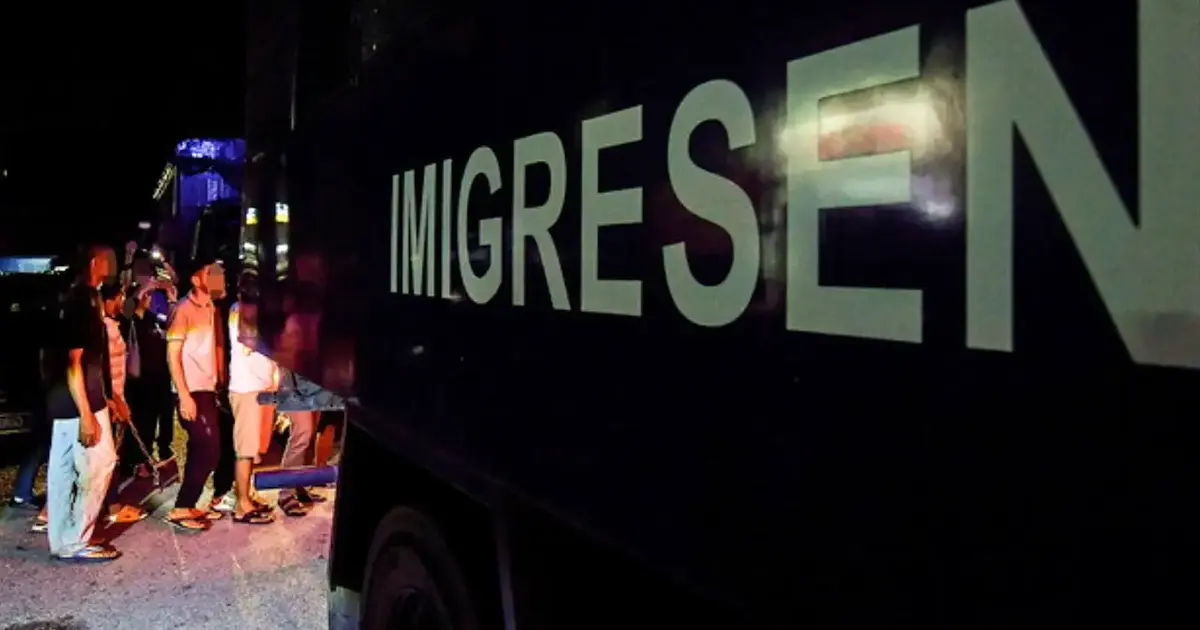
Immigration enforcement authorities have intensified their crackdown on illegal residency in Kuala Lumpur, with a coordinated midnight raid in the Pudu district resulting in the apprehension of 186 foreign nationals suspected of immigration violations. The large-scale operation underscores the government's ongoing commitment to tightening border control and combating irregular migration across the country's urban centres.
The detainees were arrested on suspicion of two primary violations: remaining in Malaysia beyond the validity of their travel permits and failing to possess legitimate travel documents required for legal residency. Both categories represent serious breaches of Malaysia's immigration framework, which maintains stringent regulations governing the entry and stay of foreign nationals within its borders.
Immigration operations of this magnitude are typically coordinated between federal immigration authorities and local enforcement units, who conduct systematic sweeps targeting high-density residential areas where undocumented migrants are believed to congregate. The Pudu locality, a densely populated commercial and residential zone in central Kuala Lumpur, has historically been identified as an area requiring intensive immigration monitoring due to its transient population and proximity to informal employment networks.
The timing of the operation—conducted under cover of darkness—reflects a deliberate tactical approach designed to maximise apprehension rates and minimise the risk of individuals escaping detection or fleeing the targeted premises. Night-time raids capitalise on reduced visibility and movement, trapping suspects who might otherwise escape through alternate routes during daylight operations when surveillance is less comprehensive.
Such enforcement exercises carry significant implications for Malaysia's broader immigration policy landscape. The nation hosts one of Southeast Asia's largest foreign worker populations, with both documented and undocumented migrants comprising substantial portions of the labour market. While legal migrant workers contribute substantially to economic sectors ranging from domestic service to construction and manufacturing, their undocumented counterparts frequently operate in informal economies with minimal regulatory oversight, creating challenges for tax collection, worker welfare standards, and public health monitoring.
The detention of 186 individuals represents a single operational snapshot within a continuous immigration enforcement apparatus. Authorities typically process apprehended migrants through established procedures involving documentation verification, deportation proceedings, and coordination with home country embassies to arrange repatriation. The logistical complexity of managing such large cohorts—particularly those requiring translation services, medical screening, and consular notification—places considerable strain on immigration detention facilities and administrative resources.
For Malaysian employers relying on foreign labour, such operations serve as periodic reminders of compliance obligations and risk exposure. Businesses employing undocumented workers face potential legal liability, financial penalties, and operational disruption when workforce members are detained. This reality has driven gradual expansion of Malaysia's regulated worker recruitment systems, though informal hiring practices persist across labour-intensive sectors where enforcement visibility remains limited.
The operation also reflects evolving approaches to immigration management within the Malaysian context. Beyond simple detention and deportation, authorities increasingly emphasise prevention through documentation verification, workplace inspections, and coordination with employers to ensure permit compliance. These complementary strategies acknowledge that supply-side enforcement alone cannot address underlying demand for cheaper undocumented labour within certain economic segments.
Regional dynamics add complexity to Malaysia's immigration challenges. The country's geographic position as a transit hub connecting South Asia, Southeast Asia, and beyond creates natural attraction for migrants seeking onward movement or temporary economic opportunity. Neighbouring countries experiencing economic hardship or political instability generate sustained outflows of migrants willing to risk irregular routes and undocumented status to pursue livelihood opportunities in relatively more developed Malaysian urban centres.
The Pudu operation also intersects with broader public health and security considerations that have gained prominence since the COVID-19 pandemic. Undocumented populations—often lacking access to formal healthcare, living in crowded conditions, and frequently mobile—present particular disease transmission risks and complicate epidemiological monitoring efforts. Immigration enforcement therefore increasingly incorporates health screening and quarantine protocols alongside traditional documentation and eligibility verification procedures.
Moving forward, the sustainability of Malaysia's immigration control architecture depends on balancing enforcement intensity with practical feasibility and resource allocation. While large-scale raids generate headlines and demonstrate governmental action, effective long-term management requires simultaneous investment in administrative capacity, employer compliance systems, and bilateral cooperation with source countries to address root causes of irregular migration.
For migrant communities, such operations create cycles of vulnerability and fear that discourage formal engagement with authorities and deepen reliance on informal networks for employment, housing, and social services. The humanitarian dimensions of immigration enforcement—encompassing worker safety, access to justice, and protection from exploitation—remain contested policy terrain across Southeast Asia, with Malaysia gradually evolving its frameworks to incorporate rights-based considerations alongside national security and economic priorities.

