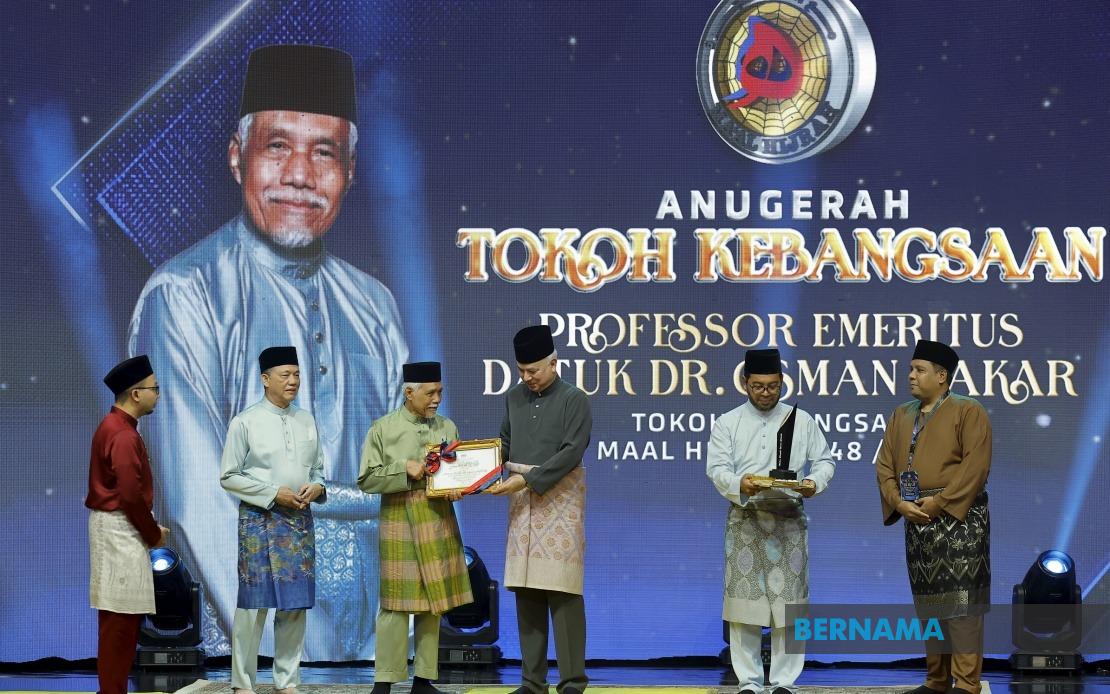
Prof Emeritus Datuk Dr Osman Bakar, rector of the International Islamic University Malaysia, has been selected as the National Tokoh Maal Hijrah for 1448H/2026, receiving the honour at an official state ceremony held at Putra Mosque in Putrajaya. The recognition places him amongst Malaysia's most distinguished Islamic scholars and reflects his decades of intellectual contribution to the nation's religious and academic landscape.
The annual Maal Hijrah awards celebrate individuals whose work exemplifies the values of Islamic scholarship and societal contribution. This year's selection of Osman Bakar underscores the continued importance of institutional leadership in advancing Islamic learning within Malaysia's higher education ecosystem. IIUM, as one of the nation's premier universities dedicated to Islamic and secular disciplines, has benefitted substantially from his stewardship and academic vision.
At the same ceremony, Morocco-based Islamic scholar Dr Ahmad Al-Raysuni was honoured as the International Tokoh Maal Hijrah, recognising the global dimension of Islamic scholarship and cross-border intellectual exchange. The dual recognition signals Malaysia's commitment to engaging with the broader Muslim world whilst simultaneously celebrating homegrown talent and institutional excellence.
Sultan Nazrin Shah, the Sultan of Perak, presented both awards in his capacity as patron of the national celebration. The recipients each received monetary prizes alongside trophies and formal certificates acknowledging their achievements. The presentation by a reigning sultan underscores the ceremonial significance accorded to these honours within Malaysia's institutional hierarchy.
The 2026 Maal Hijrah celebration adopted the thematic framework "MADANI Dihayati, Ummah Diberkati", a phrase encompassing the government's wider civilisational agenda. The theme emphasises cultivating compassion, fostering social cohesion, and prioritising community welfare—principles that extend beyond religious observance into practical social policy. For Malaysian readers, this reflects the state's positioning of Islamic values as foundational to governance and public administration.
Osman Bakar's selection carries particular resonance given his scholarly contributions spanning multiple decades. His work has bridged Islamic theological thought with contemporary scientific inquiry, positioning him as an intellectual figure capable of mediating between traditional religious knowledge and modern institutional frameworks. This positioning matters considerably for Southeast Asian universities seeking to maintain Islamic identity whilst competing in global academic markets.
The ceremony drew significant government representation, including Deputy Prime Minister Datuk Seri Fadillah Yusof and his wife Datin Ruziah Mohd Tahir, along with Dr Zulkifli Hasan, the Minister in the Prime Minister's Department overseeing Religious Affairs. This level of ministerial attendance reflects the state's prioritisation of religious leadership recognition and suggests that institutionalising Islamic scholarship remains a policy focus for Malaysia's federal administration.
For higher education stakeholders across Malaysia and Southeast Asia, Osman Bakar's recognition signals the continuing value placed on university leadership that integrates Islamic intellectual traditions with academic rigour. IIUM's prominence as a dual-mission institution—offering both Islamic and secular studies—positions it as a model institution within the broader Muslim-majority region, particularly relevant for Malaysia's educational export agenda.
The Maal Hijrah commemoration itself reflects Malaysia's religious calendar and state protocol, marking the Islamic new year whilst simultaneously functioning as an occasion for honouring individuals deemed exemplary. This institutional mechanism for celebrating scholarly and moral achievement creates pathways for recognising contributions that might otherwise remain within academic circles, elevating them to national consciousness.
Osman Bakar's trajectory from academic researcher to institutional leader to nationally honoured figure illustrates the career progression available to scholars within Malaysia's Islamic education sector. His recognition provides an implicit template for aspiring academics, particularly those at faith-based institutions seeking to balance intellectual independence with institutional responsibility and national contribution.
The international dimension represented by Al-Raysuni's selection indicates Malaysia's self-positioning as a participant in global Islamic intellectual discourse rather than a peripheral consumer of external ideas. Moroccan scholarship carries particular prestige within Islamic academic circles, making the mutual recognition between Malaysian and Moroccan scholars symbolically significant for regional knowledge hierarchies.
Looking forward, such recognition ceremonies function as soft power mechanisms, internationally broadcasting Malaysia's investment in Islamic learning and its capacity to attract and honour scholarly excellence. For regional competitors or peers seeking to strengthen Islamic education frameworks, the Maal Hijrah awards represent an institutionalised practice worth emulating, particularly as Southeast Asian nations increasingly position themselves as knowledge centres within the Muslim world.

