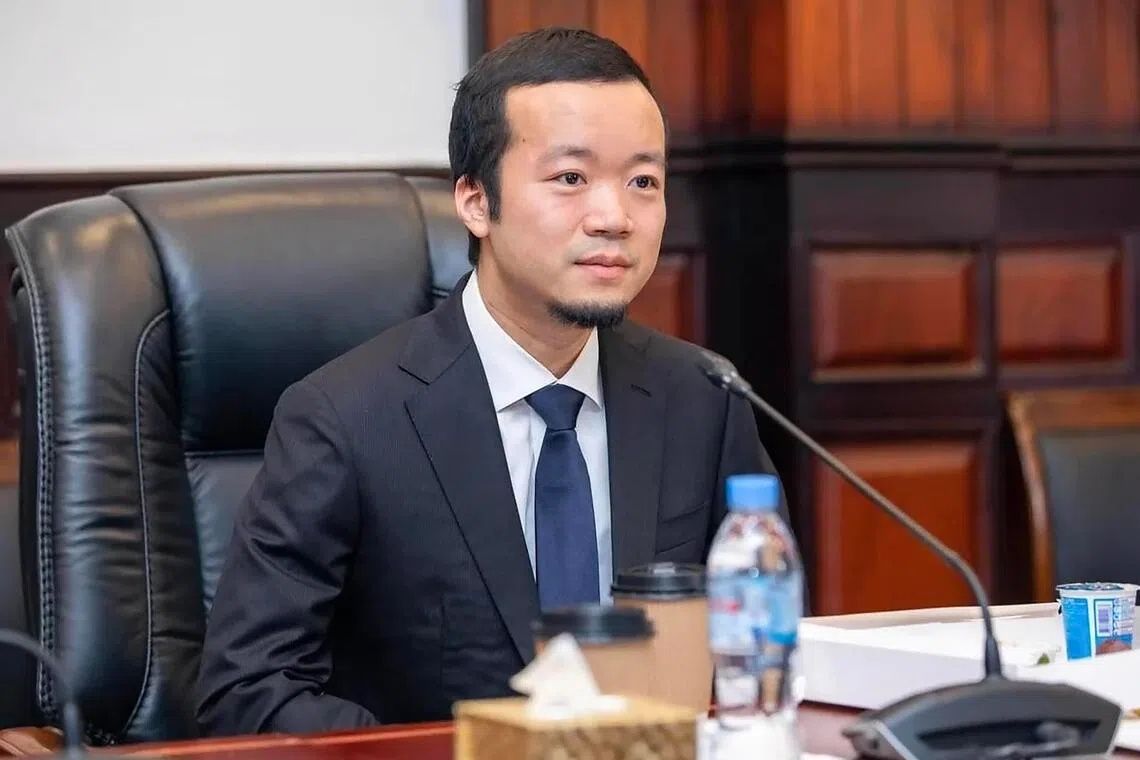
A six-month investigation by The Straits Times in collaboration with the Organised Crime and Corruption Reporting Project has identified Chen Sokly as a principal co-conspirator in one of the world's largest fraud operations, revealing how this Shanghai-born operative quietly accumulated substantial assets across Singapore, the United States, and Southeast Asia while orchestrating a sprawling criminal enterprise that generated roughly US$30 million daily in illicit proceeds.
Sokly emerged from obscurity in October 2025 when American prosecutors unsealed an indictment naming him alongside scam mastermind Chen Zhi as a key architect of the Prince Holding Group's operations. The legal action precipitated a historic financial reckoning: US authorities seized 127,271 bitcoins valued at approximately US$15 billion, representing one of the largest criminal asset forfeitures ever recorded. Six days after the indictment, the US government initiated sweeping sanctions against Chen Zhi, the Prince Group, and dozens of affiliated entities and individuals, effectively dismantling what prosecutors described as a sophisticated global crime syndicate built on investment fraud and systematic money laundering.
The criminal enterprise at the heart of this investigation drew its wealth from forced labour camps operating throughout Cambodia, where thousands of foreign nationals were coerced into conducting online scams targeting victims worldwide. Chen Zhi established the Prince Holding Group as the operational and financial nexus of this scheme, channelling billions of dollars through an intricate web of shell companies and front entities distributed across multiple jurisdictions. Sokly's role within this structure proved instrumental: prosecutors alleged he functioned as the syndicate's chief risk officer, tasked with anticipating law enforcement threats, neutralising investigations before they matured, and maintaining a portfolio of corrupted government officials who could facilitate the group's illegal activities.
Born in Shanghai in 1986, Sokly engineered a carefully constructed identity transformation around late 2017 when he secured Cambodian citizenship and legally adopted the name Chen Sokly, records from the Cambodian government gazette confirm. This reinvention allowed him to operate across Southeast Asia with minimal scrutiny, adopting yet another persona in Singapore business circles where associates knew him as the ostensibly legitimate entrepreneur Martin Chen. The Straits Times and OCCRP cross-referenced corporate registrations, citizenship documents, property deeds, and residency records across Cambodia, Cyprus, Singapore, and the United States to establish definitively that these disparate identities belonged to a single individual orchestrating operations across continents.
Sokly's engagement with corrupt officials transcended passive arrangement; court filings reveal an aggressive strategy of cultivating relationships with government functionaries at multiple levels. In May 2023, prosecutors alleged, Sokly communicated with a Chinese government official who promised to shield Prince Group associates from legal consequences in exchange for personal favours. Rather than delegating responsibilities, Sokly reportedly committed his network's resources to protecting the official's son and even directed the same official to instruct local police to extort businesses on the group's behalf. Such relationships generated considerable confidence within the organisation: Sokly boasted to associates that nothing would derail the Prince Group despite Cambodian authorities' escalating crackdowns on scam compounds. Internal communications recovered by federal investigators documented lengthy discussions between Sokly and Chen Zhi cataloguing the roster of officials they controlled and their respective spheres of influence.
A ledger of bribes maintained by Chen Zhi and discovered during the US government's investigation provided concrete evidence of Sokly's methods. In 2019, prosecutors alleged, Sokly purchased a yacht exceeding US$3 million for a foreign government official, a transaction recorded in meticulous detail in the syndicate's financial records. Such extravagant gifts formed part of a deliberate strategy to entrench relationships with officials who possessed authority to derail investigations or obstruct prosecutions. Sokly's role encompassed enforcement operations as well: when a group member absconded with stolen funds in July 2024, Chen Zhi directed an associate to contact Sokly, delegating to him the responsibility of disciplining the transgressor. The assignment reflected Sokly's reputation as someone willing to deploy violence to maintain organisational cohesion and deter defection.
Singapore figured prominently in Sokly's acquisition strategy during his emergence as a major player within the Prince Group hierarchy. In 2017, he announced his arrival with the purchase of a 5,694 square foot apartment at 10 Leedon Heights for S$11 million, a substantial investment that immediately signalled his arrival among the city-state's wealthy expatriate community. Within months of acquiring this flagship residence, he established M Capital Global Holdings, a Singapore-registered company in which he and his wife invested just over S$5 million in equal shares; both remain registered shareholders. Over the subsequent two years, Sokly positioned himself as a director of at least 16 different Singapore firms, though systematic name removals between 2020 and 2023 suggest deliberate efforts to obscure his involvement. These companies shared administrative offices on Shenton Way; when The Straits Times visited the address, electronic directories indicated only two unrelated organisations occupying the designated space, suggesting the corporate structure served primarily as a vehicle for asset placement and financial movement rather than substantive commercial operations.
Former employees who interacted with Sokly during his Singapore sojourns, conducted under the condition of anonymity, described a pattern of seasonal visits typically spanning two to three months annually. During these periods, Sokly maintained a visible lifestyle commensurate with his role as a major syndicate operator: he accumulated a fleet of luxury vehicles including a Bentley and a customised seven-seater kept at his Leedon Heights residence, and spent evenings socialising with associates including Chen Zhi himself. The apparent ordinariness of this expatriate wealth—expensive cars, premium real estate, memberships in exclusive circles—masks the systematic criminality underwriting every asset and transaction. This pattern of behaviour reflects a broader challenge confronting financial regulators and law enforcement agencies throughout Southeast Asia: determining when ostensible legitimate wealth accumulation conceals proceeds from transnational organised crime operating with increasing sophistication across porous digital and physical borders.
Sokly's American property portfolio demonstrates similar obfuscation strategies deployed to prevent asset forfeiture and legal attachment. In 2019, he purchased a home in California from Fang Zhizhen, a member of the Knight Attack Group, a cybercriminal syndicate operating in China that predated the Prince Group. Fang was among nine individuals and 26 entities subsequently identified in the same Office of Foreign Assets Control sanctions applied against Prince Group affiliates, suggesting that Sokly's property acquisition occurred within an interconnected ecosystem of organised crime actors. He sold this property in 2024 for approximately US$4.5 million, generating substantial capital gains during the property's holding period. Days after sanctions were formally announced in October 2025, Sokly transferred ownership of a separate US$4 million property to his wife on November 4, 2025; the property was placed in a trust administered by his wife the following December, a sequence of transactions consistent with asset protection strategies designed to place wealth beyond government seizure authority.
The exposure of Sokly's operational infrastructure carries significant implications for Southeast Asian nations already grappling with the expansion of organised crime networks across their jurisdictions. His Singapore operations, while modest compared to his international footprint, demonstrate how criminal enterprises embed themselves within legitimate financial and real estate markets, leveraging the region's openness to investment and financial flows. The multiple identities, jurisdictional shells, and deployment of family members to hold assets represent standard techniques increasingly employed by transnational organised crime figures seeking to compartmentalise risk and distribute liability across legal entities. For Malaysian authorities, the investigation underscores the necessity of strengthening international cooperation mechanisms and developing more sophisticated asset-tracing capabilities to identify and prevent similar networks from establishing footholds within Malaysian financial and property markets.
The timing of the indictment and subsequent sanctions raises questions about the duration of Sokly's operations undetected by authorities and the mechanisms that allowed such extensive asset accumulation despite presumably routine financial compliance reviews. Financial institutions across Singapore, Cambodia, Cyprus, and the United States processed transactions associated with Sokly's operations; none appear to have triggered sufficient regulatory concern to prompt investigation until American federal prosecutors commenced their systematic examination of the Prince Group's global infrastructure. This enforcement gap suggests that transnational organised crime networks maintain sophisticated capacity to mimic legitimate business activity, fragmenting operations across jurisdictions in ways that prevent individual regulators from recognising the underlying criminal pattern. As Southeast Asian governments modernise their financial crime detection capabilities and deepen regional cooperation frameworks, the Sokly case provides a template for identifying similar operators whose prominence within legitimate business circles masks orchestration of large-scale criminal enterprises.
The investigation also illuminates how scam compounds in Cambodia—facilities that generated the foundational wealth underlying the Prince Group's entire operation—remained functional despite international awareness of forced labour conditions and criminal coercion. Sokly's confident assertion that nothing would happen to the Prince Group despite Cambodian crackdowns reflected accurate assessment of his network's ability to protect operations through strategic corruption. This dynamic perpetuates a fundamental challenge for the region: despite expressed commitments to combat trafficking and forced labour, enforcement remains inconsistent, leaving vulnerable populations exposed to exploitation by well-connected criminal organisations. For Malaysian policymakers and law enforcement agencies, Sokly's operational success in compartmentalising risk and cultivating protective relationships across jurisdictions provides a cautionary illustration of how regional vulnerabilities can be systematically exploited by sophisticated crime syndicates.

