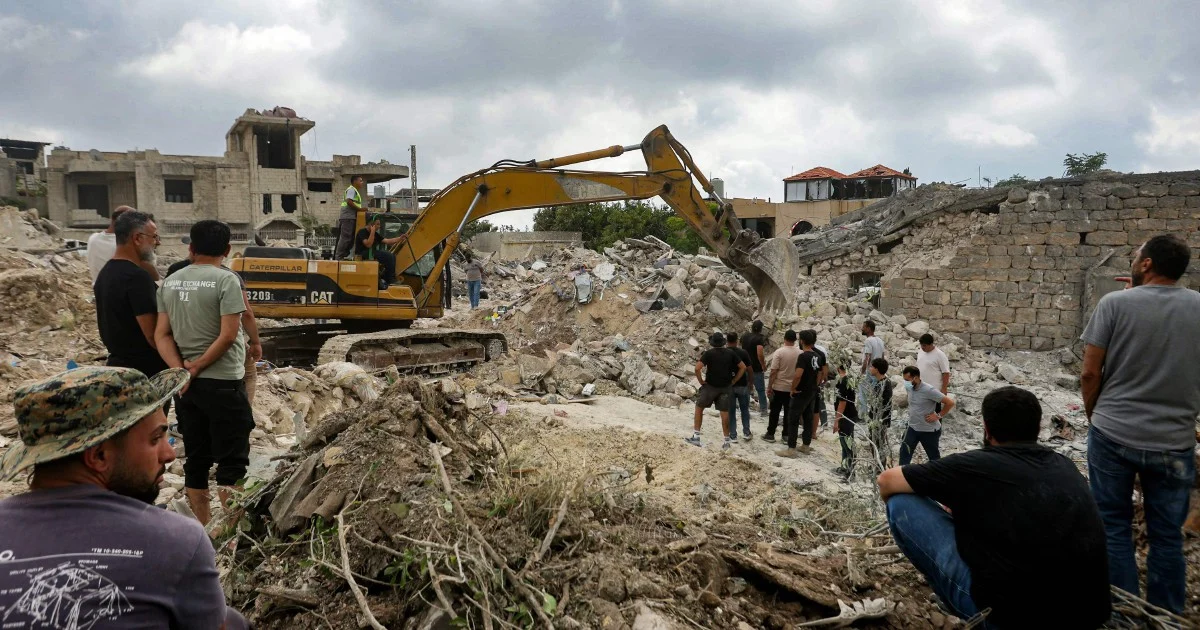
The Lebanese militant group Hizbollah moved to block any prospect of a permanent Israeli military foothold in southern Lebanon on Sunday, with party chief Naim Qassem flatly rejecting proposals for what Israel has termed a security zone. His statement came in direct response to Israeli Prime Minister Benjamin Netanyahu's recent declaration that his country's troops would maintain their presence south of the Litani River for an indefinite period, contingent only on Israel's own security assessments.
Qassem's rejection underscores the deepening impasse between Hizbollah and Israel over the terms of any ceasefire or long-term settlement in the border region. For years, southern Lebanon has remained a flashpoint between the two adversaries, with the area serving as a strategic buffer and a contested space where both parties claim legitimate security interests. The question of Israeli military deployments there now sits at the heart of negotiations between the warring sides, with international mediators struggling to broker an arrangement acceptable to all parties.
Israel's insistence on maintaining troops in southern Lebanon reflects broader strategic concerns about Hizbollah's military capabilities and its proximity to Israeli communities in the north. Israeli officials argue that a security zone under their control would prevent the re-armament of Hizbollah and eliminate threats to Israeli territory. From Tel Aviv's perspective, any withdrawal must be coupled with verifiable assurances that the group cannot reconstitute its weapons stockpiles or launch cross-border operations. Netanyahu's public commitment to keeping forces in place indefinitely, rather than adhering to a fixed timeline, signals Israel's determination not to exit under pressure or international deadlines.
For Hizbollah and its Lebanese government patrons, however, any long-term Israeli military presence represents an unacceptable violation of Lebanese sovereignty. The group views such zones as colonial-style occupation that fundamentally compromises Lebanon's territorial integrity and national dignity. Qassem's rejection is thus both a matter of principle and a rallying point for nationalist sentiment in Lebanon, where resentment of foreign military presence runs deep across much of the political spectrum. The Lebanese state itself has consistently opposed Israeli forces on its soil, viewing their presence as incompatible with Lebanon's independence.
The standoff carries significant implications for Malaysia and the broader Southeast Asian region. Lebanon's instability and the perpetuation of Israeli-Hizbollah tensions risk creating a protracted humanitarian crisis that could destabilize the eastern Mediterranean and trigger wider regional conflict. Malaysia, as a Muslim-majority nation with historic ties to Palestinian and Arab causes, maintains close diplomatic relations with several actors in the region and has long advocated for peaceful resolution of Middle Eastern disputes. Any escalation could reshape regional alliances and complicate Malaysia's balancing act between its non-aligned foreign policy and its strategic partnerships.
The security zone proposal also raises complex questions about what international observers and neutral parties might accept. The United Nations has historically played a role in monitoring the Lebanon-Israel border, particularly through UNIFIL, the UN Interim Force in Lebanon. However, strengthening UN mechanisms to verify compliance with any agreement on security arrangements remains contested. Hizbollah and its allies question whether international monitors could genuinely prevent Israeli military action or enforce mutual restraint, while Israel expresses skepticism that external oversight would adequately protect its citizens from Hizbollah attacks launched from Lebanese territory.
Negotiations over southern Lebanon occur within the broader context of Middle Eastern geopolitics. Iran, Hizbollah's primary patron and weapons supplier, has its own stake in any settlement. Regional powers including Saudi Arabia, the United Arab Emirates, and others have varying interests in how the Israel-Lebanon situation resolves. Syria, Hizbollah's geographic and strategic ally, has likewise been watching developments carefully. For smaller nations like Malaysia that seek to maintain balanced relations across the region, these competing interests create diplomatic complexity. Any settlement must thread the needle between Israeli security demands and Lebanese sovereignty, a task that has eluded negotiators for decades.
The economic dimensions of Lebanon's crisis further complicate the standoff. Lebanon faces severe economic collapse, with its currency having lost most of its value and widespread poverty affecting millions of citizens. A prolonged Israeli military presence in the south would hamper reconstruction efforts and economic recovery in the region's already devastated areas. This economic suffering fuels popular resentment and makes compromise politically difficult for Lebanese leaders who must answer to their constituents. Conversely, Israel argues that security guarantees must precede any regional development, creating a chicken-and-egg dilemma that international mediators struggle to overcome.
Civil society voices in both Lebanon and Israel have occasionally called for creative solutions that might balance legitimate security concerns with respect for borders and sovereignty. Some proposals involve enhanced international verification mechanisms, demilitarization agreements with concrete timelines, and economic incentives tied to security compliance. Yet such compromises gain little traction when hardliners on both sides dominate the narrative and maintain veto power over negotiations. Hizbollah's categorical rejection of any Israeli security zone suggests that this particular moment offers little room for middle-ground solutions.
As the standoff persists, the humanitarian toll continues to mount. Civilians on both sides of the border live with uncertainty, restricted movement, and the constant threat of renewed violence. Entire communities remain displaced, livelihoods remain disrupted, and education and healthcare systems struggle to function. For the international community, including Southeast Asian nations concerned with global stability, the situation serves as a reminder of how unresolved territorial and security disputes can fester indefinitely, preventing peace and prosperity for generations.
Moving forward, any breakthrough will likely require either a significant shift in positions by one or both parties, or an external catalytic event that forces renegotiation. Qassem's firm rejection on Sunday suggests Hizbollah shows no sign of budging on the sovereignty question. Netanyahu's equally firm commitment to maintaining troops indefinitely indicates Israel will not abandon its security demands. Until one side finds reason to recalibrate its priorities, the impasse appears set to define the Lebanon-Israel border for the foreseeable future, with ripple effects felt across the region and beyond.
%22%2F%3E%3C%2Fpattern%3E%3C%2Fdefs%3E%3Crect%20width%3D%22100%25%22%20height%3D%22100%25%22%20fill%3D%22url(%23ph19gl2g)%22%2F%3E%3Crect%20width%3D%22100%25%22%20height%3D%22100%25%22%20fill%3D%22url(%23ph19gl2p)%22%2F%3E%3Ctext%20x%3D%2250%25%22%20y%3D%2250%25%22%20text-anchor%3D%22middle%22%20dominant-baseline%3D%22central%22%20fill%3D%22rgba(255%2C255%2C255%2C0.95)%22%20font-family%3D%22Georgia%2C%20'Times%20New%20Roman'%2C%20serif%22%20font-weight%3D%22700%22%20font-size%3D%22151%22%20letter-spacing%3D%22-0.02em%22%3EMuhyiddin%3C%2Ftext%3E%3C%2Fsvg%3E)
%22%2F%3E%3C%2Fpattern%3E%3C%2Fdefs%3E%3Crect%20width%3D%22100%25%22%20height%3D%22100%25%22%20fill%3D%22url(%23ph1zf89g)%22%2F%3E%3Crect%20width%3D%22100%25%22%20height%3D%22100%25%22%20fill%3D%22url(%23ph1zf89p)%22%2F%3E%3Ctext%20x%3D%2250%25%22%20y%3D%2250%25%22%20text-anchor%3D%22middle%22%20dominant-baseline%3D%22central%22%20fill%3D%22rgba(255%2C255%2C255%2C0.95)%22%20font-family%3D%22Georgia%2C%20'Times%20New%20Roman'%2C%20serif%22%20font-weight%3D%22700%22%20font-size%3D%22320%22%20letter-spacing%3D%22-0.02em%22%3EKing%3C%2Ftext%3E%3C%2Fsvg%3E)