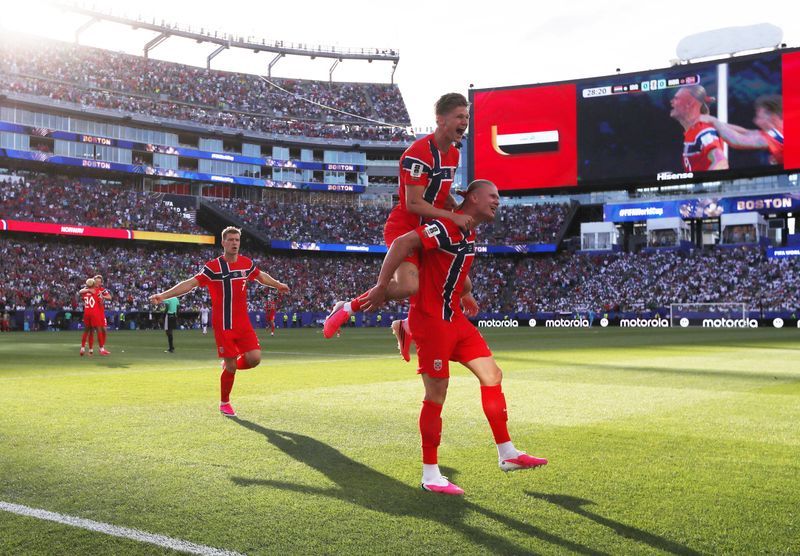
Erling Haaland wasted little time in making his mark on football's grandest stage, bagging a brace in Norway's crushing 4-1 victory over Iraq on Tuesday and delivering exactly the statement his nation needed from its marquee striker. The performance represented a commanding entrance to the World Cup for both player and country, though it also exposed vulnerabilities in the Scandinavian side's overall structure that could prove costly against stronger opposition in the knockout rounds.
The 23-year-old's opening-half explosion means he has now etched his name into the record books by scoring on his debut across four of Europe's most prestigious competitions: the German Bundesliga, English Premier League, Champions League, and the World Cup finals itself. Such consistency at the highest levels underscores not merely his individual talent but his psychological resilience and instinct for the moment—qualities that define truly elite strikers. For Norwegian supporters starved of World Cup football for nearly three decades, Haaland's immediate impact provided an emotional release and validation of the faith placed in a generational talent.
Yet beneath the scoreline lay a more complicated narrative. Norway's overall control of the match proved sporadic and imprecise, characterised by loose passing sequences and a failure to build sustained attacking momentum beyond Haaland's contributions. The team gifted Iraq several dangerous openings through poor defensive awareness and midfield carelessness, and were duly punished when Aymen Hussein equalised with a strike that caught the Norwegian rearguard ball-watching. Captain and playmaker Martin Odegaard, tasked with orchestrating the side's attacking flow, delivered a surprisingly muted display that limited Norway's ability to establish the domination their talent suggested they should achieve.
Haaland's first strike epitomised clinical finishing—a textbook poacher's conversion from David Moller Wolfe's precision delivery across the six-yard box—while his second showcased the pressing intensity and opportunism that defines his game. After forcing a weak Iraqi back-pass through aggressive closing, Haaland's block of the goalkeeper's clearance attempt ricocheted into the net, a goal that combined tactical awareness with the kind of fortune that often favours the aggressive and prepared. These moments encapsulate why Norwegian coach Stale Solbakken's tactical approach fundamentally revolves around positioning Haaland advantageously and trusting his exceptional conversion rate to unlock matches.
The strategic philosophy had been reinforced a day earlier when Norwegian Prime Minister Jonas Gahr Stoere made the observation that whilst individual brilliance scores goals, collective teamwork wins tournaments. The statement carried obvious truth but also implicit pressure: Norway's hopes rest almost entirely on Haaland's shoulders, a concentration of expectation that leaves little margin for error. When Odegaard or other midfield creators underperform, there exists no secondary attacking dimension capable of maintaining intensity or creating alternative goalscoring pathways. This structural imbalance proved manageable against Iraq's limited defensive infrastructure but will present serious challenges against elite sides.
Norway's return to the World Cup finals after a 28-year drought carries immense emotional significance within Scandinavian football culture, and the victory provided an immediate tonic to supporters who remembered the nation's last World Cup appearance in 1998. The three-point haul positioned Norway temporarily atop their group, ahead of France, who simultaneously defeated Senegal 3-1, though goal difference separated the nations and subsequent fixtures would likely shuffle the standings. Yet Haaland himself provided sober perspective on the performance, acknowledging in the post-match celebration that his side would require substantially improved execution to progress further in a tournament populated by significantly stronger attacking units.
For Malaysian and broader Southeast Asian observers, Norway's performance holds particular relevance as a case study in how nations with limited playing depth must construct cohesion around singular superstars. The Asian game has frequently grappled with similar challenges, where one or two exceptional players carry disproportionate responsibility for national team success, often with mixed results when tournament football demands consistent collective performance. Norway's early stumbles against a relatively modest opponent suggest that even European nations must navigate the delicate balance between empowering star talent and building defensive and midfield structures resilient enough to weather unfavourable circumstances.
Haaland's emergence as an immediate World Cup force also reflects the modern economics of football, wherein elite strikers are developed through carefully calibrated European club experiences before shouldering national team burdens. His pathway through Salzburg and Borussia Dortmund provided technical refinement and competitive exposure that prepared him for international football at the highest level. Few players of equivalent age possess similar credentials across multiple elite European leagues, explaining why Norwegian expectations centre so intensely upon his performance and why his early goal contributions carry outsized strategic importance to his country's tournament prospects.
The wider Norwegian camp, reputedly reserved and media-averse, found in Haaland a player willing to engage in post-match reflection despite his general preference for allowing his goalscoring to dominate discourse. His grin when noting he hoped Norwegians back home were celebrating captured the joy that underpins this unexpected tournament participation, a sentiment transcending sport and touching upon national identity and sporting pride. The psychological boost from an opening victory—particularly one delivered so emphatically through a talismanic figure—typically strengthens team confidence and supporter enthusiasm, momentum-building factors that could prove decisive in knockout competition.
Looking ahead, Norway faces the dual challenge of maintaining Haaland's goal-scoring momentum whilst tightening defensive and midfield discipline to genuinely compete with tournament favourites. The opening fixture delivered the required three points but also revealed concerning gaps that stronger opponents will ruthlessly exploit. Haaland's announcement to the World Cup stage was emphatic and genuine, yet sustaining such standards across multiple matches against progressively difficult opposition presents an entirely different proposition—one that will define whether his early brilliance translates into deeper tournament success or becomes another cautionary tale of individual excellence outrunning collective capability.

