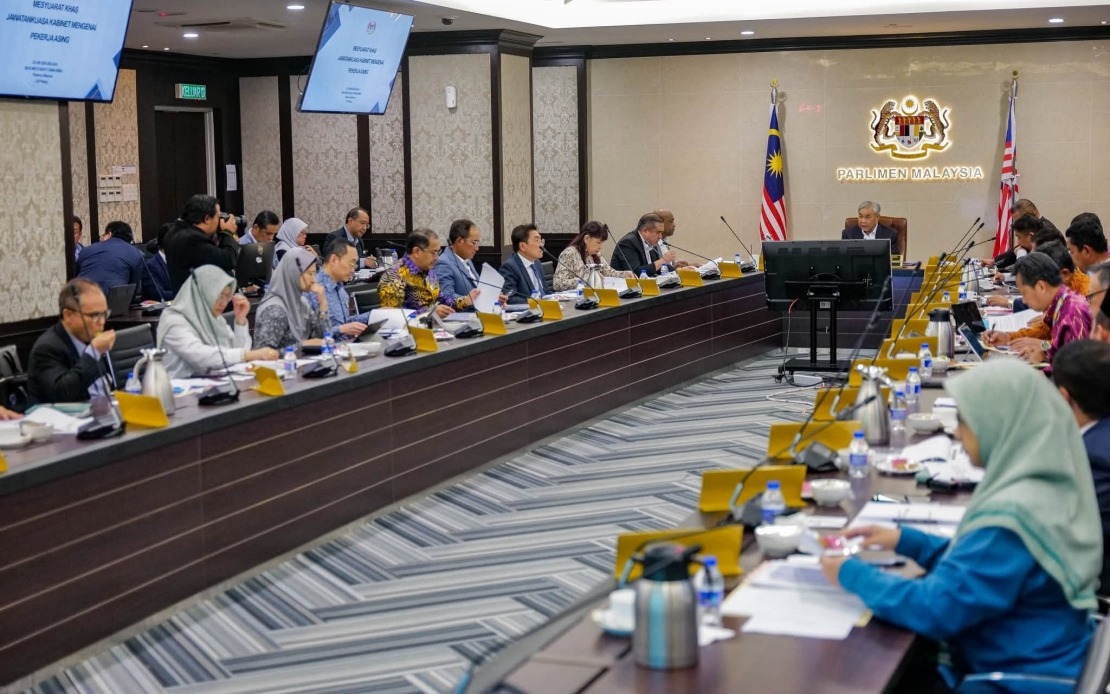
The Malaysian government has committed to a comprehensive restructuring of its foreign worker management apparatus, with Deputy Prime Minister Datuk Seri Dr Ahmad Zahid Hamidi announcing the initiative following a special Cabinet Committee meeting held at Parliament. The overhaul represents a significant policy shift aimed at creating a more streamlined, transparent and responsive system for managing the country's foreign workforce, which has become increasingly complex as Malaysia balances economic growth with domestic employment protection.
The restructuring framework, endorsed at the Cabinet Committee on Foreign Workers meeting chaired by Ahmad Zahid, addresses longstanding concerns about the fragmentation and inefficiency that has plagued the existing system. Multiple government agencies have historically operated with overlapping jurisdictions and inconsistent standards, creating bottlenecks for employers seeking to hire foreign talent while simultaneously complicating enforcement efforts against illegal workers and unscrupulous labour practices. The new approach seeks to consolidate these disparate functions into a more unified structure that can respond more nimbly to changing economic conditions and industry demands.
A centrepiece of the restructuring initiative involves repositioning the One Stop Centre for Foreign Worker Management under the supervision of the Ministry of Human Resources. This administrative realignment is intended to strengthen coordination between labour market policy and workforce management operations, ensuring that foreign worker recruitment decisions are informed by broader human capital development strategies. The placement under the Human Resources Ministry also signals an intention to shift the narrative around foreign workers from a security or compliance issue toward one of sustainable labour market integration.
Ahmad Zahid articulated the underlying philosophy driving these reforms, emphasizing that the government aims to create a foreign worker management system characterised by efficiency, integrity and responsiveness to genuine industry needs. The administration recognises that Malaysia's position as a regional manufacturing and services hub requires access to specialised skills and labour that the domestic workforce cannot always supply in sufficient quantities or with the necessary expertise. However, this economic necessity must be balanced against the imperative to protect Malaysian workers from displacement and to ensure that foreign labour complements rather than substitutes for local employment.
The government intends to adopt a more strategic approach to assessing foreign labour requirements across different sectors and regions. Rather than relying on standardised quotas or historical precedents, future labour import policies will be grounded in rigorous analysis of actual skill gaps and workforce shortages within specific industries. This data-driven methodology should reduce the risk of over-reliance on foreign workers in sectors where automation or local workforce development could address labour needs, while ensuring that critical labour shortages in essential services and emerging industries are adequately addressed.
Parallel to the restructuring effort, the government has reaffirmed its commitment to reducing Malaysia's structural dependence on migrant labour through a multi-pronged strategy. This includes efforts to boost the participation and retention of Malaysian workers in the formal labour market, particularly among younger cohorts who may have better educational qualifications than previous generations. Investment in technical and vocational training is intended to create a more skilled domestic workforce capable of competing for higher-value employment opportunities, particularly in sectors undergoing technological transformation.
The acceleration of industrial automation represents another critical element of the government's broader strategy to recalibrate the foreign worker landscape. By facilitating the adoption of robotics and artificial intelligence across manufacturing, construction and other labour-intensive sectors, Malaysia can theoretically reduce its reliance on migrant workers while simultaneously improving productivity and competitiveness. However, this transition requires significant capital investment and workforce retraining programmes to ensure that displaced workers can transition to new roles in the digital economy.
For Malaysian readers and regional observers, these policy developments carry important implications. The restructuring could improve the business environment by reducing bureaucratic friction in the foreign worker hiring process, potentially benefiting labour-intensive industries such as manufacturing, construction and hospitality that have struggled with compliance costs and unpredictability. Conversely, stricter oversight and more transparent allocation mechanisms could limit the informal hiring practices that have characterised some sectors, particularly domestic service and small-scale agriculture.
The emphasis on protecting local employment opportunities and developing the domestic workforce reflects broader political and social pressures that have intensified across Southeast Asia. Public concern about wage depression, job competition and the social costs of rapid labour migration has prompted governments throughout the region to recalibrate their foreign worker policies. Malaysia's approach, which seeks to maintain economic dynamism while safeguarding worker protections, represents an effort to navigate this delicate political and economic terrain.
The success of these reforms will ultimately depend on implementation quality and the willingness of both government agencies and private employers to embrace more rigorous standards. Creating genuinely coordinated management requires not merely structural reorganisation but also a change in institutional culture and incentives. The government will need to invest in capacity-building for the revamped system while ensuring that enforcement mechanisms are sufficiently robust to prevent manipulation or evasion of the new requirements.
Looking forward, Ahmad Zahid's assertion that all government measures will be guided by national interests and public welfare suggests an intention to elevate the foreign worker issue beyond narrow sectoral lobbying toward broader consideration of societal impacts. This framing acknowledges that the foreign worker question extends beyond economics to encompass social cohesion, public services, housing and community stability in areas with high migrant concentrations.

