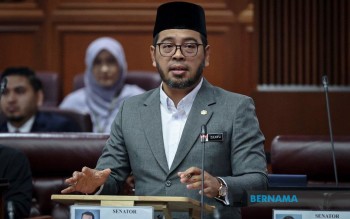
The Malaysian government has committed a rescue package exceeding RM10 billion to stabilise Lembaga Tabung Haji (TH), the country's pilgrim fund management body, following years of financial deterioration caused by internal mismanagement and fraudulent activities. The intervention, disclosed during a special sitting of the Dewan Rakyat, represents a critical government response to an institution that had slipped into insolvency and threatened the life savings of hundreds of thousands of Malaysian Muslims.
Dr Zulkifli Hasan, the Minister in the Prime Minister's Department overseeing Religious Affairs, clarified that the intervention's purpose centres on restoring TH's operational viability and financial stability rather than acquiring its assets for government benefit. This distinction proves essential in addressing public concern about state control over Islamic institutions and the potential commodification of Muslim pilgrim savings. The government's primary objective remains enabling TH to function sustainably over the long term, protecting the accumulated funds of intending hajj pilgrims across Malaysia.
The minister took particular care to dismiss circulating allegations that TH's assets had been transferred to non-Muslim entities or Chinese-controlled companies, characterising such claims as inflammatory misinformation designed to fuel communal tensions. These false narratives, promoted by certain quarters seeking to exploit religious sensitivities for political gain, contradicted the actual ownership structure of divested assets. The assets in question remain under the control of Urusharta Jamaah, a wholly-owned subsidiary of the Minister of Finance Incorporated, maintaining them within the government's Islamic institutional framework.
The underlying crisis that necessitated intervention had reached critical proportions by the final quarter of 2018. TH faced a deficit gap between its liabilities and assets that had ballooned to more than RM10 billion, a shortfall that left the institution technically insolvent and incapable of meeting its obligations to depositors. The compressed timeline—with merely three months to devise and implement a rescue solution—left authorities with limited options beyond immediate government intervention to prevent catastrophic fund collapse and widespread financial loss for pilgrims.
This insolvency represented the culmination of systematic failures within TH's management structures and governance systems. Embezzlement schemes and widespread mismanagement had eroded the institution's financial position over an extended period, reducing its capacity to generate returns on pilgrim deposits while draining resources through fraudulent schemes. The depth of these problems necessitated not merely financial injection but comprehensive restructuring to prevent recurrence and restore institutional integrity.
The Royal Commission of Inquiry into TH's affairs, whose findings prompted parliamentary discussion of the rescue plan, documented the extent of internal dysfunction that had developed unchecked. The commission's investigation identified governance lapses, inadequate oversight mechanisms, and fraudulent activities that collectively undermined TH's financial foundation. The briefing session presented both the RCI's findings and the government's remedial strategy, providing parliament with comprehensive perspective on the institution's predicament and proposed recovery pathway.
For Malaysian pilgrims, many of whom had accumulated substantial sums within TH over decades, the government intervention carries both immediate reassurance and long-term significance. The bailout ensures that deposited funds remain secure rather than evaporating through institutional collapse, while the restructuring initiative aims to restore TH's capacity to facilitate hajj pilgrimages and preserve the accumulated savings of millions of Malaysian Muslims. This protection extends across income levels and regions, as TH serves as the primary savings vehicle for ordinary Malaysians aspiring to undertake the Islamic pilgrimage.
The Pakatan Harapan government's decision to deploy such substantial resources reflects acknowledgment of TH's systemic importance within Malaysia's Islamic institutional ecosystem and broader social fabric. The institution functions beyond merely financial services; it embodies trust placed by the Muslim community in state-managed Islamic instruments. Allowing TH to collapse would have constituted not merely an economic loss but a profound breach of fiduciary responsibility toward Malaysian Muslims.
The restructuring approach selected by government authorities emphasises restoration rather than consolidation, indicating that intervention targets institutional rehabilitation rather than expansion of state control or asset acquisition. This distinction proves politically and socially important in contexts where Muslim communities harbour sensitivities regarding state stewardship of Islamic institutions and communal resources. By framing the bailout explicitly as financial rescue rather than takeover, government communication aims to maintain community confidence in state commitment to protecting Islamic institutional interests.
The resolution of TH's crisis carries broader implications for governance standards within Malaysia's Islamic finance sector and state-linked institutions generally. The severity of problems that accumulated undetected until insolvency threatened highlights critical deficiencies in oversight, internal audit, and accountability mechanisms that presumably govern similar entities. Future reforms addressing TH's restructuring will likely encompass enhanced governance frameworks, strengthened regulatory oversight, and more rigorous management accountability standards applicable across comparable institutions.
Regional observers note that Malaysia's experience with TH mirrors challenges confronting Islamic finance institutions across Southeast Asia where rapid growth, insufficient regulatory frameworks, and governance weaknesses have periodically created vulnerabilities. The Malaysian government's intervention demonstrates state willingness to deploy resources protecting community-held Islamic funds, while simultaneously raising questions about preventative governance mechanisms that might obviate future crises requiring such substantial bailouts.
Moving forward, TH's recovery trajectory will require sustained management discipline, reformed governance structures, and restored depositor confidence. The RM10 billion investment represents merely the financial component of institutional rehabilitation; successful restoration demands cultural and operational transformation within the organisation to prevent recurrence of mismanagement and fraud that previously characterised its operations. Pilgrims entrusting funds to TH will assess recovery success through the institution's ability to generate competitive returns while maintaining transparent, accountable stewardship of their hajj savings.

