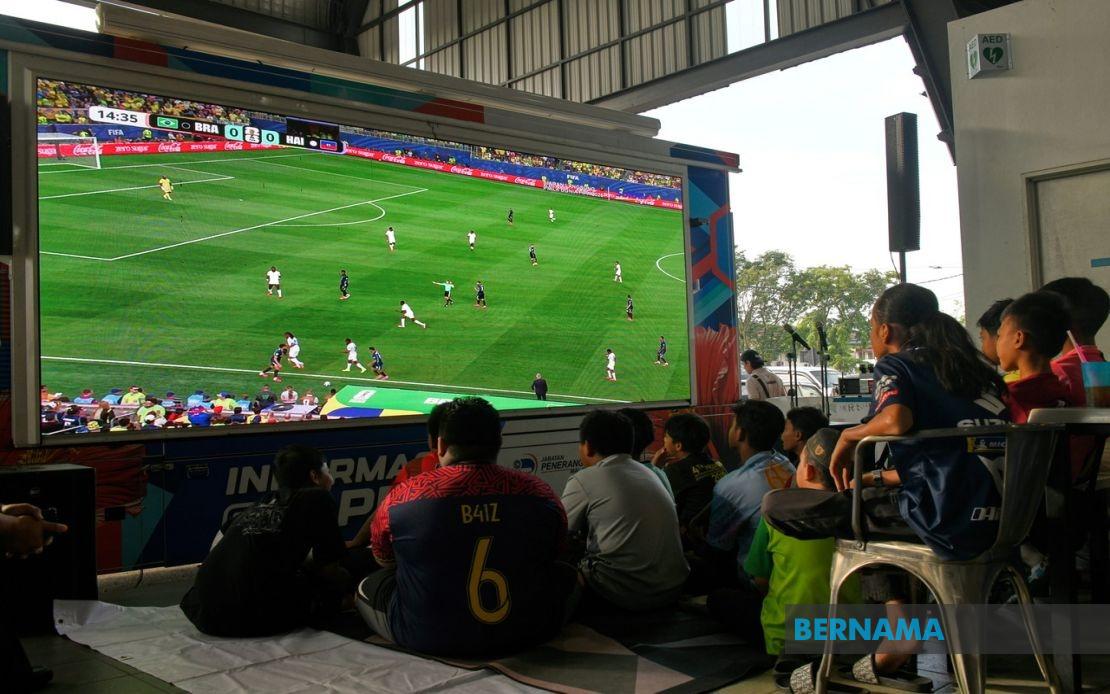
Communications Minister Datuk Fahmi Fadzil has highlighted the positive reception of the government's move to provide free 2026 FIFA World Cup broadcasts through Radio Televisyen Malaysia and Unifi TV, signalling the initiative's tangible impact on business operators and ordinary Malaysians grappling with cost pressures. The minister made his remarks after engaging directly with traders and patrons at the Seberang Jaya Public Market in Butterworth, where he observed the opening moments of a Brazil versus Haiti match and gathered ground-level insights into prevailing economic conditions.
The decision to make World Cup matches freely accessible represents a deliberate policy choice with cascading benefits across the hospitality sector. Restaurant and food establishment owners have reported meaningful savings by eliminating the substantial licensing fees typically required to screen live sporting events to patrons. The Malaysian Muslim Restaurant Owners Association, which communicated feedback directly to the minister, characterised the broadcasting arrangement as generating considerable financial relief—a development that carries particular weight given ongoing pressure on operating margins throughout Malaysia's food and beverage landscape.
One trader shared a poignant observation with Fahmi, noting that two decades had elapsed since he last enjoyed the privilege of watching World Cup fixtures without incurring broadcast licensing costs. This testimony underscores how mounting commercial burdens have squeezed even small business operators, forcing difficult choices about which entertainment offerings they could sustain. The return to free public access therefore represents more than a courtesy; it acknowledges the sector's vulnerability to cumulative expense increases and provides temporary relief during a major sporting event expected to draw significant customer traffic.
The government has structured its broadcast strategy across multiple accessible platforms, including RTM's traditional television channel, the RTMKlik online service, and Unifi TV's streaming infrastructure. This multi-platform approach maximises reach across different demographic groups and consumption preferences, from households relying on conventional broadcasts to younger audiences accessing content via digital channels. The redundancy built into this arrangement ensures that technical limitations at any single platform do not exclude segments of the population from participation in the global sporting spectacle.
Beyond the immediate cost savings, the initiative carries strategic implications for the food and beverage sector's ability to attract and retain customer traffic during the tournament. World Cup events traditionally drive considerable foot traffic to hospitality venues, as fans gather to experience matches in communal settings. By eliminating a significant cost barrier, the government has implicitly encouraged food businesses to capitalise on this phenomenon, potentially translating improved customer volume into revenue that might otherwise have been dissipated in licensing fees. This creates a virtuous cycle wherein lower operational burdens enable more competitive pricing or enhanced service offerings, further incentivising patron visits.
Fahmi's decision to immerse himself in ground conditions at the Seberang Jaya Public Market reflected a broader administrative philosophy emphasising direct engagement with affected communities. Beyond observing match broadcasts, the minister undertook a methodical survey of trader conditions, documenting the multifaceted challenges confronting small business operators. His recognition that ministers, parliamentarians, and state representatives should routinely conduct such ground-level assessments suggests a frustration with governance disconnected from lived experience—an implicit acknowledgment that policy effectiveness depends upon authentic understanding of implementation realities.
The economic pressures documented during the minister's market visit extend well beyond World Cup licensing arrangements. Rising costs in critical commodity categories, substantially driven by geopolitical turbulence in West Asia, have created a persistent headwind for Malaysian traders and households alike. The conflict's economic tentacles reach into Malaysia's supply chains, inflating prices for imported goods and raw materials essential to food preparation and retail operations. In this context, the government's broadcasting initiative, while modest in absolute terms, carries symbolic weight as a concrete demonstration of policy responsiveness to documented hardship.
The connection between international geopolitical instability and domestic economic strain deserves particular emphasis for Malaysian audiences. Unlike larger economies with diversified sourcing networks and substantial strategic reserves, Malaysia remains vulnerable to supply chain disruptions and commodity price volatility. When conflicts abroad disrupt transportation routes or constrain resource availability, Malaysian traders—who operate on comparatively thin profit margins—experience disproportionate pressure. The minister's explicit acknowledgment of West Asia's cost-of-living implications suggests governmental recognition that localised policy interventions, while valuable, cannot fully insulate the economy from external shocks.
Fahmi's commitment to convey trader feedback to Prime Minister Datuk Seri Anwar Ibrahim and Penang Chief Minister Chow Kon Yeow indicates that the market visit was not merely ceremonial. The structured documentation of grievances and requested assistance suggests that documented trader input will influence policy formulation at both federal and state administrative levels. For the food and beverage sector, which has repeatedly cited operational challenges during the post-pandemic recovery period, this represents a potential mechanism for securing targeted government support beyond one-off broadcasting concessions.
The World Cup broadcasting initiative ultimately illustrates how strategic government intervention can address market imperfections and accessibility barriers without substantial direct expenditure. By leveraging existing public broadcasting infrastructure and commercial partnerships, the government has delivered tangible benefits to identifiable constituencies—food business operators and sports enthusiasts—whilst simultaneously advancing broader economic objectives. The arrangement also demonstrates sensitivity to sectoral vulnerabilities and willingness to modify arrangements when direct engagement reveals genuine hardship.
Looking forward, the success of this initiative may establish precedent for similar interventions around future major sporting events. If the free broadcasting model produces the anticipated benefits—strengthened food sector performance and expanded public participation in major sporting events—policymakers may be encouraged to institutionalise comparable arrangements for subsequent tournaments. This would represent a meaningful shift toward treating major sporting events as public goods rather than purely commercial properties subject entirely to market licensing mechanisms.
For Malaysian households and small business operators, the World Cup broadcasting arrangement offers immediate practical relief during a period of accumulated economic strain. Beyond the specific cost savings, the initiative signals governmental attentiveness to ground-level challenges and willingness to mobilise existing resources toward alleviating identified hardships. Whether this translates into sustained economic improvement for traders and households will depend upon complementary policy interventions addressing the deeper structural cost pressures—particularly those emanating from international supply chain disruptions—that characterise Malaysia's current economic environment.

