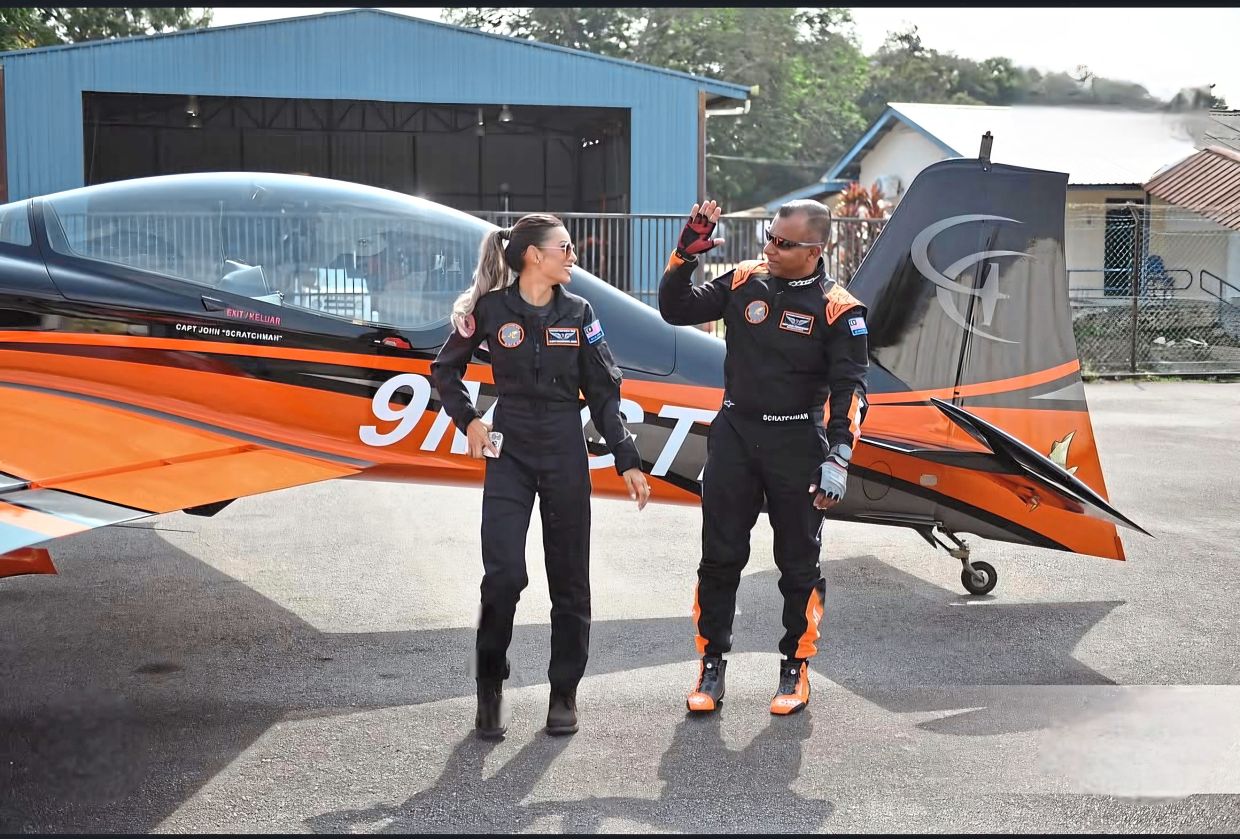
The cockpit runs in the blood of Samantha Laura John. At 26, she has just completed her training as a qualified pilot, graduating from flight school in Ipoh in 2025—a milestone that represents far more than a professional achievement. It marks the continuation of a family tradition rooted in service, discipline, and an unwavering fascination with flight that spans generations. Her father, Lieutenant-Colonel (retired) John Sham Alagarsamy, 54, spent 26 years as a Royal Malaysian Air Force fighter pilot before transitioning to the commercial aviation sector in 2019, and now leads training operations at a flying school in Ipoh. For Samantha, following this path was never simply about replicating her father's career—it was about understanding the values that defined his life and the world he inhabited.
Growing up, Samantha witnessed firsthand the demands and rewards of aviation service. Her childhood memories are woven through military postings across Malaysia, from Labuan and Kuantan to Alor Setar and Butterworth in Penang, often before she had even begun primary school. Rather than viewing these frequent relocations as mere displacement, she describes them as formative experiences that cultivated discipline and resilience. Living on air force bases exposed her to an environment where purpose was tangible and responsibility was paramount. "I saw firsthand the responsibility RMAF pilots carry in safeguarding Malaysia's airspace and maritime borders," she reflects. This early exposure created a deep appreciation for her father's work and the broader mission of aviation beyond commercial enterprise.
John's influence extended beyond the professional realm. He has consistently emphasized to his children that ambition should be boundless. "I always told them that if they aim for the stars, at least they'd reach the sky. The bigger your dreams, the greater your success—you have to dream it before you achieve it," he explains. Yet he was also careful never to impose his own path onto his children. Rather, he created an environment where exploration was encouraged and decisions were respected. This balance between inspiration and autonomy appears to have been crucial in Samantha's journey. When she completed her IGCSE qualifications, she chose to enroll in a two-year cadet pilot programme with an airline in Sepang, Selangor, in 2018, testing her resolve and genuine interest in the profession.
The cadet programme proved rewarding yet ultimately revelatory. Despite the positive experience, Samantha recognized that the role did not fully satisfy her deepest aspirations. Rather than accept this as failure, she reframed it as clarification. "Sure, I tried a different path, but deep down, I always knew I would come back to aviation," she says with characteristic candor. This realization prompted her to pursue formal pilot training, which culminated in her graduation in 2025. Her willingness to explore alternatives before committing fully to aviation suggests a maturity beyond her years—a quality perhaps inherited from a father who himself successfully navigated a career transition from military to civilian aviation.
The broader context of female representation in Malaysian aviation adds another dimension to Samantha's achievement. When she was younger, female pilots remained relatively uncommon in Malaysia, particularly within military contexts. Rather than discouraging her, this rarity solidified her determination. She recognized an opportunity to contribute to a field where women's participation continues to expand but remains notable. Her success comes at a time when the aviation industry across Southeast Asia is actively working to diversify its pilot workforce, a trend that has significant implications for workforce sustainability and organizational culture in the region.
John's own trajectory embodies the dynamic nature of modern aviation careers. His 26-year tenure in the RMAF encompassed multiple roles—fighter pilot, instructor, and examiner—before he transitioned to civil aviation. Remarkably, he holds a distinction that reflects his exceptional skill: he is recognized by the Civil Aviation Authority of Malaysia as the country's first and only civil aviator certified for aerobatics. Over the years, he has graced major airshows, including the Langkawi International Maritime and Aerospace Exhibition (Lima), performing intricate aerobatic displays in the GB1 GameBird aircraft. These performances represent not merely technical competence but artistry—a dimension of aviation that Samantha has clearly inherited and appreciated.
What distinguishes John further is his multidimensional engagement with flight and performance. Beyond his aviation credentials, he is an accomplished musician and professional deejay operating under the moniker "Scratchman." In 1992, he won the Malaysian Open DJ Competition during the vinyl and turntablism era, demonstrating a creative energy that extends far beyond the technical world of aviation. This artistic dimension of his personality may explain how he has managed to maintain passion and engagement across such a long and varied career. For Samantha, this modeling of diverse interests has likely provided permission to pursue multiple endeavors simultaneously, as she currently balances event management in Kota Kinabalu with vocal coaching and her aspirations in commercial aviation.
Samantha's current situation illustrates the complex reality of modern career development, particularly in Malaysia. Although she holds a commercial pilot's license, she is based in Kota Kinabalu, where she runs an event management company alongside her husband, David Chong, 30. She has not yet fully integrated aviation into her primary professional identity. However, she articulates a clear intention to eventually transition back to commercial flying. This trajectory—where a licensed professional pursues alternative income sources while maintaining long-term aviation ambitions—reflects economic realities and the flexibility increasingly necessary in contemporary work environments. Her enthusiasm for flying remains undiminished. "Once you're in the cockpit, you have to be fully focused and aware of your surroundings. You're always looking ahead, thinking ahead, and staying situationally aware. It's almost like working in six dimensions," she describes, highlighting the cognitive and emotional demands of piloting.
Academic research from Universiti Teknologi Malaysia provides empirical support for what the John family exemplifies intuitively. A study titled "Parental Influence and Undergraduates' Career Choice Intentions" demonstrates that strong parent-child relationships, open communication, and mutual trust significantly influence career decisions by encouraging exploration and deliberate long-term planning. Samantha's journey validates these findings. Her parents consistently encouraged autonomous decision-making while providing a compelling example of purposeful work. The family's 2012 relocation to Canberra, when John pursued a master's degree in military and defence studies from the Australian National University while attached to the Australian Defence Force, further broadened Samantha's perspective. "It gave me a wider perspective about military cooperation and aviation systems. It was a very formative period for me," she notes. This international exposure during a critical developmental phase enriched her understanding of aviation beyond national contexts.
The John family's experience is not isolated within Malaysia's aviation community. Sisters Safia Amira Abu Bakar and Safia Anisa Abu Bakar followed their father Captain Abu Bakar Shafie into aviation, demonstrating that intergenerational career patterns in this sector are not uncommon. These examples reflect both the selective nature of aviation careers—requiring significant education, commitment, and opportunity—and the profound influence that parental role modeling exerts. When a parent operates at the highest levels of a technical profession, their children inherit not merely genetic predisposition but direct knowledge of expectations, challenges, and rewards.
What emerges from Samantha's narrative is a portrait of mentorship rooted in values rather than prescription. John's decoration with the Most Gallant Order of Military Service (Kesatria Angkatan Tentera) during his RMAF career marks official recognition of his contributions, yet he measures success differently now. "It is measured by the positive impact we leave on others, especially our children, who often learn more from what we do than what we say," he reflects. This philosophy has clearly resonated. Samantha speaks to her father with a respect that transcends the typical parent-child dynamic, grounded in admiration for his choices and accomplishments. The discipline and manners evident in her demeanor appear to be direct extensions of the environment he cultivated throughout her childhood.
As Samantha contemplates her future, she carries forward a legacy that is both aviation-specific and fundamentally about character. Whether she ultimately pursues full-time commercial flying or continues to blend aviation with other professional pursuits, she has already demonstrated the qualities that defined her father's career: commitment to growth, willingness to explore difficult paths, and respect for the profound responsibility that flying entails. For Malaysian families considering careers in aviation, and for young people navigating choices between parental influence and personal aspiration, the John family's journey offers reassurance that these need not be opposing forces. Instead, when grounded in genuine communication, respect, and shared values, parental influence can become a launching pad for individual achievement.

