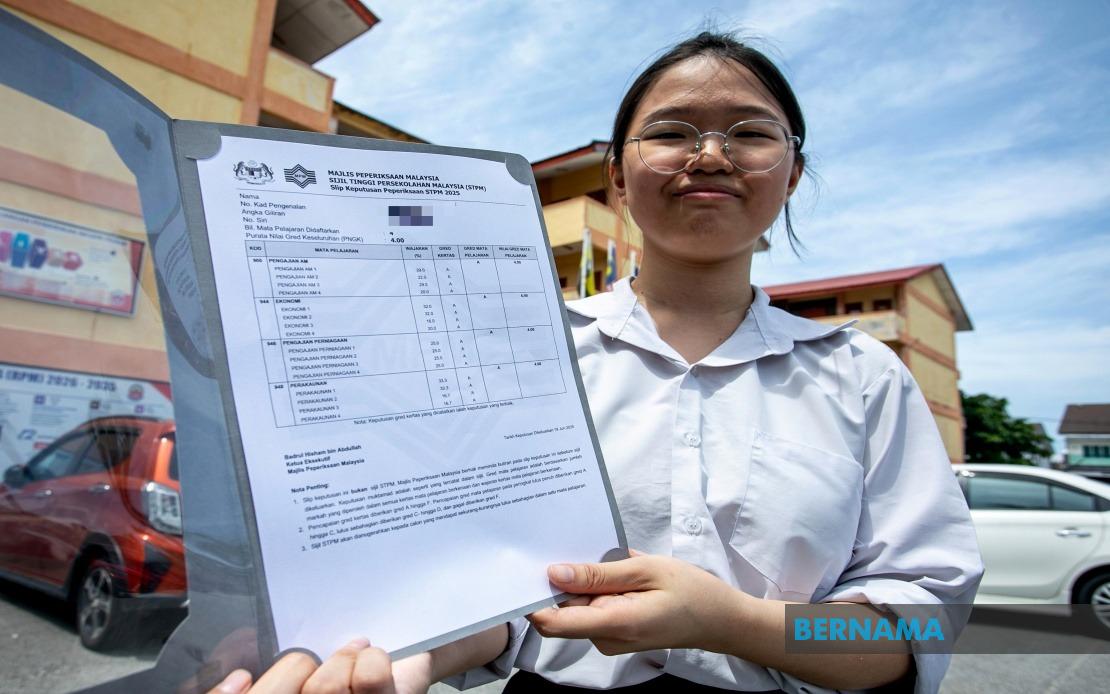
When Yong Xin Yi received her 2025 Sijil Tinggi Persekolahan Malaysia (STPM) results, the 20-year-old Sekolah Menengah Kebangsaan Jalan Tasek student had every reason to celebrate. Securing four As and a perfect Cumulative Grade Point Average of 4.00 marks an exceptional achievement in Malaysia's most demanding pre-university qualification. Yet behind this stellar outcome lay not sudden inspiration or innate genius, but rather a methodical commitment to structured revision that consumed five hours of her day, every single day, even as her peers pursued lighter schedules.
The architecture of her success reveals an instructive lesson for Malaysian secondary students navigating the competitive landscape of STPM. Xin Yi carved out her study window from 5:00 pm to 10:00 pm each evening, a disciplined block of uninterrupted focus that became non-negotiable in her weekly routine. Rather than treating revision as a frantic scramble approaching examination dates, she embedded consistent practice into the rhythm of her ordinary school year. This approach transformed learning from a cyclical crisis into a sustainable habit, allowing knowledge to accumulate gradually rather than requiring desperate last-minute cramming.
What distinguishes her methodology extends beyond the mere quantity of hours invested. Xin Yi deliberately prioritised attentive participation during classroom instruction, recognising that the foundation of genuine understanding must be laid during live teaching moments rather than reconstructed later from incomplete notes. By absorbing explanations directly from teachers, she reduced the cognitive burden of revision, which could then focus on reinforcement rather than deciphering muddled concepts. This integration of classroom attention with home study created a coherent learning ecosystem where each component reinforced the others.
Her completion of all assigned homework without exception demonstrates an often-overlooked principle in academic success: that structured practice through formal assessment tasks serves purposes beyond satisfying teacher requirements. Homework, when completed seriously, functions as a diagnostic tool revealing gaps in understanding before examinations arrive, while simultaneously cementing procedural knowledge through repetition. For Xin Yi, this obligation became an asset rather than a burden.
The Ipoh-born student confronted particular difficulty with General Studies, the STPM paper demanding sophisticated writing ability alongside command of content and alignment with specific marking criteria. Rather than allowing this weakness to fester, she deliberately allocated additional attention to the problematic subject, applying what education researchers call "deliberate practice" — focused effort on areas requiring improvement. This targeted intervention exemplifies how high-achieving students respond pragmatically to identified vulnerabilities rather than simply working harder across the board.
Her four A grades spanned General Studies, Principles of Accounting, Economics, and another subject, representing breadth across both humanities and vocational domains. This diversity suggests intellectual versatility and the capacity to navigate disparate disciplinary frameworks. Among SMK Jalan Tasek's cohort, only five students nationwide achieved this distinction, underlining both the rarity and prestige of her accomplishment.
Beyond the mechanics of study technique, Xin Yi attributes meaningful weight to psychological and emotional support systems. She consistently acknowledged her parents' encouragement as instrumental to her achievement, recognising that sustained motivation over the extended STPM preparation period requires external reinforcement, not merely internal discipline. Her mother's work as a clerk and father's employment in mobile phone sales represent modest professional positions, yet both parents invested emotional labour in supporting their only child's educational ambitions. This dynamic reflects a Malaysian family pattern where parental sacrifice across socioeconomic strata often proves decisive in student outcomes.
The student's articulated motivation — to improve her family's circumstances and honour parental sacrifices — reveals how academic achievement becomes entangled with broader family narratives and intergenerational aspiration. For many Malaysian students from non-professional household backgrounds, examination success represents not merely personal advancement but a vehicle for family mobility and the fulfilment of parental investment. This aspiration-driven framework can sustain effort through challenging periods when intrinsic academic motivation might otherwise flag.
Xin Yi's choice to pursue economics at Universiti Putra Malaysia reflects deliberate career planning informed by genuine interest assessment and labour market awareness. Having determined that the economic sector offers expanding career prospects, she aligned her subject selection and university choice with this objective. This purposefulness contrasts with the reactive approach some students adopt, where university selection follows examination results rather than preceding and shaping them. Her decision-making process demonstrates intellectual agency and forward planning.
The aspiration to become an economist suggests engagement with dynamic, evolving understanding of economic systems, policy, and analytical frameworks rather than narrow technical competence. Within Malaysia's increasingly complex economic landscape — spanning digital transformation, regional trade dynamics, and domestic fiscal challenges — economists occupy positions of genuine influence. Xin Yi's trajectory positions her to contribute meaningfully to these conversations.
For Malaysian educators and parents observing this case, several principles emerge. First, sustained daily effort distributed across extended preparation periods outperforms sporadic intensive work. Second, classroom engagement constitutes the foundation upon which revision builds rather than an optional preliminary. Third, targeted intervention on identified weaknesses produces greater returns than undirected increased effort. Fourth, family support systems exert measurable influence on student persistence. Finally, alignment between academic achievement and articulated career purpose amplifies motivation and purpose.
Xin Yi's achievement illustrates that excellence in STPM, while demanding, remains attainable through disciplined application of proven study methods combined with systematic classroom engagement and emotional support. Her systematic approach offers a replicable template for aspiring students across Malaysia navigating similar examination challenges.

