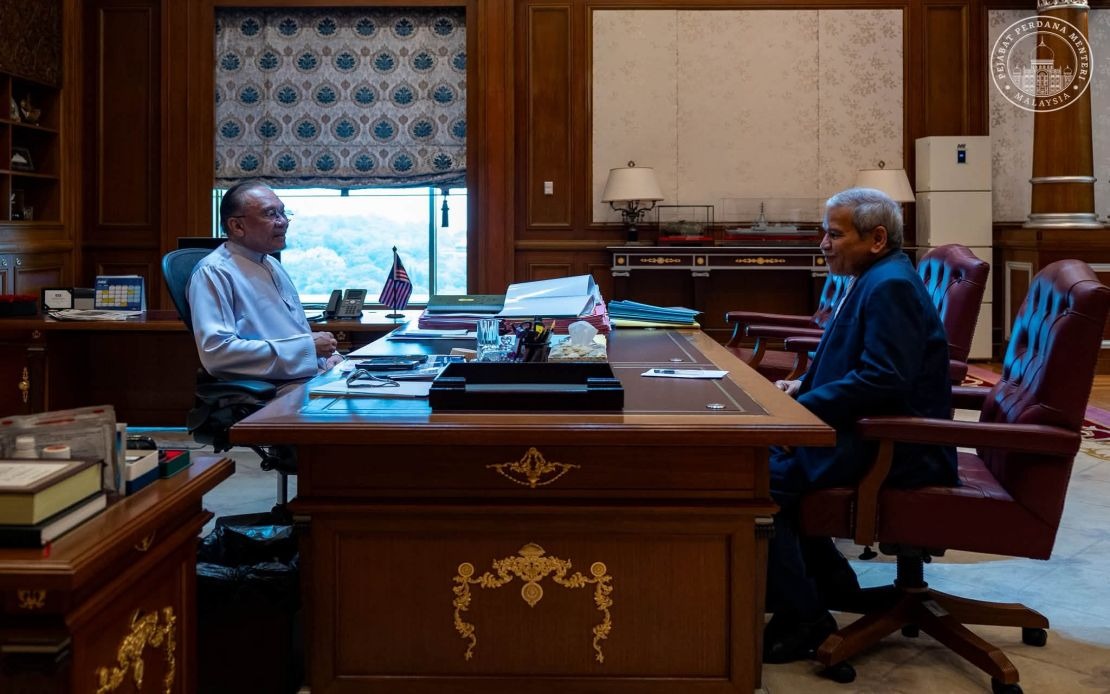
Prime Minister Datuk Seri Anwar Ibrahim has reaffirmed the government's commitment to bolstering the Federal Land Development Authority as a critical institution dedicated to improving the welfare and dignity of its settler communities. During a meeting with newly appointed FELDA chairman Tan Sri Ahmad Badri Mohd Zahir in Putrajaya, Anwar outlined the necessity for sustained institutional development that balances social support with economic modernisation.
The appointment of Tan Sri Ahmad Badri, effective July 15, marks a transition in FELDA's leadership following the completion of Datuk Seri Ahmad Shabery Cheek's term on June 30. As Prime Minister and Finance Minister, Anwar's emphasis on FELDA's role signals the administration's broader focus on land-based rural communities, which represent a significant constituency in Malaysia's political and economic landscape. The positioning of FELDA's strengthening as a priority reflects broader concerns within government about maintaining institutional relevance in a rapidly evolving economic environment.
Anwar's remarks underscore a dual mandate that FELDA must pursue simultaneously: safeguarding settler welfare while enhancing institutional competitiveness. This balancing act has long challenged FELDA, which manages over 350,000 hectares of land schemes across Malaysia and directly affects hundreds of thousands of settler families. The Prime Minister's explicit mention of generational welfare—particularly attention to younger settlers—indicates government recognition that FELDA's traditional model requires adaptation to address contemporary challenges facing the next generation of land scheme participants.
The economic sustainability dimension of Anwar's statement carries particular weight in Malaysia's current fiscal environment. FELDA has faced recurring challenges around commodity price volatility, particularly in palm oil—its primary revenue source—and questions about operational efficiency. By linking institutional strengthening to economic competitiveness, the government signals that sentiment alone cannot sustain FELDA; structural reforms and competitive positioning must accompany social commitments. This framing suggests that the new chairman's mandate extends beyond welfare administration to encompassing business transformation.
Generational issues represent an understudied but critical challenge for FELDA. Many original settlers are reaching retirement age, and questions persist about how effectively FELDA schemes accommodate younger participants seeking alternative livelihoods or investment returns. Government acknowledgment of this gap through Anwar's remarks indicates that policy discussions are advancing beyond traditional settler support models. The reference to addressing younger generation concerns hints at potential policy evolution around land utilisation, income diversification, and skill development programs.
Anwar's confidence in Tan Sri Ahmad Badri's ability to execute the restoration agenda reflects considered leadership selection. The new chairman inherits an institution requiring careful navigation of political expectations, settler aspirations, and commercial realities. The Prime Minister's public endorsement carries weight in signalling stability and continuity during leadership transition, though it also establishes clear performance expectations that the new administration must meet.
The MADANI Government's promised continued support carries financial and political dimensions. Beyond budget allocations, government backing translates into policy prioritisation and bureaucratic facilitation across multiple agencies affecting FELDA operations—from land administration to agricultural extension services to infrastructure development. Such coordination proves essential for institutional effectiveness, as FELDA's challenges often transcend its direct operational scope.
FELDA's relevance extends beyond direct settler impact to regional development patterns. The authority manages substantial land assets in numerous Malaysian states and influences local economic structures, employment patterns, and rural demographics. Government commitment to FELDA's strengthening therefore carries implications for broader rural development strategy and regional inequality management—concerns that resonate across Southeast Asia's developing economies grappling with urbanisation and rural economic transition.
The timing of Anwar's emphasis reflects broader political and economic contexts. As Malaysia navigates post-pandemic economic recovery and addresses cost-of-living pressures affecting many households, rural constituencies represented by FELDA settlers constitute an important political base. Government messaging around institutional strengthening reassures these communities that their interests remain central to national policy, even as economic modernisation proceeds.
FELDA's modernisation agenda likely encompasses multiple dimensions—from technological adoption in agricultural operations to digital connectivity for remote settler communities to professional development for scheme management personnel. The new chairman's success will depend partly on implementing these improvements while maintaining social protections that justify FELDA's existence as a development institution rather than a purely commercial enterprise.
Moving forward, FELDA faces the complex task of attracting and retaining younger settlers while demonstrating economic viability to government and markets. The institution's evolution will serve as a test case for how Malaysia balances developmental objectives with commercial imperatives—a challenge increasingly relevant across Southeast Asia as nations pursue inclusive economic growth amidst globalisation pressures.

