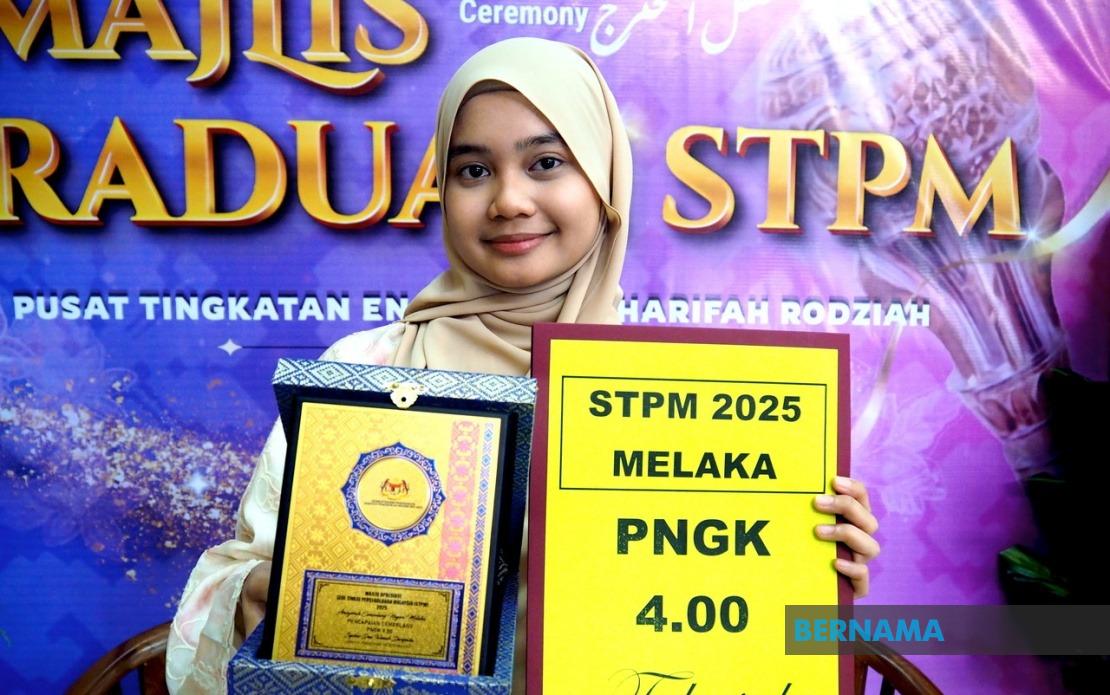
Nurfariesya Nasywa Hamedee, 21, has achieved a perfect Cumulative Grade Point Average of 4.00 in the 2025 Sijil Tinggi Persekolahan Malaysia examination announced in Melaka on June 19, completing a remarkable academic journey shaped by personal tragedy and family determination. The student from Sekolah Menengah Kebangsaan Agama Sharifah Rodziah credits her success not to innate brilliance but to the final counsel of her father, Hamedee Asri, who passed away a week before she sat for her SPM trial examination several years ago. His death from a heart attack struck during a critical academic period, threatening to derail her educational plans entirely.
The loss profoundly shook Nurfariesya's resolve. As the third of four siblings in a family now navigating life without their primary breadwinner, the young woman considered abandoning her schooling altogether to seek employment and ease the financial burden on her remaining family members. Such a decision would have been understandable given the circumstances, yet it was precisely her father's parting instruction—relayed through her mother Yusnita Ruslan—that provided an anchor during her darkest period. His message was simple but powerful: do not squander the intellectual potential you possess. For Nurfariesya, those words became a compass pointing her back toward her desk and her textbooks when abandoning them seemed the more pragmatic choice.
What makes her achievement particularly noteworthy is that she substantially exceeded even her own expectations. Based on her trial examination scores and preliminary calculations, Nurfariesya had anticipated a final CGPA hovering around 3.92, making the 4.00 outcome an unexpected culmination of sustained effort. This gap between forecast and actual result speaks to a student who continued pushing beyond perceived limitations right through to the final examination paper. Her earlier SPM performance—which saw her secure seven As—had already demonstrated academic competence, yet the STPM results represent a consolidation and elevation of that foundation.
Beyond the numerical achievement lies a genuine intellectual engagement with her chosen subjects. Nurfariesya selected General Studies, Arabic, Usuluddin, History, and Shariah, a combination reflecting a deliberate pathway toward her career aspiration of becoming a Shariah lawyer. This is not a random collection of subjects taken by a student chasing grades; rather, it represents a carefully considered educational trajectory aligned with her long-term professional ambitions. Her deep-rooted interest in Shariah law, cultivated over her school years, provided the intrinsic motivation that transforms routine studying into purposeful learning. She has already undertaken an interview for a Bachelor's Degree program at Universiti Malaya, positioning herself for the next phase of her legal education.
Her choice of STPM over alternative pathways deserves consideration within the broader Malaysian educational landscape. Nurfariesya consciously selected the two-year certificate program because it represented a more expedient route to university entry compared to other qualifications. This pragmatic calculation reflects not just academic ambition but awareness of the structural advantages within Malaysia's higher education system. For many students balancing multiple pressures—whether financial, familial, or personal—such pathway optimization becomes essential. The STPM's recognition by Malaysian universities and its direct articulation into degree programs made it the logical choice for someone eager to progress toward professional training.
When asked to distill the essence of her success, Nurfariesya offers a response that resonates with educational researchers and parents alike: there is no secret formula beyond determined effort, resilience in the face of setbacks, and spiritual grounding. She emphasizes the importance of not surrendering easily when obstacles arise, and maintaining faith in Allah as a sustaining force. Such counsel from a high-achieving student carries particular weight in a Malaysian context where many young people grapple with external pressure, family expectations, and internal doubt. Her message fundamentally rejects the notion that academic excellence flows primarily from innate talent or privileged circumstances, instead placing agency squarely with the individual's choices and commitment.
The state education authorities recognized her accomplishment during the official Announcement of the 2025 Melaka State STPM Results ceremony, presided over by Datuk Rosli Abdullah, the State Deputy Exco for Education, Higher Education, and Religious Affairs. This public recognition serves multiple functions: it celebrates the student's individual achievement, acknowledges the contributions of her school and teachers, and signals to other Melaka students that such excellence is attainable within their own communities. The ceremonial framework provides important symbolic validation of educational success, particularly valuable for a young woman who overcame grief and family crisis to reach this point.
Parallel to Nurfariesya's triumph, the 2025 STPM results also spotlighted Ng Zhen Hong, 20, a student from Kolej Tingkatan Enam Tun Fatimah, who earned recognition as the National-Level Best Student Award recipient for the Science Stream. Ng's achievement—coming after he secured ten As in his SPM examination—demonstrates the caliber of academic excellence emerging from Melaka's educational institutions this year. Like Nurfariesya, Ng attributes his success to parental support, teacher guidance, and personal passion for his subject matter. His commitment to daily revision, spending one to two hours reviewing lessons, and his philosophical approach of viewing scientific challenges as motivational fuel rather than obstacles, parallels Nurfariesya's methodology from a different disciplinary angle.
Ng aspires toward Chemical Engineering or Electrical Engineering at Universiti Malaya, representing the STPM cohort's continued concentration of talent into technical and professional fields. His emergence as the national-level science stream leader, a distinction he did not anticipate, underscores that Melaka is producing students capable of competing at the highest national level. The presence of both a perfect-scoring humanities-focused student and a nationally-recognized science student within the same examination cohort suggests a healthy breadth of academic achievement across different knowledge domains.
For Malaysian parents and students wrestling with educational choices and life challenges, these narratives offer concrete testimony to the transformative power of perseverance and purposeful direction. Nurfariesya's journey specifically illustrates how personal tragedy, rather than necessarily derailing a student, can become a catalyst for deeper commitment when coupled with clear purpose and external support. Her father's final advice transcended the immediate moment of its utterance, continuing to shape her decisions and drive her efforts through multiple examination cycles. Similarly, Ng's success demonstrates that systematic effort, genuine interest in one's subjects, and willingness to embrace intellectual challenge yield measurable results in Malaysia's competitive educational environment.
The broader implications for Malaysia's education system are encouraging. The STPM continues producing graduates with the academic foundation and discipline required for advanced tertiary study. Both Nurfariesya and Ng have secured interviews or admission pathways to Universiti Malaya, one of the nation's premier institutions, suggesting that STPM remains an effective qualifier for top-tier universities. For students contemplating their post-SPM options, these examples demonstrate that sustained excellence across two rigorous years of STPM study opens doors to selective university programs and, by extension, competitive professional pathways.

