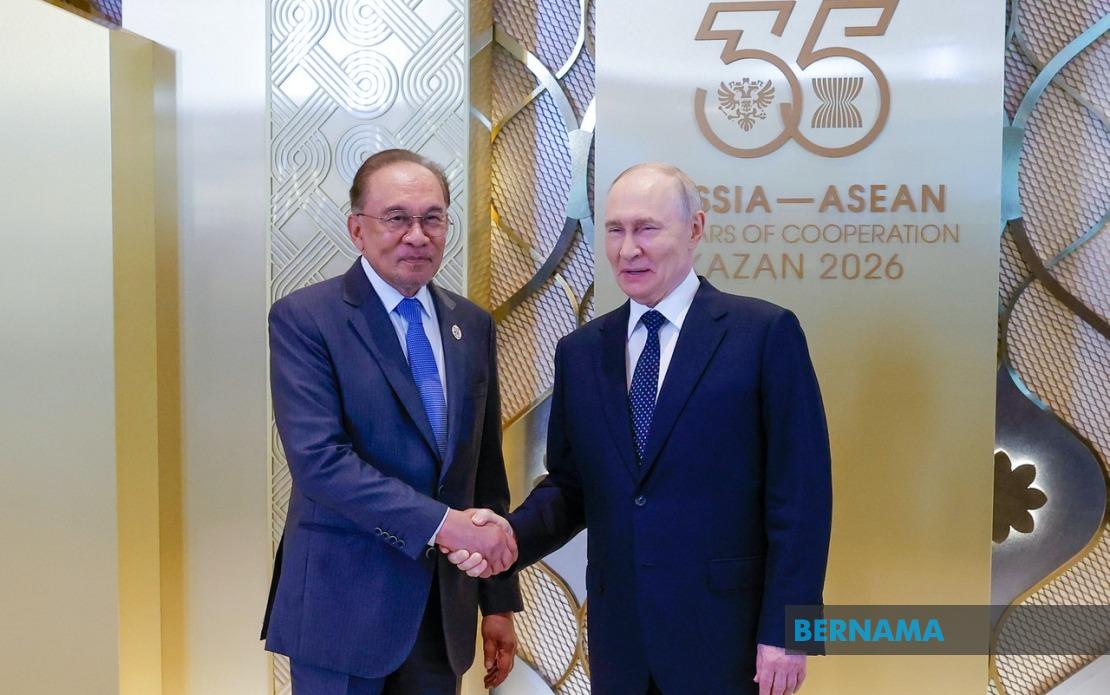
Prime Minister Datuk Seri Anwar Ibrahim has underscored the critical importance of structured engagement platforms in navigating an increasingly complex geopolitical landscape marked by persistent challenges and uncertainty. Speaking after a formal dinner hosted by President Vladimir Putin at the ASEAN-Russia Commemorative Summit in Kazan, Anwar emphasised that such forums serve far more than ceremonial purposes—they function as essential mechanisms for deepening mutual comprehension and strengthening the foundation upon which bilateral and multilateral relationships are built.
The summit, held in Tatarstan's capital from June 17 to 18, represents a significant moment for Southeast Asian-Russian dialogue at the highest political level. According to Anwar, who is attending in his dual capacity as Prime Minister and Finance Minister, the gathering provided participating leaders with a rare opportunity to engage directly on matters of regional and global significance. The informal settings that accompany such formal summits often prove more conducive to candid exchanges than structured bilateral negotiations, allowing leaders to develop personal rapport that can translate into substantive policy alignment.
Beyond the symbolic value of bringing together leaders from ten ASEAN member states and Russia, Anwar highlighted the tangible benefits that emerge from such engagement. These platforms create space for identifying specific areas where cooperation can yield tangible advantages for all parties involved. For ASEAN nations, which balance relationships with multiple great powers, such forums offer opportunities to articulate collective interests while maintaining strategic autonomy. For Russia, engagement with Southeast Asia represents a crucial avenue for expanding its economic and political influence in the Indo-Pacific region, a zone of increasing strategic competition.
Anwar noted that the summit functioned as a vehicle for cultural and historical exchange, with Russia's presentation of its rich heritage and traditions serving to humanise diplomatic relations often characterised by abstract strategic calculations. When leaders understand the historical context and cultural values of their counterparts' nations, they are better positioned to appreciate different perspectives and find common ground on contentious issues. This cultural dimension of diplomacy, while sometimes overlooked in analyses focused on power dynamics, contributes meaningfully to the durability of international relationships.
The emphasis on trust-building carries particular significance in the current global environment. Tensions between major powers, economic volatility, and transnational challenges ranging from climate change to pandemics require unprecedented levels of cooperation. Yet such cooperation is impossible without the foundational element of trust—the belief that other parties will honour their commitments and act in good faith. High-level summits like the ASEAN-Russia gathering provide spaces where trust can be tested, reinforced, and occasionally rebuilt following periods of strain.
For Malaysia specifically, the summit represents an opportunity to advance bilateral relations with Russia while strengthening ASEAN's collective voice on matters of regional importance. Malaysia's position as a middle power within ASEAN and as a significant economy in Southeast Asia makes its participation in such forums consequential. The country's diverse population and experience navigating cross-cultural relations give Malaysian leaders particular credibility in emphasising the importance of mutual understanding across different civilisational and political contexts.
The identification of mutual benefits stands at the heart of Anwar's argument about engagement platforms. Unlike zero-sum frameworks where one party's gain necessitates another's loss, the most productive international relationships recognise areas of genuine convergence. In ASEAN-Russia relations, these might include economic cooperation, scientific collaboration, educational exchanges, and security dialogue on issues like combating terrorism and maritime piracy. When both sides understand these potential areas of cooperation and see pathways to mutual gain, the relationship acquires momentum that transcends the vicissitudes of geopolitical competition.
Anwar's characterisation of engagement platforms as highly meaningful reflects a diplomatic philosophy that prioritises dialogue and relationship-building over confrontation and isolation. This approach aligns with ASEAN's foundational principle of non-interference and its tradition of engaging all major powers through mechanisms like the East Asia Summit and ASEAN Regional Forum. By maintaining open channels of communication with Russia, ASEAN insulates itself from being forced to choose sides in great power competitions and preserves space for autonomous decision-making.
The practical implications of such engagement extend beyond ceremonial gatherings. When leaders establish personal relationships and develop mutual understanding at formal summits, subsequent technical negotiations and economic discussions often proceed more smoothly. Bureaucrats and business representatives operate with clearer guidance on their leaders' intentions and priorities. Trade negotiations benefit from a foundation of political goodwill. Military-to-military dialogues occur within a framework of understood strategic limitations and agreed boundaries.
Looking forward, the ASEAN-Russia relationship will likely deepen in areas where both sides perceive genuine strategic advantage. Russia's pivot toward Asia, driven partly by its need to diversify away from European markets and partnerships, aligns with ASEAN's interest in maintaining relationships with all major powers. Southeast Asian nations, including Malaysia, benefit from this dynamic as they position themselves as valuable partners whom Moscow seeks to cultivate. Such engagement platforms, properly utilised, can translate this mutual interest into concrete cooperation that advances both economic development and regional stability.

