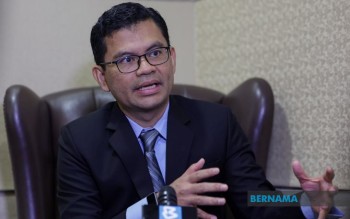
The Economy Ministry has outlined preliminary spending plans for 2027 that would commit approximately RM58 billion towards development initiatives nationwide. Economy Minister Akmal Nasrullah Mohd Nasir disclosed the projection during a press conference in Putrajaya, though the proposal remains subject to formal endorsement by the Finance Ministry before it gains official status. The figure represents a measured continuation of current spending trajectories, with deliberate structuring to balance infrastructure advancement against fiscal sustainability concerns that dominate policy discussions across the region.
The allocation framework adheres to the government's established proportional model, whereby seven-tenths of the total development budget flows directly into foundational infrastructure categories. This policy anchor—maintaining a consistent 70 per cent ratio—reflects a strategic priority toward essential services and physical asset creation rather than discretionary expenditure. Akmal Nasrullah emphasised that the ministry's senior management team will complete the detailed planning exercise before formal submission to the Finance Ministry, indicating that the RM58 billion figure represents the preliminary position rather than a finalised commitment.
Development spending in this tier encompasses roads, utilities, healthcare facilities, educational institutions, and water systems—the backbone upon which economic productivity and living standards depend. By maintaining this allocation level, the government signals confidence that continued investment in foundational capacity will support the broader growth agenda while ensuring smooth delivery of public services that Malaysian citizens depend upon daily. The consistency of the 70 per cent formula across multiple budget cycles suggests this has become embedded within planning methodology, providing predictability for project managers and contractors operating in the development sector.
Historical context reveals the trajectory of these commitments. In 2026, the Finance Ministry allocated RM57.6 billion to fundamental development expenditure, representing 71 per cent of the total development envelope. This represented an uptick from 2025, when RM55.67 billion—or 65 per cent of the total—was directed toward basic development. The progression indicates gradual real-term increases alongside a slight contraction in the proportional share, suggesting total development allocations are expanding while maintaining the basic development commitment in nominal terms. For 2027, the RM58 billion projection sits marginally above 2026 levels, implying modest real growth in the coming budget cycle.
The Economy Minister clarified that the Finance Ministry will undertake the comprehensive assessment required for the full Budget 2027 framework, which extends far beyond development expenditure alone. Questions surrounding global oil price benchmarking for budget construction—a matter of considerable significance for Malaysia given petroleum revenues—fall within the Finance Ministry's domain rather than the Economy Ministry's purview. Akmal Nasrullah acknowledged that oil price assumptions fundamentally shape fiscal planning and revenue projections, but emphasised that his ministry concentrates specifically on development project allocation and continuity.
Economic performance during the first half of 2026 provides the backdrop against which these development plans are being calibrated. The Malaysian economy expanded at 5.8 per cent during the second quarter, bringing the first-half aggregate growth rate to 5.6 per cent. This outcome exceeded the central bank's earlier projection band of 4 to 5 per cent, suggesting resilience within the economic structure despite external headwinds. The stronger-than-anticipated performance reflects accumulated momentum from infrastructure investments in prior years, supply chain adjustments, and domestic demand expansion, validating the continued emphasis on developmental spending.
However, the Economy Minister cautioned against complacency despite the robust growth indicators. He highlighted that a strong first-half foundation typically creates mathematical challenges for maintaining equivalent growth rates in subsequent quarters, as the baseline for comparison becomes increasingly elevated. This dynamic mathematical reality means that even solid performance in the third and fourth quarters could appear muted relative to first-half achievements. Beyond these technical considerations, broader environmental and geopolitical uncertainties cloud the outlook, requiring government spending to remain counter-cyclical where necessary.
El Niño weather patterns present a particular concern for Malaysian economic activity, given the nation's substantial agricultural and resource-dependent sectors. Unusual precipitation, temperature extremes, and associated supply disruptions could constrain production in palm oil, electronics manufacturing, and tourism during the latter half of 2026. Development expenditure, strategically deployed, can mitigate such shocks by maintaining infrastructure resilience and supporting vulnerable economic segments, making the timing of project deployment crucial during periods of climatic uncertainty.
The global economic landscape remains fragile according to Akmal Nasrullah's assessment, with multiple crises demanding vigilance from Malaysian policymakers. Trade tensions, currency volatility, central bank policy divergence, and geopolitical instability in critical shipping lanes all represent transmission mechanisms through which external shocks could reach the Malaysian economy. Development spending calibrated at RM58 billion for 2027 represents a deliberate policy choice to sustain forward momentum while signalling fiscal responsibility, rather than an attempt to engineer artificial acceleration.
Budget 2027 will be formally tabled in Parliament on October 9, 2026, with Prime Minister Datuk Seri Anwar Ibrahim—who also holds the Finance Minister portfolio—presenting the comprehensive fiscal framework to the Dewan Rakyat. This consolidated budget presentation will integrate development spending decisions alongside revenue projections, debt management strategies, and transfer arrangements to states and public entities. The October timeline allows sufficient intervening months for the Finance Ministry to conduct its broader assessment and for consensus-building within the cabinet on fiscal trade-offs.
For regional observers and investors monitoring Malaysian economic direction, the RM58 billion development projection signals continuity and measured confidence rather than dramatic policy reorientation. The government has evidently concluded that existing development frameworks warrant sustained commitment, even as global uncertainty intensifies. This approach contrasts with more volatile regional counterparts, suggesting Malaysia is prioritising steady, infrastructure-anchored growth over cyclically responsive spending surges. The preliminary nature of the Economy Ministry's projection underscores that definitive figures will only crystallise once the Finance Ministry completes its comprehensive budget construction process in the coming months.

