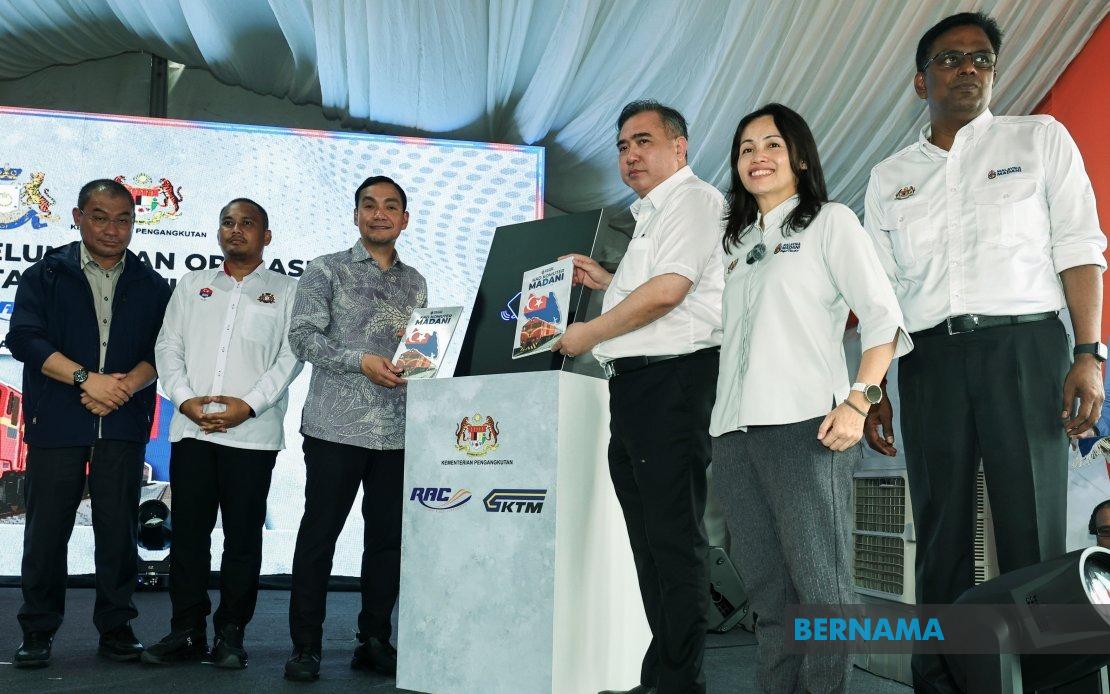
Johor Menteri Besar Datuk Seri Onn Hafiz Ghazi has underscored the critical importance of the Elevated Autonomous Rapid Transit (E-ART) project in containing traffic congestion across Johor Bahru once the Johor Bahru-Singapore Rapid Transit System Link commences service in 2025. Speaking at the launch of the Southern Shuttle train service at KTM Kulai Station on June 16, Onn Hafiz framed the E-ART as an essential long-term investment to sustain the city's transportation infrastructure as passenger volumes surge following the RTS Link's opening.
The remarks come as Johor faces mounting pressure to upgrade its mobility ecosystem ahead of what officials anticipate will be transformative cross-border movement. With the RTS Link set to dramatically increase the ease of commuting between Johor Bahru and Singapore, state planners are confronting the prospect of unprecedented demand on local roads and transit networks. Onn Hafiz's intervention signals growing anxiety among regional leadership about whether existing infrastructure can absorb the influx of daily travellers, particularly during peak hours when congestion already plagues key arterial routes through the city centre.
Current efforts to manage the anticipated surge are, according to the Menteri Besar, fundamentally limited in scope and duration. Authorities have rolled out incremental fixes—notably the expansion of Park & Ride facilities that allow commuters to shift from private vehicles to rail, and the deployment of intelligent traffic management systems centred on JB Sentral—but these measures function as temporary palliatives rather than systemic solutions. Onn Hafiz acknowledged this candidly, noting that short- and medium-term interventions cannot substitute for the permanent capacity gains that a dedicated elevated transit network would provide. The distinction he drew reflects a recognition that without transformative infrastructure, Johor Bahru risks sliding into the kind of chronic gridlock that has defined congestion patterns in Kuala Lumpur and other major regional cities.
The E-ART project represents a qualitative leap beyond conventional traffic management. As an autonomous rapid transit system operating on elevated tracks, it would bypass road congestion entirely, creating a dedicated corridor insulated from the pressure of automobile traffic. This design philosophy has proven effective in other fast-growing Asian cities facing similar challenges. For Johor, where cross-border commuting patterns are already reshaping urban development, such a system could prove transformative in distributing passenger loads across multiple transport modes and preventing any single corridor from becoming a bottleneck.
Johor Bahru's demographic and geographic profile amplifies the urgency of the E-ART case. The state capital is home to approximately 1.8 million residents—a population nearly matching that of Penang—yet lacks the multi-modal transit infrastructure common to cities of comparable size. This structural deficit becomes acute when considering Johor Bahru's role as Malaysia's principal international gateway to Singapore. The city's position as a focal point for cross-border commerce, daily employment migration, and leisure traffic generates transportation demands that dwarf those of inland urban centres. Without deliberate expansion of public transport capacity, the RTS Link, despite its promise to streamline cross-border rail access, risks merely shifting congestion from one mode or location to another rather than genuinely improving overall mobility.
Transport Minister Anthony Loke and Deputy Communications Minister Teo Nie Ching, who represents the Kulai constituency, were present at the launch, signalling federal-level engagement with state-level concerns. This alignment of state and federal attention suggests momentum toward advancing the E-ART through the approval and funding mechanisms necessary for construction. The presence of these figures also underscores transport's position as a priority within the broader federal agenda, particularly as infrastructure investments become tools for demonstrating government effectiveness at the grassroots level.
Onn Hafiz framed federal implementation of the E-ART in explicitly political terms, characterizing it as tangible evidence of the government's commitment to Johor. By linking efficient public transport directly to quality of life and daily convenience, he positioned the project as a form of federal intervention that residents would directly experience. This framing carries particular weight in Johor, a state that has historically harboured concerns about equitable treatment relative to federal-level investments flowing disproportionately to the Klang Valley. An E-ART system would be visible, regionally significant infrastructure that would resonate across Johor's urban and suburban populations.
The broader context for this push involves Southeast Asia's ongoing competition to establish itself as a region of efficient, tech-enabled urban systems. Singapore's integration of seamless public transport networks has become a regional benchmark. As Johor Bahru increasingly integrates with Singapore's economy and job market, the quality disparity in transit infrastructure becomes both a practical bottleneck and a psychological marker of relative competitiveness. An elevated autonomous system would position Johor as a jurisdiction serious about modernization and efficiency, potentially enhancing its attractiveness to investors and cross-border talent seeking high-quality urban amenities.
The timing of Onn Hafiz's appeal reflects a critical juncture in Johor's infrastructure planning. With the RTS Link's opening imminent—scheduled for 2025—the window for planning and financing complementary transit infrastructure is narrowing. While construction of a system as complex as E-ART typically spans several years, delays in securing approvals and funding would push completion well into the period when congestion impacts from the RTS Link are already being felt. This temporal pressure explains the Menteri Besar's emphasis on expediting the project; every month of delay potentially corresponds to years of congestion that residents and commuters will experience.
The E-ART proposal also reflects evolving thinking about urban mobility in Malaysia. Rather than approaching congestion solely through road expansion—a strategy that historically has proven ineffective at containing long-term demand—planners are increasingly advocating for capacity-building in public transport. This philosophical shift, evident in major cities' embrace of rail and elevated transit systems, represents a maturing understanding that automobile-centric solutions generate their own demand and ultimately prove self-defeating. For Johor Bahru, adopting this framework positions the state as a jurisdiction aligned with global best practices in urban planning, rather than perpetually chasing congestion through incremental road-building.
The success of the E-ART proposal will depend not only on securing federal funding and technical expertise but also on sustained political commitment across electoral cycles and ministerial changes. Onn Hafiz's public advocacy signals his determination to keep the project elevated on the state and federal policy agenda. However, infrastructure projects of this scale require institutionalized support mechanisms, dedicated funding sources, and coordination across multiple government agencies. The launching of the Southern Shuttle train service, while modest in scale, demonstrates that the state remains focused on advancing transit solutions. Whether this momentum can carry through to the more ambitious and costly E-ART initiative remains a question that will shape Johor Bahru's livability for the coming decade.

