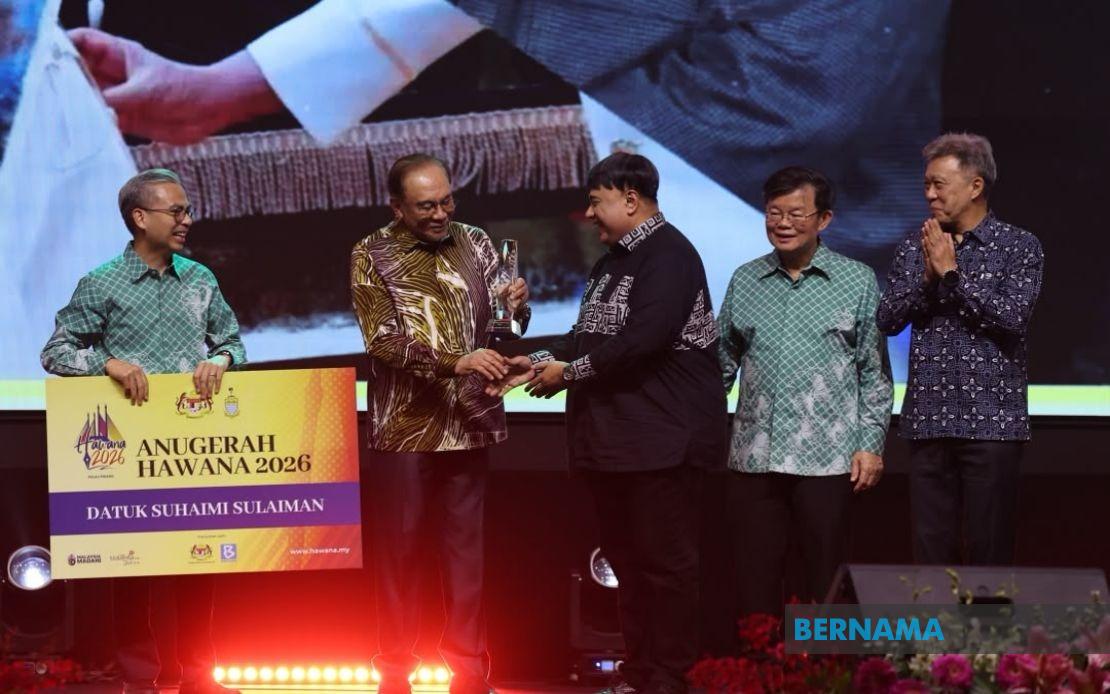
Datuk Suhaimi Sulaiman, a towering figure in Malaysian broadcasting and journalism, has been honoured with the HAWANA 2026 Award in recognition of more than three decades of dedicated service to the nation's media sector. The former Broadcasting Malaysia (RTM) director-general received the accolade from Prime Minister Datuk Seri Anwar Ibrahim during the HAWANA 2026 Grand Finale held at PICCA @ Arena Butterworth Convention Centre in Penang, with Penang Chief Minister Chow Kon Yeow and Communications Minister Datuk Fahmi Fadzil in attendance.
The National Journalists' Day award ceremony brought together senior figures from Malaysia's news and broadcasting establishment, including Malaysian National News Agency (Bernama) chairman Datuk Seri Wong Chun Wai, Bernama chief executive officer and HAWANA 2026 Working Committee chairman Datin Paduka Nur-ul Afida Kamaludin, and editor-in-chief Arul Rajoo Durar Raj. The gathering underscored the significance of acknowledging distinguished careers within the journalism profession at a time when the media landscape faces unprecedented transformation and challenge.
Suhaimi's trajectory through Malaysian broadcasting represents a critical period in the nation's media evolution. Having steered RTM, the country's oldest and most established public broadcaster, his leadership helped shape editorial standards and journalistic practices across multiple decades. His tenure coincided with transformative moments in Malaysian broadcasting history, from the early days of television expansion through the digital revolution that fundamentally altered news production and distribution methods.
In responding to the award, Suhaimi characterised the recognition not merely as a personal achievement but as a meaningful affirmation of his continued commitment to journalism and learning. He emphasised that receiving such honour at this stage of his career carried particular significance, as it validated the ongoing relevance of his work and experience within the profession. His words reflected a measured appreciation for the milestone, grounded in the acknowledgment that recognition in journalism ultimately serves to reinforce professional standards and inspire continued excellence.
The timing of this award proves particularly pertinent given the rapidly shifting technological environment reshaping global media. Suhaimi highlighted the emergence of artificial intelligence as a defining challenge for contemporary journalists and broadcasters, stressing that media practitioners must remain perpetually engaged in learning and skill development. His observation touches on a critical issue facing newsrooms across Malaysia and Southeast Asia, where the integration of AI tools for content generation, verification, and distribution demands fundamental reassessment of journalistic workflows and editorial judgment.
The acceleration of AI adoption in media operations has created both opportunities and risks within the journalism profession. While these technologies can enhance efficiency in routine reporting tasks and data analysis, they simultaneously raise questions about editorial independence, accuracy, and the preservation of distinctly human journalistic judgment. Suhaimi's emphasis on continuous adaptation reflects the pragmatic approach increasingly necessary for media organisations seeking to maintain credibility and relevance in an AI-inflected landscape.
Malaysia's media sector stands at an inflection point where veteran practitioners like Suhaimi provide invaluable institutional memory and ethical grounding. As younger journalists enter the profession equipped primarily with digital-native skillsets, the intergenerational transfer of journalistic values and methodology becomes increasingly critical. Suhaimi's commitment to sharing experience and mentoring represents an essential function within an industry where consolidation and commercial pressures have sometimes compromised the transmission of professional standards.
The HAWANA award ceremony itself carries symbolic importance within Malaysia's media culture. By elevating recognition of distinguished media professionals at the national level, the event reaffirms journalism's societal role and invests in the cultural prestige of the profession. In Southeast Asian contexts where press freedom and journalistic independence face periodic challenges, institutional recognition of long-serving practitioners carries political and cultural resonance beyond individual celebration.
Suhaimi's path through RTM leadership positioned him at the intersection of state broadcasting responsibilities and professional journalistic ethics—a tension point that has characterised Malaysian media for decades. His navigation of these institutional dynamics, alongside his contributions to broadcasting standards, makes his recognition particularly relevant for contemporary discussions about media governance and editorial autonomy in Malaysia. The award implicitly endorses his record of managing these competing pressures while maintaining professional integrity.
The presence of Communications Minister Datuk Fahmi Fadzil at the ceremony signals government acknowledgment of the broadcasting sector's importance to national development and democratic functioning. Media policy conversations in Malaysia increasingly incorporate discussions about digital transformation, misinformation management, and the evolving regulatory environment—domains where experienced practitioners like Suhaimi offer crucial perspective and institutional continuity.
Looking forward, Suhaimi's continued engagement with the profession through mentorship and advocacy for professional standards represents an underutilised resource within Malaysian media. As the sector confronts questions about sustainability models, technological integration, and talent development, the insights and convening capacity of recognised elder statesmen in journalism become increasingly valuable for industry cohesion and standard-setting.
The HAWANA 2026 Award validates not simply Suhaimi's historical contributions to Malaysian broadcasting, but positions his voice as relevant to current and emerging challenges facing the profession. In an era when journalism globally confronts existential questions about its economic viability, technological disruption, and societal role, honouring those who have stewarded the profession through previous transformations provides both symbolic affirmation and practical wisdom for navigating the changes ahead. Suhaimi's recognition ultimately reflects institutional investment in ensuring that Malaysia's media sector continues to benefit from the experience and principled judgment of its most accomplished practitioners.