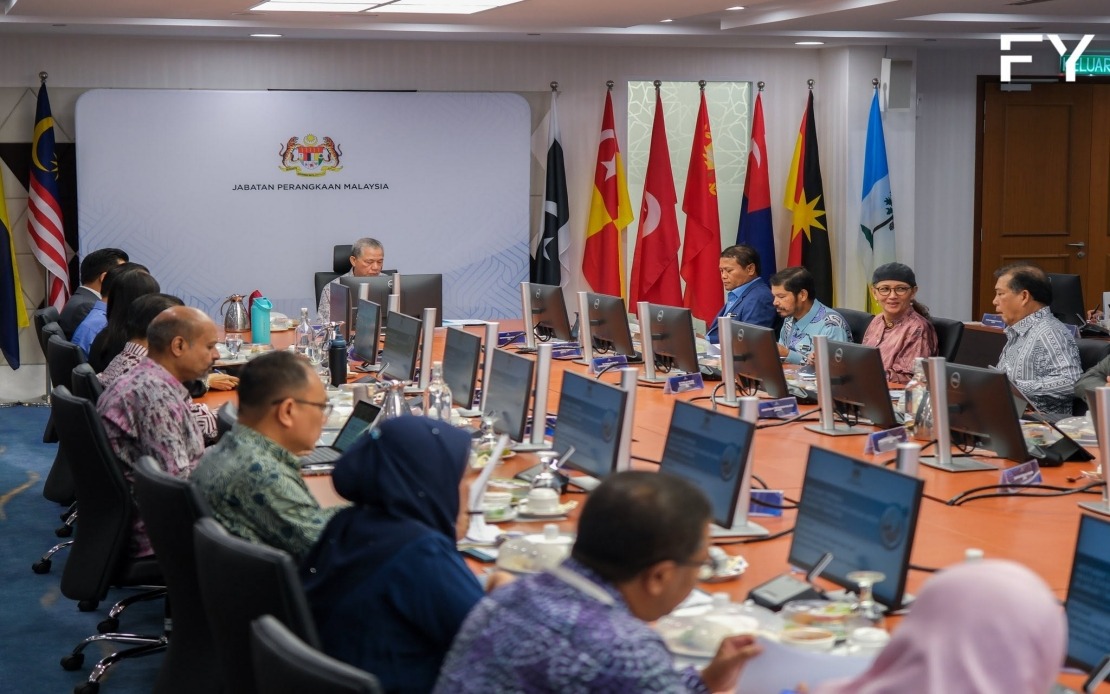
Deputy Prime Minister Datuk Seri Fadillah Yusof has signalled that Malaysia's development ambitions for the coming five-year period hinge critically on building institutional capacity for data-driven governance and artificial intelligence deployment. Speaking after chairing a high-level meeting of the National Statistics and Data Council (MSDN), Fadillah outlined how the government intends to harness data and AI as foundational tools for formulating, executing and assessing policies under the 13th Malaysia Plan spanning 2026 to 2030.
The Deputy Prime Minister's remarks reflect a broader recognition within government circles that traditional approaches to policy formulation no longer suffice in an environment marked by economic volatility, technological disruption and complex transnational challenges. He identified several headwinds confronting policymakers today: mounting economic uncertainties stemming from global trade tensions, geopolitical realignments that reshape investment patterns and supply chains, the accelerating pace of digital transformation across industries, climate-related risks demanding immediate mitigation, and the dual promise and peril embedded in rapid technological advances including artificial intelligence. Within this context, Fadillah positioned high-quality statistics and data analytics not merely as administrative conveniences but as strategic national assets integral to government effectiveness and national resilience.
Malaysia's recent economic performance appears to vindicate this emphasis on evidence-based decision-making. The economy expanded by 5.4 per cent in the first quarter of 2026, a figure Fadillah credited to development policies rooted in rigorous data analysis. This performance suggests that the administration's investment in strengthening analytical capacity has yielded tangible returns, though sustaining such growth will require continued commitment to data infrastructure and human expertise. The connection between robust statistical frameworks and economic outcomes carries particular significance for Malaysia as it navigates post-pandemic recovery while competing with regional peers for investment and talent.
Central to the government's approach is the recognition that data and official statistics serve multiple functions simultaneously. Beyond their traditional role as informational tools, they have evolved into instruments that enhance the efficiency of public service delivery while fortifying the nation's capacity to respond to shocks. This transformation reflects a maturation in how governments worldwide approach governance, where decisions increasingly rest on measurable evidence rather than intuition or historical precedent. For Malaysia, this institutional evolution becomes essential as the country pursues more ambitious development targets.
The Strengthening of the National Statistical System (SNSS) initiative represents the operational vehicle through which these ambitions will be realised. Fadillah emphasised that progress depends fundamentally on strategic collaboration spanning the full spectrum of institutional actors: federal ministries and agencies, state governments, the private sector, universities and independent research organisations. This multi-stakeholder approach acknowledges that data relevant to policy questions often resides in decentralised locations and that effective governance requires breaking down institutional silos that traditionally compartmentalise information. Such collaboration carries practical complexity, as different organisations operate under varying data governance regimes, technical standards and reporting requirements.
The digital era has created both opportunity and imperative for integrated data systems. Fadillah highlighted that the government's capacity to synthesise information from disparate sources in ways that are simultaneously secure, ethically sound and analytically productive has become indispensable. The integration of big data analytics and AI technologies enables policymakers to identify patterns and correlations that might escape detection through traditional statistical methods. However, this capability brings attendant risks: data security vulnerabilities, privacy breaches, algorithmic bias and misuse of powerful analytical tools. The challenge facing Malaysian institutions lies in harvesting these technological advantages while establishing robust safeguards.
Specific policy domains emerging as priorities for data-driven enhancement include energy transition and climate change mitigation, water sector transformation, and sustainable development initiatives more broadly. These sectors demand comprehensive data architecture because policy failures carry substantial consequences for environmental outcomes, public health and economic efficiency. The water sector, for instance, faces mounting pressure from population growth, urbanisation and climate variability, making data-driven resource management increasingly vital. Similarly, Malaysia's energy transition commitments require detailed information about consumption patterns, renewable generation potential and grid infrastructure to guide investment decisions efficiently.
The MSDN meeting reviewed several concrete initiatives positioned as foundational to building what Fadillah termed a more integrated and development-oriented national data ecosystem. These include standardising official statistical methodologies across agencies, establishing coherent data governance frameworks, integrating data held within administrative systems rather than maintaining isolated databases, developing dedicated talent repositories in science, technology and innovation fields, and systematically capturing information relevant to youth development programmes. Additionally, the government is establishing centralised management systems for national road asset data, addressing infrastructure challenges through improved information architecture.
Fadillah, who holds the additional portfolio of Minister of Energy Transition and Water Transformation, signalled that these sector-specific data initiatives reflect his priorities across the government. The bundling of data infrastructure improvements with energy and water responsibilities underscores how resource-constrained sectors depend on better information systems to improve outcomes. Southeast Asian governments generally, including Malaysia, have historically underinvested in institutional statistical capacity relative to more developed economies, creating efficiency losses across public administration.
The emphasis on AI and advanced analytics speaks to Malaysia's positioning within the global competitive landscape. Nations and regions pioneering AI deployment in governance gain first-mover advantages, potentially achieving superior policy outcomes and attracting talent and investment. However, Malaysia must also navigate the reality that AI tools trained on international datasets may not adequately reflect local conditions, requiring investment in domestically-oriented research and development. The government's stated commitment to leveraging AI while building integrated databases suggests an awareness that technological adoption without supporting institutional infrastructure yields disappointing results.
The scope of initiatives outlined—ranging from youth development databases to road asset management—reflects how comprehensively data infrastructure now pervades government functions. This represents a departure from past frameworks where statistics occupied a narrower administrative niche. Contemporary governance demands that information systems serve as connective tissue linking disparate policy domains, enabling holistic rather than siloed decision-making. For Malaysia, this institutional transformation carries implications for workforce development, requiring investments in data science, statistics and AI expertise that educational institutions must anticipate and support.
The success of these ambitions ultimately depends on sustained political commitment and adequate resource allocation. Data infrastructure projects characteristically exhibit long gestation periods before delivering measurable policy improvements, creating vulnerability to budget cuts or political reprioritisation when competing demands emerge. Malaysia's ability to maintain momentum with initiatives such as the SNSS strengthening programme will reveal whether current enthusiasm translates into durable institutional change or represents another cycle of announced priorities that fade when fiscal pressures intensify.
For Malaysian readers and regional observers, the Deputy Prime Minister's emphasis on data-driven governance signals an intention to embed more sophisticated analytical capacity throughout the machinery of state. Whether this aspiration materialises into improved public services, more resilient economic performance and better environmental outcomes will become apparent through the 13th Malaysia Plan implementation period. The government's investment in data infrastructure represents an acknowledgment that twenty-first century development requires institutional capabilities markedly different from those that sufficed in earlier eras.