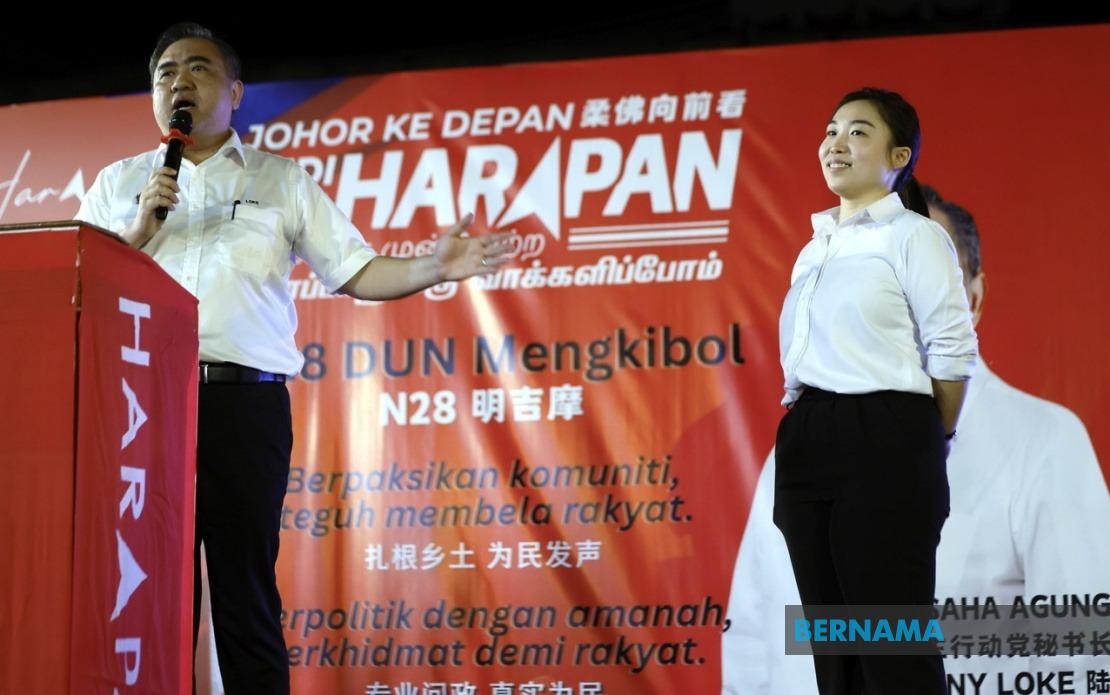
The Democratic Action Party has tapped Chu Poh Yee, a 33-year-old legal professional, to contest the Mengkibol seat in the forthcoming Johor state election, marking a generational shift in the party's candidacy approach. The announcement, made during a ceremony in Kluang on Monday evening, signals DAP's strategic repositioning of incumbent assemblyman Chew Chong Sin, who vacates the seat after two consecutive terms representing the constituency. Party secretary-general Anthony Loke unveiled the decision, emphasizing the nomination reflects the party's broader commitment to creating avenues for women candidates in electoral competitions across Malaysia.
Chew's departure from Mengkibol is not a retirement from politics but rather a calculated advancement within the party hierarchy. The incumbent has been earmarked as the prospective candidate for the Labis parliamentary constituency in the subsequent federal elections, following signals from the current Labis Member of Parliament Pang Hok Liong that he will not contest another term. This transition exemplifies how opposition parties strategically manage their talent pool, promoting seasoned state representatives to federal-level candidacies while introducing fresh blood at the grassroots level. Loke articulated this succession strategy clearly, noting that leadership identified Chew's potential to transition into a parliamentary role, thereby creating the opening for a new face in the Mengkibol assembly segment.
Chu's professional background in law positions her as a candidate with demonstrable expertise in constituencies' practical governance needs. Her specialization in legal aid cases and her track record assisting local elected representatives underscore credentials that extend beyond typical political maneuvering. According to Loke, she possesses strong educational qualifications, multilingual capabilities, and established community connections within Mengkibol, attributes that collectively construct a competitive candidacy profile. The party leadership's unanimous endorsement suggests internal consensus around her suitability, a notable factor in Malaysian politics where factional tensions within coalition partners periodically surface during candidate selections.
The nomination reflects a conscious initiative to elevate women's participation in Malaysian electoral contests. DAP's publicly stated aspiration to provide greater opportunities for female candidates aligns with broader conversations within Southeast Asian political movements about gender representation and diversity. While Malaysia's parliament and state assemblies remain male-dominated, selective parties have incrementally expanded women's candidacies, though substantive parity remains distant. Chu's selection represents incremental progress, though systemic barriers to women's political advancement persist across Malaysia's electoral landscape.
The Mengkibol seat itself carries moderate significance within Johor's political geography. As one of DAP's incumbent-held constituencies, retaining this seat proves essential for maintaining the party's footprint in the southern state. Johor has historically been a Barisan Nasional stronghold, making opposition gains particularly valuable and vulnerable to erosion during subsequent contests. The choice to field Chu rather than simply promoting another male assemblyman carries implicit risk assessment by DAP leadership, suggesting confidence that her profile adequately compensates for the incumbent advantage of fresh representation.
DAP's broader Johor strategy encompasses contesting seventeen state seats, comprising ten incumbently held seats including Mengkibol, four previously lost constituencies the party intends to reclaim, and three additional seats representing new territory. This configuration demonstrates the party's calculated approach to electoral positioning—consolidating existing strongholds while selectively challenging opposition-held areas. The sequenced announcement of candidates, with four more revealed this Saturday and the remainder unveiled alongside broader Pakatan Harapan candidates the following Monday through the Prime Minister, reflects coalition coordination mechanisms and centralized campaign scheduling.
The timing of these announcements carries strategic weight within Malaysia's election calendar. Early nomination of candidates provides these individuals campaign runway to build ground presence and constituent familiarity before official campaign periods commence. For a new face like Chu, this extended pre-election period becomes particularly valuable for establishing credentials within a constituency and neutralizing potential criticism about insufficient local rootedness. Opposition parties, perpetually operating under resource constraints compared to government machinery, optimize whatever time advantages they can secure through strategic scheduling.
Chew's potential transition to Labis parliamentary candidacy reflects DAP's confidence in retaining representation across electoral tiers in Johor. The Labis seat encompasses both state and federal dimensions, and DAP's willingness to advance Chew suggests assessment that the party possesses competitive capacity at parliamentary level in this region. Conversely, the decision to contest seventeen state seats rather than pursuing every available seat indicates selective focus, concentrating resources on winnable constituencies rather than dispersing efforts across long-shot campaigns.
Chu's legal expertise in administrative and access-to-justice matters positions her candidacy within a broader repositioning narrative, where opposition parties increasingly emphasize candidates' technical competencies and professional credentials. This contrasts with earlier eras when political heredity or seniority dominated candidate selection frameworks. Contemporary Malaysian voters, particularly in urbanized constituencies like segments of Johor, demonstrate sensitivity to candidates' educational backgrounds and professional achievements, factors that DAP strategically highlights through selections like Chu's.
The announcement simultaneously signals confidence in the party's organizational capacity to identify and vet emerging talent. Malaysian political parties frequently rely on informal networks and existing patronage structures for candidate identification, but DAP's highlighting of Chu's qualifications and community connections suggests more systematic vetting procedures. Whether this reflects genuine meritocratic selection processes or sophisticated public relations framing remains analytically complex, yet the party's willingness to publicly emphasize such criteria indicates awareness of voter preferences for perceived competence.
As the Johor state election approaches, Chu's candidacy will receive close observation from analysts tracking whether DAP's wager on new female candidates yields electoral dividends or faces backlash from voters expecting continuity with familiar representatives. Her success or failure will influence opposition calculations regarding future candidate diversification strategies across Malaysia's remaining states, particularly regarding gender representation in electoral contests. The broader implications extend beyond Mengkibol, affecting how political parties across the peninsula calibrate candidate selection formulas balancing incumbency advantage, diversity objectives, and electoral competitiveness.

