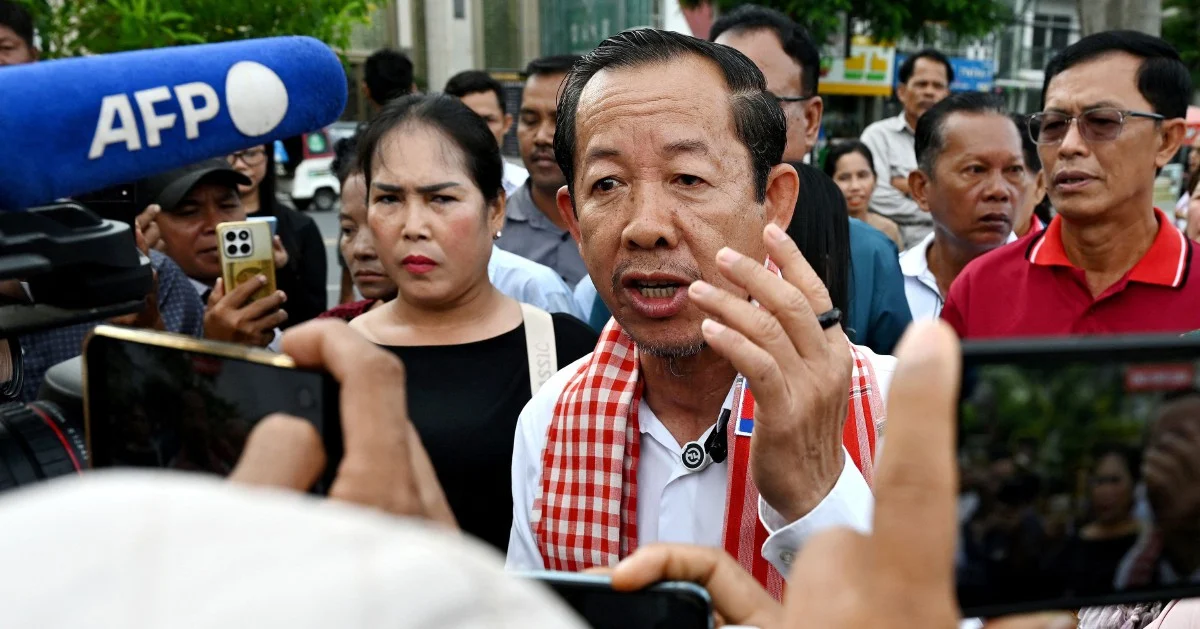
Cambodia's Supreme Court has moved to suspend a prison sentence imposed on opposition politician Rong Chhun while maintaining restrictions that bar him from running for elected office, his legal team disclosed on Friday. The dual ruling represents a partial reprieve for the prominent dissent figure, though the election ban remains a significant constraint on his political participation in the kingdom.
The decision underscores the complex legal terrain navigated by opposition figures in Cambodia, where court proceedings involving political opponents have frequently attracted regional scrutiny. Rong Chhun, who has maintained a vocal presence in Cambodian politics despite considerable obstacles, faces ongoing limitations on his democratic participation. The suspension of incarceration appears designed to address international concerns about detention practices while preserving the practical consequence of excluding him from ballot access.
For Malaysian and Southeast Asian observers, the case illustrates persistent challenges to electoral pluralism in the region. Cambodia's political landscape has grown increasingly constrained in recent years, with multiple opposition figures subject to legal proceedings that critics argue serve as mechanisms for limiting political competition. The maintenance of Rong Chhun's candidacy prohibition suggests that domestic judicial institutions continue to prioritise constraints on opposition activity even as they adjust sentencing approaches.
The election ban carries profound implications for Cambodia's democratic structure, effectively removing an experienced opposition voice from electoral competition. Such restrictions prevent voters from accessing a full spectrum of political choices and diminish the opposition's capacity to mount meaningful electoral challenges. For a nation where democratic institutions remain developmentally contested, the perpetuation of such prohibitions undermines prospects for genuine political contestation.
Rong Chhun's case reflects broader patterns affecting Cambodia's political opposition. Multiple figures have faced legal charges and candidacy restrictions, creating an environment where mounting electoral challenges to the ruling party becomes systematically difficult. The combination of criminal proceedings, imprisonment threats, and electoral disqualifications produces a cumulative effect that disadvantages opposition movements relative to governing entities with control over judicial machinery.
The suspension of his prison sentence may reflect sensitivity to international diplomatic pressure and regional concerns about democratic standards. Many nations and international organisations maintain scrutiny over Cambodia's treatment of opposition figures, and incarceration can provoke unwanted international commentary and potential sanctions discussions. By suspending the prison term while maintaining the election ban, Cambodia's court may have sought to navigate between appeasing international opinion and preserving domestic political constraints.
For Southeast Asia's broader political trajectory, Cambodia's approach exemplifies a recurrent challenge: the capacity of judicial systems to function as instruments of political control rather than neutral arbiters of law. The region contains several nations where court systems have faced comparable critiques regarding selective enforcement against opposition figures. Thailand, for instance, has witnessed similar concerns about weaponised legal proceedings, suggesting that Cambodia's pattern reflects region-wide tensions between formal democratic structures and practical political constraints.
The implications extend to Malaysia's own political considerations. While Malaysian governance has evolved differently, understanding how neighbouring states employ legal and electoral mechanisms to constrain opposition participation provides valuable comparative perspective. Malaysia's own electoral history includes episodes of contested judicial processes and candidate disqualifications, making Cambodia's current situation neither entirely foreign nor irrelevant to regional political dynamics.
Rong Chhun's situation also highlights how criminal convictions can serve as functional alternatives to direct suppression. By maintaining a conviction record while suspending actual imprisonment, authorities preserve barriers to future candidacy without incurring the diplomatic costs of visible detention. This approach demonstrates legal sophistication in consolidating political constraints through ostensibly neutral criminal justice mechanisms rather than overtly political prohibitions.
For opposition movements throughout Southeast Asia, the case underscores the strategic importance of building resilience within constrained environments. Political opponents in Cambodia continue organising and advocating despite significant obstacles, suggesting that opposition activity persists even when electoral pathways become administratively foreclosed. Understanding how such movements operate under restrictive conditions provides lessons for regional observers concerned with democratic governance and political pluralism.
The Supreme Court's decision arrives amid Cambodia's ongoing political consolidation around ruling party dominance. With multiple opposition figures subject to similar legal constraints and electoral restrictions, the kingdom has constructed a system where electoral competition occurs within significantly narrowed parameters. International observers and democratic watchdog organisations maintain critical attention to these patterns, recognising that narrowing electoral competition affects not merely Cambodia but regional perceptions of democratic health across Southeast Asia.
Moving forward, the sustainability of such restrictions depends partly on Cambodia's capacity to maintain them without provoking major international intervention or regional destabilisation. Continued constraint of opposition participation risks eventual international pressure escalation, potentially involving sanctions or diplomatic consequences. The Supreme Court's apparent effort to balance these concerns through sentence suspension while maintaining electoral bars suggests ongoing navigation of tensions between domestic political control and international acceptability—a balancing act that multiple Southeast Asian governments continue attempting across different contexts.

