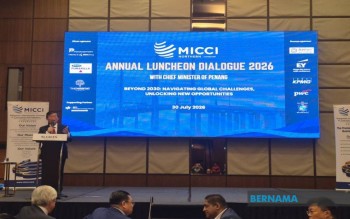
Malaysia's business community is facing a critical inflection point as artificial intelligence, automation and digitalisation reshape the economic landscape, prompting the Malaysian International Chamber of Commerce and Industry to sound a clarion call for strategic investment in human capital and innovation. Speaking at the MICCI Northern Branch Annual Luncheon Dialogue 2026 in George Town today, Northern Branch chairman Datuk Brian Tan Guan Hooi emphasised that companies must recognise technological disruption not merely as a threat but as a catalyst for creating new industries and higher-value employment opportunities. The challenge, he suggested, lies in how swiftly Malaysian businesses can adapt their talent strategies to match the pace of technological change.
The transformation underway extends far beyond the deployment of new machines or software systems. Rather, it encompasses a fundamental reimagining of what skills and attributes workers will need in the coming years. Tan noted that technical qualifications alone will no longer suffice. Instead, companies must ensure their workforce possesses a diverse skill mix encompassing technical competency, creative problem-solving, interpersonal communication and a demonstrated commitment to continuous learning. This shift reflects a broader recognition across global economies that adaptability and intellectual agility are becoming as valuable as domain-specific expertise.
The education-industry alignment challenge represents one of the most pressing concerns for Malaysia's economic future. Tan highlighted the critical disconnect that often exists between what educational institutions teach and what industry actually requires. This gap has long been a weakness in Southeast Asian economies, where curriculum development frequently lags behind market demands by years or even decades. To close this divide, he called for education and training systems to maintain closer integration with industry needs, ensuring that young Malaysians develop capabilities aligned with actual employer requirements rather than outdated skill sets.
Young Malaysians entering the workforce today must be equipped not only with formal qualifications but also with the softer competencies increasingly demanded by employers navigating the digital age. Communication skills, for instance, become more critical as human workers shift toward roles emphasising creativity, strategy and interpersonal connection—areas where machines currently cannot compete. Similarly, the willingness and capacity to learn continuously throughout one's career has transformed from a desirable trait into an essential survival skill in industries subject to rapid technological upheaval.
Companies across Malaysia face mounting pressure to look beyond immediate quarterly challenges and invest in long-term capability building. This requires a strategic mindset that acknowledges short-term costs of training, talent retention and innovation in exchange for sustained competitiveness over the next decade. Tan underscored that the ability to develop skilled talent has become a primary determinant of whether Malaysian businesses can successfully capture emerging opportunities while maintaining their competitive standing in an increasingly challenging global environment. Such investment becomes particularly vital for companies seeking to move beyond cost-competition toward higher-value manufacturing and services.
The public-private partnership dimension of this challenge cannot be overlooked. Tan advocated for deeper collaboration between government and business to construct a stronger ecosystem supporting growth and innovation. He articulated a vision where government provides direction, establishes supportive policies and develops infrastructure, while the private sector contributes investment capital, innovation capabilities, operational expertise and employment. Neither sector, he argued, can achieve sustainable competitive advantage in isolation. Rather, progress demands honest, constructive engagement between government officials and business leaders.
Such dialogue becomes particularly important as Malaysia seeks to position itself within the shifting dynamics of global competition. As labour-intensive manufacturing continues migrating toward lower-cost jurisdictions and automation reduces demand for routine tasks, Malaysia must increasingly compete on innovation, quality and value addition rather than on cost alone. This strategic repositioning requires policy certainty, aligned infrastructure investment and regulatory environments that encourage rather than impede technological adoption and workforce experimentation.
Government policies, supporting infrastructure and institutional frameworks must continually evolve to remain aligned with business sector needs. Tan emphasised that continuous dialogue between industry associations and policymakers ensures that regulatory sandboxes, funding mechanisms, skills development programmes and other government initiatives actually address real business challenges rather than reflecting bureaucratic assumptions about market needs. MICCI's role as intermediary between private sector and government becomes increasingly valuable in this context.
MICCI itself, having served Malaysia's business community since 1837 and now marking its 189th anniversary, has positioned itself as a bridge between private enterprise and government policy. The chamber plans to continue leveraging its extensive business network and institutional credibility to share industry insights with policymakers and contribute practical solutions to systemic challenges. This institutional role extends beyond traditional advocacy toward active participation in shaping the policy frameworks that will determine Malaysia's economic trajectory through this period of technological disruption.
The remarks delivered at the Northern Branch gathering, attended by Penang Chief Minister Chow Kon Yeow as guest of honour, reflect broader conversations occurring across Malaysia's business leadership. Recognition has grown that superficial responses—modest training budgets, incremental process improvements—will prove insufficient to navigate the coming transformation. Instead, comprehensive reimagining of workforce strategies, organisational capabilities and competitive positioning represents the only viable path forward for Malaysian companies intent on thriving rather than merely surviving in the rapidly evolving global economy.

