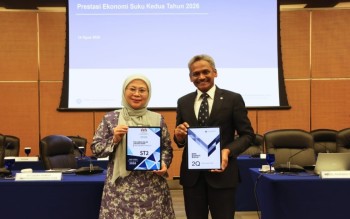
Bank Negara Malaysia has no intention to revise its 2026 gross domestic product growth forecast downward from the targeted 5.0 per cent, Governor Datuk Seri Abdul Rasheed Ghaffour declared on Wednesday, signalling the central bank's bullish outlook for the nation's economic performance. The decision to hold firm on the growth projection comes as Malaysia's second-quarter expansion outpaced expectations, delivering encouraging signals about the economy's underlying resilience heading into the latter half of 2026.
The Malaysian economy expanded by 6.0 per cent in the second quarter, exceeding the Department of Statistics Malaysia's preliminary estimate of 5.8 per cent and reinforcing BNM's confidence in achieving the annual target. Speaking at a press conference in Kuala Lumpur following the GDP announcement, Abdul Rasheed explained that any formal revision to the growth forecast would typically be presented during the Budget announcement period, suggesting the central bank sees no compelling need for adjustment at this juncture.
Domestic demand has emerged as the primary engine driving Malaysia's economic expansion, with consumption, investment, and tourism all contributing meaningfully to the upswing. Abdul Rasheed highlighted that growth momentum has consistently exceeded BNM's internal expectations over the past three consecutive quarters, reflecting the breadth and durability of economic activity across multiple fronts. This sustained outperformance provides the foundation for the central bank's continued confidence in the 5.0 per cent annual growth target, even as global headwinds present ongoing challenges.
Household consumption has proved particularly resilient, expanding at 4.8 per cent during the second quarter and underpinning the overall growth picture. The stability in consumer spending draws from three interconnected sources: steady income growth, accumulated household savings, and government policy support measures that have bolstered purchasing power. Notably, Abdul Rasheed emphasised that household borrowing remains a marginal contributor to consumption growth, suggesting that the expansion in consumer demand rests on fundamentally sound foundations rather than unsustainable debt accumulation, a distinction of significance for long-term economic stability.
The external sector has also provided meaningful support, particularly in the previous quarter, demonstrating that Malaysia's growth narrative extends beyond domestic demand. Exports have expanded across both traditional and emerging product categories, with the electrical and electronics sector maintaining its traditional strength whilst non-E&E exports have also gained traction. This diversification within the export base reduces Malaysia's vulnerability to sector-specific shocks and reflects ongoing economic transformation, a development particularly relevant for policymakers weighing medium-term structural competitiveness.
Information and communications technology services represent an increasingly important component of Malaysia's export profile, signalling the economy's gradual but steady pivot toward higher-value-added activities. The growth in ICT services exports underscores the potential for Malaysia to capture emerging opportunities in the digital economy, a trend that could support sustained productivity improvements and wage growth across the labour force. For Malaysian businesses and investors, this sectoral expansion offers both opportunities and competitive pressures as the regional digital economy intensifies.
Looking ahead, Abdul Rasheed acknowledged that the global environment presents genuine uncertainties, particularly surrounding geopolitical tensions that could affect trade flows and investor sentiment. The central bank governor cautioned that these external headwinds, combined with ongoing global economic volatility, may exert downward pressure on Malaysia's growth trajectory if conditions deteriorate significantly. However, he maintained that the combination of strong domestic foundations and diversified growth drivers positions Malaysia reasonably well to navigate near-term external shocks without abandoning the 5.0 per cent growth objective.
Climate-related concerns also feature in BNM's economic assessment, with El Niño patterns likely to produce effects that manifest gradually and concentrate primarily within the agricultural sector. While the immediate macroeconomic impact appears contained, Abdul Rasheed advised businesses and households to prepare preemptively should weather-related challenges intensify. This guidance reflects the central bank's awareness that climate risks increasingly shape economic planning across the region, requiring proactive adaptation strategies rather than reactive responses.
The central bank's decision to maintain the growth forecast reflects confidence grounded in recent data rather than optimistic assumptions. Malaysia's ability to exceed quarterly growth expectations, sustain resilient consumption, and achieve broad-based expansion across sectors suggests that the 5.0 per cent annual target remains achievable. For regional observers, Malaysia's sustained growth momentum provides a counterweight to concerns about Southeast Asian economic slowdown, demonstrating that well-diversified economies with strong domestic demand fundamentals can perform robustly even amid global uncertainty.
For Malaysian investors, businesses, and policymakers, the central bank's forecast conveys a message that whilst vigilance regarding external risks remains warranted, the fundamental conditions supporting economic expansion remain intact. The emphasis on consumption-driven growth backed by income rather than borrowing suggests a more sustainable growth model than in previous cycles. As Malaysia progresses through 2026, the interplay between domestic strength and external headwinds will ultimately determine whether the nation achieves or exceeds the 5.0 per cent growth target that BNM has now confidently reaffirmed.

