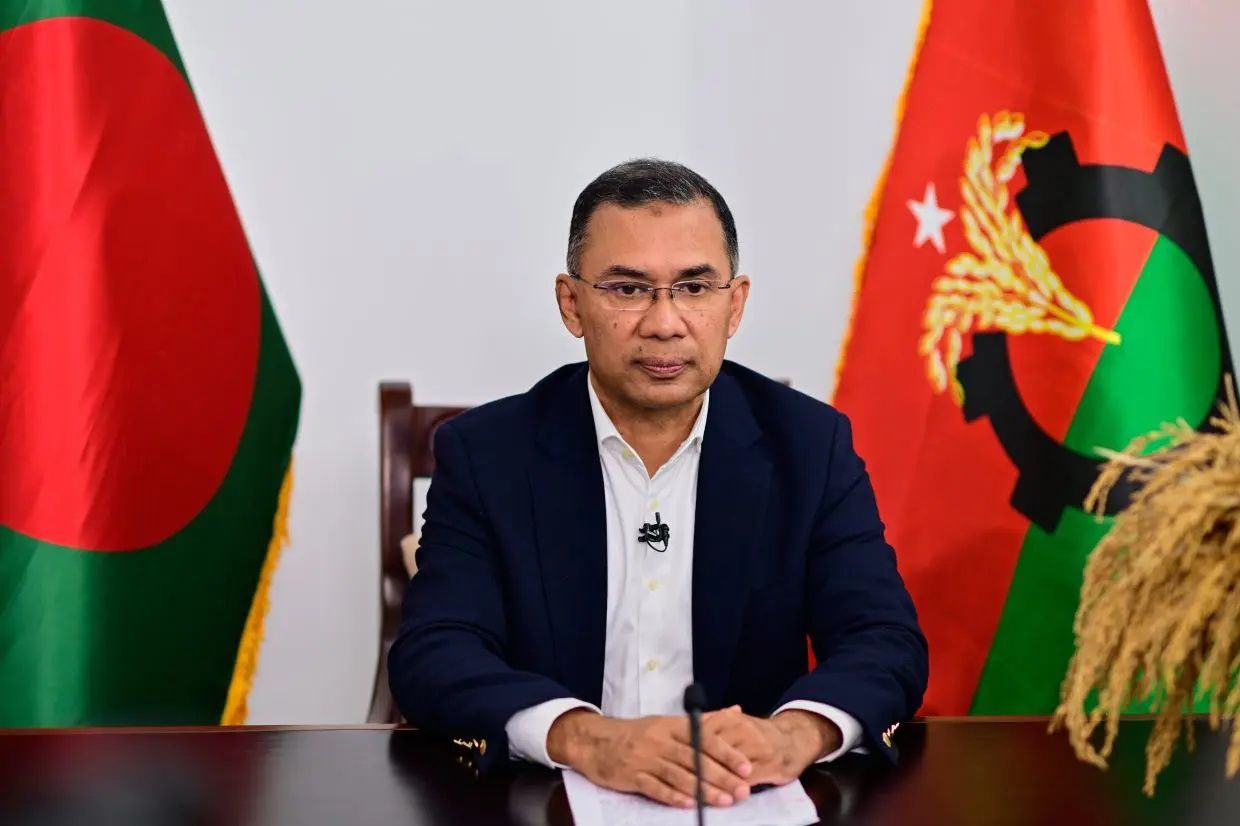
Bangladesh Prime Minister Tarique Rahman is stepping onto the global stage for the first time in his new role, with a carefully planned journey that underscores shifting priorities in South Asian geopolitics. Rather than following the traditional diplomatic protocol of visiting immediate neighbours, Rahman has chosen to begin his foreign engagement in Malaysia before proceeding to China, a strategic choice that carries considerable weight given the region's complex power dynamics.
The two-nation tour, starting Sunday with Malaysia and continuing into China the following day, reflects deliberate positioning by Dhaka's leadership. This is not merely ceremonial globe-trotting. Officials in Bangladesh's foreign ministry have framed the visits as a concerted effort to deepen economic ties and expand the nation's partnership portfolio beyond its immediate geographical sphere. The sequence itself—Malaysia first, China second—suggests an attempt to balance commercial relationships with large-power engagement, rather than leading solely with Beijing's interests.
Malaysia holds particular significance in this diplomatic calculus. The Southeast Asian nation hosts approximately 800,000 Bangladeshi workers, representing more than one-third of Malaysia's total foreign labour force. This human dimension creates powerful mutual interests between the two countries. For Bangladesh, these workers represent vital remittance flows that buttress the national economy and provide employment for millions of families back home. For Malaysia, this workforce has become deeply embedded in manufacturing, construction, and service sectors. The visit allows Rahman to demonstrate commitment to protecting and advancing the interests of this substantial diaspora, a politically important constituency at home.
China figures prominently in the second phase of this tour, with infrastructure development and bilateral trade agreements forming the core agenda. Most notably, discussions are expected to centre on the long-stalled Teesta River project, a massive undertaking designed to restore and harness one of Bangladesh's crucial waterways through comprehensive dredging, embankment reinforcement, and irrigation system development. Chinese investment and technical expertise have been critical to advancing this initiative, which has faced repeated delays and complications. Beijing's willingness to commit resources to such projects signals its strategic interest in cementing influence in Bangladesh at a moment when the country's political orientation remains somewhat uncertain.
The diplomatic timing is revealing. Rahman assumed office in February following elections, taking the reins from an interim administration that had governed since the tumultuous 2024 uprising that toppled Prime Minister Sheikh Hasina. That popular uprising fundamentally altered Bangladesh's political trajectory and its relationship with India, which had backed Hasina's government. The ousted premier remains in hiding in India, and Dhaka has repeatedly demanded her extradition—demands India has rebuffed. This unresolved situation has become a persistent irritant in bilateral relations, preventing any genuine normalisation despite modest improvements since Rahman's election victory.
The fraught India-Bangladesh dynamic forms the unspoken backdrop to Rahman's foreign tour. Geographically, Bangladesh is almost entirely surrounded by Indian territory, creating unavoidable interdependence alongside rivalry. New Delhi has long viewed China's expanding influence in South Asia with considerable wariness, seeing it as a challenge to Indian regional preeminence. The competition between Asia's two most populous nations for influence across South Asia remains a defining feature of contemporary geopolitics. By visiting China so early in his tenure, Rahman signals that Dhaka intends to maintain strategic autonomy and will not be confined to an India-centric regional framework.
Border tensions have further complicated the relationship. India has been accused of systematically sending individuals it classifies as illegal migrants across the frontier into Bangladesh, a practice that Dhaka views as a unilateral burden-shifting tactic. These incidents reflect deepening mistrust and underscore why Bangladesh sees value in cultivating partnerships elsewhere in Asia. Rahman's government appears determined to reduce its vulnerability to Indian pressure by developing alternative relationships with economically powerful nations and regional powers.
The rehabilitation of India-Bangladesh ties since Hasina's ouster has been incomplete and fragile. While the acute hostility that characterised the final years of Hasina's tenure has diminished, fundamental trust deficits persist. The extradition issue remains unresolved, and New Delhi's apparent reluctance to address Bangladeshi concerns about border management suggests that structural tensions will endure. Against this backdrop, Rahman's decision to prioritise Malaysia and China signals that Dhaka will pursue a more diversified foreign policy rather than gravitating exclusively toward its larger neighbour.
For Malaysia, hosting Rahman early in his premiership represents an opportunity to strengthen the relationship and potentially expand cooperation beyond labour migration into sectors such as trade, investment, and cultural exchange. The presence of such a large Bangladeshi community means that developments in the bilateral relationship affect hundreds of thousands of families and generate significant political attention in both capitals. Rahman's visit allows both governments to reaffirm commitment to managing this relationship constructively.
China's position in this diplomatic dance merits careful attention. Beijing has long pursued patient, sustained engagement across South Asia, and Bangladesh represents an important component of this strategy. Investment in projects like the Teesta initiative, combined with broader infrastructure development under frameworks such as Belt and Road Initiative participation, positions China as a development partner with both resources and technical capacity. For a government like Rahman's, seeking to consolidate legitimacy through economic performance and visible development progress, such partnerships hold genuine appeal.
The broader implications extend beyond bilateral relations. Rahman's tour reflects an emerging pattern where South Asian nations increasingly seek to balance relationships rather than defaulting to India-centric alignments. This multipolar approach to foreign policy, evident in Bangladesh's cultivation of ties with China, Japan, and regional Southeast Asian partners, suggests a region in transition. The old certainties of India's unquestioned regional dominance are giving way to more complex, genuinely competitive diplomatic engagement.
As Rahman embarks on this tour, he carries with him the expectations of a nation navigating profound political change. The 2024 uprising demonstrated popular desire for governance that serves Bangladesh's interests more directly, unconstrained by entangling commitments to external powers. By visiting Malaysia and China, Rahman signals that his government intends to deliver on this aspiration by pursuing economic partnerships that create genuine benefits for Bangladesh's population, while maintaining strategic independence in a region where larger powers constantly manoeuvre for advantage.

