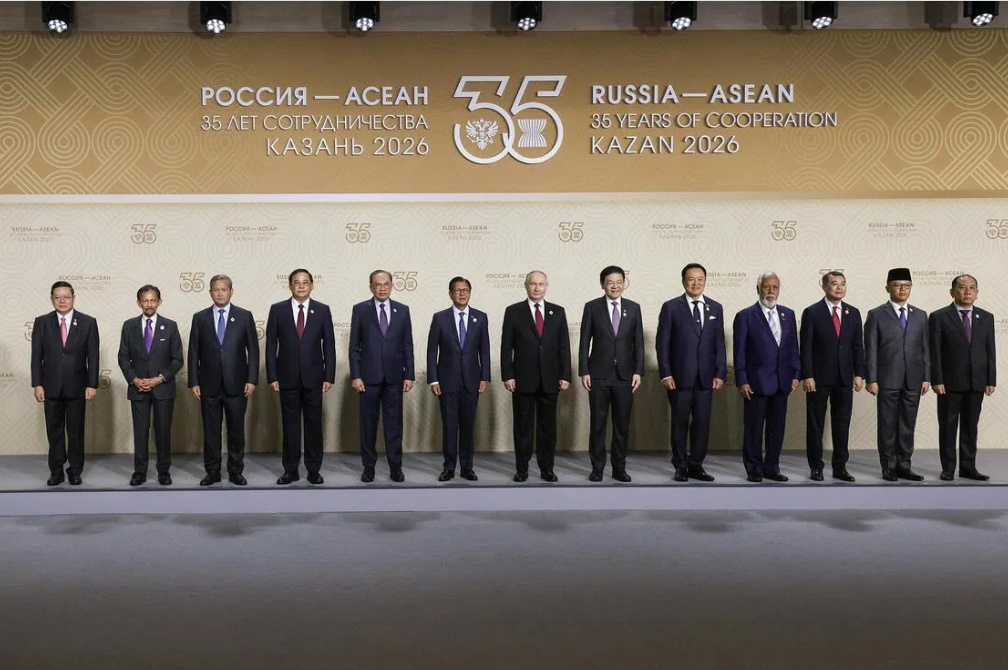
The Asean-Russia Commemorative Summit in Kazan has underscored the sustained commitment between Southeast Asia's regional bloc and Moscow to expand their partnership across multiple sectors. Held on June 17 and 18 and hosted by President Vladimir Putin, the gathering marked a significant milestone: 35 years since Asean and Russia first established diplomatic relations, alongside the 30th anniversary of their formal Dialogue Partnership. The summit's significance extends beyond ceremonial recognition, with participating nations adopting several foundational documents designed to guide bilateral and multilateral engagement through the coming decade.
Three key agreements emerged from the proceedings, each establishing frameworks for deepened institutional cooperation. The Kazan Declaration reviewed the trajectory of Asean-Russia relations over three and a half decades while outlining a strategic vision for future collaboration. This declaration calls for intensified engagement across a diverse portfolio of sectors including maritime affairs, commercial and investment activities, energy resources, infrastructure connectivity, security matters, educational programmes, and cultural initiatives. Complementing this overarching statement, negotiators finalised a Joint Statement on Cultural Cooperation that emphasises strengthening interpersonal bonds between Russian and Southeast Asian citizens through expanded cultural exchange mechanisms. The most operationally concrete outcome was the Asean-Russia Comprehensive Plan of Action spanning 2026 to 2030, a five-year roadmap designed to translate high-level diplomatic commitments into tangible cooperative projects and initiatives.
Prime Minister Lawrence Wong's remarks at the summit illuminated Singapore's perspective on the value of pragmatic engagement with Russia despite geopolitical tensions elsewhere. Wong articulated a position that Asean member states should concentrate collaborative efforts on domains where interests demonstrably align, while simultaneously strengthening confidence-building mechanisms and dialogue initiatives that promote regional stability and prosperity. This framing reflects a broader Southeast Asian diplomatic strategy of maintaining relationships across competing international blocs while prioritising issues directly affecting the region. Wong specifically commended Russia's historical recognition of Asean Centrality—the principle that the region should remain the strategic fulcrum of Indo-Pacific affairs—and noted Moscow's sustained participation in Asean-led institutional forums including the Asean Regional Forum and East Asia Summit.
Practical cooperation opportunities extend into areas with immediate relevance for Southeast Asian states. Wong identified disaster management and counter-narcotics operations as priority domains where Asean and Russia can marshal complementary capabilities. Educational and cultural exchanges represent another avenue of deepening ties; Wong highlighted that Russian officials regularly participate in civil service training programmes across Asean member states, including Singapore itself. This people-to-people dimension of the relationship, often overshadowed by geopolitical considerations, represents a substantial foundation of mutual understanding and institutional familiarity that transcends periodic diplomatic tensions.
The summit occurs against a backdrop of substantial global uncertainty that Wong characterised as increasingly unpredictable and volatile. Within this constrained geopolitical environment, Singapore has advocated strongly for international law and the rules-based global order as essential stabilising frameworks. This emphasis reflects acute Southeast Asian concerns regarding unilateral action and the erosion of norms governing state behaviour, particularly given the region's geographical dependence on freedom of navigation through strategically critical waterways. Wong underscored Asean's commitment to maintaining unobstructed transit through key international maritime passages in accordance with the United Nations Convention on the Law of the Sea, a position with obvious implications for global commerce and regional security.
Wong's comments regarding major international conflicts revealed Singapore's consistent application of principled foreign policy positions rather than alignment with any particular great power. Regarding Ukraine, Wong explained that Singapore's criticisms of Russia's military actions stem not from strategic partnership with Western powers but from unwavering commitment to principles of state sovereignty and territorial integrity as enshrined in the UN Charter. Singapore's 2022 decision to impose sanctions and restrictions on Russia remains in effect, yet Wong's remarks indicate willingness to compartmentalise disagreements on specific issues from broader cooperative frameworks. This balancing act requires considerable diplomatic dexterity, particularly as Southeast Asian nations navigate competing pressures from major powers pursuing influence in the region.
The situation in the Middle East, where a peace agreement between the United States and Iran had recently emerged, garnered Wong's particular attention. He expressed hope that this agreement could enable permanent resolution of the underlying conflict and restoration of normal commerce through the Strait of Hormuz, a waterway of critical importance to Asian energy security and trade. The mention of this development signals Southeast Asia's keen interest in stabilising a geopolitical hotspot whose volatility directly affects regional prosperity. Disruptions to Middle Eastern peace or maritime security translate quickly into elevated energy prices and shipping costs that ripple through Southeast Asian economies heavily dependent on imported oil and international commerce.
On the bilateral level, Wong met separately with President Putin, a scheduling arrangement initiated at the Russian leader's request. During these discussions, the two leaders surveyed the current state of bilateral relations alongside regional and international developments. Wong expressed Singapore's enthusiasm for expanded cooperation with Russia during Singapore's upcoming tenure as Asean Chair in 2027, indicating sustained interest in institutional coordination despite existing policy differences. The bilateral engagement underscores that even amid disagreements on major international questions, both sides recognise sufficient common ground and institutional value in maintaining regular high-level dialogue.
Wong also convened with Rustam Minnikhanov, the Rais (president) of the Russian republic of Tatarstan, reflecting Singapore's sustained engagement with Russia's constituent regions. Singapore-Tatarstan relations extend back to at least 2007, when then-Minister Mentor Lee Kuan Yew visited the region, establishing a diplomatic foundation spanning nearly two decades. The discussion between Wong and Minnikhanov covered cultural, educational, and people-to-people cooperation, demonstrating that Asean engagement with Russia operates across multiple institutional levels beyond central government relationships.
The Kazan summit ultimately illustrates a Southeast Asian approach to major power relations characterised by pragmatism rather than ideological alignment. While Singapore and other Asean members maintain principled positions on international law and rules-based order—positions that sometimes place them at odds with Russian policies—they simultaneously recognise opportunities for cooperation in areas of mutual benefit. This strategy allows the region to maintain relationships across geopolitical divides while advancing its own interests in stability, security, and economic development. As the international environment grows more contested, such balanced engagement may become increasingly valuable for a region seeking to remain prosperous and autonomous rather than drawn into zero-sum great power competition.