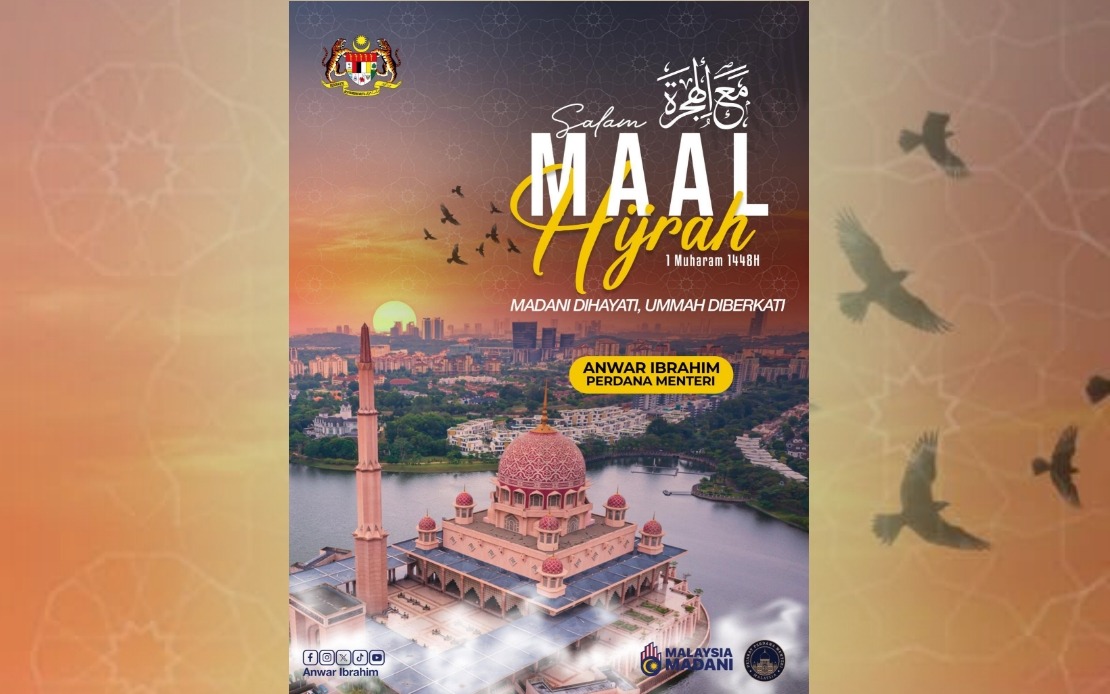
Prime Minister Datuk Seri Anwar Ibrahim has underscored the necessity of collective action and broad consensus in translating the spiritual lessons of Hijrah into tangible national reforms that prioritize justice, truth, prosperity and security. Speaking on the occasion of Maal Hijrah 1448H, the Premier drew parallels between the Prophet Muhammad SAW's historic migration to Madinah and the contemporary challenges facing Malaysia's reform programme, positioning unity as the essential foundation for meaningful change across the nation's diverse population.
The Hijrah, which marked the Prophet's departure from Mecca to Madinah, represents far more than a geographical relocation in Islamic history. Instead, Anwar emphasized, it symbolized the establishment of a thriving civilization built on collaborative principles and shared purpose. The narrative of this transformative journey, the Prime Minister noted, demonstrates that monumental achievements emerge not from the efforts of isolated individuals or solitary institutions, but rather through disciplined teamwork rooted in common faith and values. This historical framework provides, in Anwar's framing, a template for understanding how modern Malaysia might approach its own developmental trajectory.
Central to Anwar's message was recognition of the diverse roles played by participants in the original Hijrah. The Prime Minister specifically highlighted the instrumental contributions of youth figures such as Saidina Ali Abi Talib, the indispensable support provided by women including Asma Abu Bakar, and the broader ecosystem of companions whose organizational efforts and personal sacrifices made the migration possible. By invoking these examples, Anwar implicitly argued that national transformation in contemporary Malaysia similarly requires mobilizing talent across generational and gender lines, rejecting any approach that concentrates responsibility within narrow institutional or political boundaries.
The Premier acknowledged the formidable difficulty of translating Hijrah's spiritual principles into practical policy action within Malaysia's modern, multifaith context. Rather than presenting reform as an inevitable trajectory, he emphasized the sustained effort required to navigate the complexities of building consensus among a heterogeneous society characterized by varying worldviews, interests and priorities. This candid assessment suggests Anwar recognizes that invoking religious concepts, however deeply resonant, does not automatically overcome structural obstacles to cooperation. Instead, the process demands patience, deliberation and genuine commitment to accommodating divergent perspectives.
Critically, Anwar rejected the notion that rhetorical flourishes, catchy political slogans or isolated institutional initiatives could constitute adequate substitutes for genuine collaborative reform. His insistence that "success will not come merely through rhetoric, slogans and individual effort" represents an implicit critique of approaches that prioritize communication over substantive consensus-building. This distinction carries significant implications for how Malaysia's governing structures might need to evolve to facilitate the kind of deep engagement across political parties, civil society organizations, religious groups and communities that authentic reform arguably demands.
The Prime Minister emphasized that reform efforts reflecting Hijrah's spirit must represent collective undertakings rather than initiatives championed by any single political party or governmental institution. This framing potentially signals openness to incorporating opposition perspectives, civil society expertise and grassroots input into the reform process, though it remains unclear how such institutional arrangements might be formalized or operationalized. The statement may also represent an attempt to reposition Malaysia's reform agenda as transcending partisan politics, appealing instead to shared national and religious values that theoretically command broader assent.
Anwar's invocation of Quranic verse 100 from Surah An-Nisa, which addresses the spiritual reward awaiting those who migrate for Allah's cause, served to link Hijrah's historical resonance with contemporary moral imperatives. The Prime Minister's characterization of Hijrah as simultaneously "sacrifice, struggle, brotherhood" and "unity-building" created a multilayered conceptual framework suggesting that reform necessarily entails loss, effort and relationship-strengthening alongside institutional innovation. This approach transforms potential resistance to reform into an opportunity for collective spiritual and national maturation.
The Department of Islamic Development Malaysia (Jakim) complemented the Prime Minister's message by unveiling the theme for this year's National Maal Hijrah Celebration: "MADANI Dihayati, Ummah Diberkati" (MADANI Embraced, The Ummah Blessed). The selection of this theme explicitly links the government's MADANI framework—which has served as the broader political umbrella for policy initiatives—with the Hijrah narrative, suggesting the administration views this religious observance as an opportune moment for reinforcing the spiritual and moral foundations underlying its policy direction.
For Malaysian observers and regional analysts, Anwar's framing represents an effort to ground the government's reform agenda in Islamic intellectual traditions while simultaneously emphasizing inclusive governance principles. By drawing on Hijrah's historical emphasis on collaborative institution-building and acknowledging the essential contributions of diverse participants, the Premier attempts to position reform as compatible with pluralistic values and broad-based participation. However, the practical mechanisms through which such consensus-driven reform might overcome entrenched institutional interests, bureaucratic resistance and political opposition remain largely unspecified, raising questions about whether the government possesses sufficient political will and structural capacity to operationalize its stated commitment to unity and collective endeavor.
The invocation of Hijrah during an election cycle and amid ongoing debates about the pace and substance of Malaysia's governance reforms carries additional significance. By emphasizing sacrifice and struggle, the Prime Minister may be preparing the public for difficult choices and trade-offs inherent in ambitious reform programmes. Simultaneously, the focus on unity potentially serves to delegitimize opposition critiques as sectional or particularistic rather than national in orientation, a rhetorical move that neutralizes political resistance while appearing to embrace inclusivity.
For Southeast Asian governments wrestling with similar challenges of balancing rapid institutional reform with social cohesion, Anwar's emphasis on the need for patient consensus-building and acknowledgment of diverse contributions offers a model worth examining. Whether Malaysia's political system can translate these high-minded principles into sustainable governance structures that genuinely distribute decision-making authority across competing constituencies remains an open question. The coming months will reveal whether the government's commitment to consensus-driven reform extends beyond ceremonial invocations to substantive institutional redesign.

