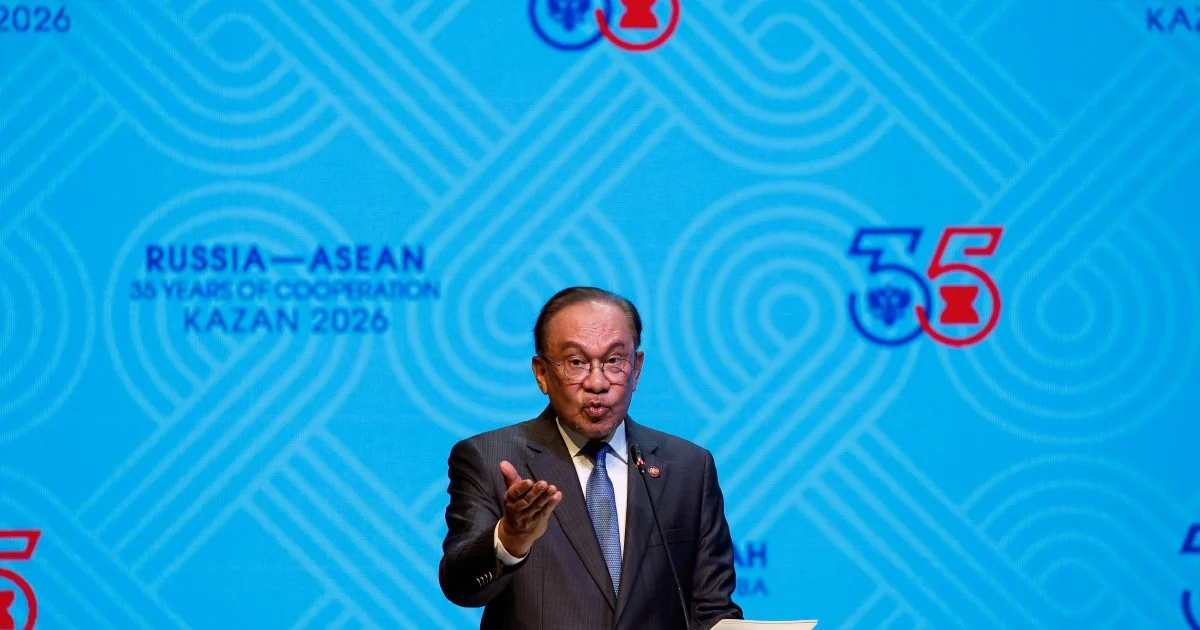
Prime Minister Datuk Seri Anwar Ibrahim has endorsed the completion of the Asean-Russia Strategic Programme on Trade and Investment Cooperation 2026-2035, signalling Malaysia's commitment to strengthening economic partnerships between Southeast Asia and Russia despite geopolitical headwinds. Speaking in Kazan, the Malaysian leader acknowledged that finalising the comprehensive framework represents a watershed moment for bilateral commerce, though he stressed that the roadmap's success hinges on establishing the necessary institutional and regulatory conditions to translate strategic intent into measurable outcomes.
The ten-year programme marks a significant development in regional diplomacy, coming at a time when Asean has been recalibrating its economic relationships beyond traditional Western partners. Malaysia, as a major trading nation with diverse export interests ranging from palm oil to semiconductors, stands to benefit substantially from improved market access to Russia and expanded investment opportunities in energy and resources sectors. The strategic nature of the initiative underscores Asean's broader positioning as a non-aligned bloc capable of pursuing pragmatic economic partnerships across multiple geopolitical camps.
Anwar's emphasis on creating an enabling environment reflects a sophisticated understanding of the practical challenges confronting cross-regional trade partnerships. Beyond signing agreements, nations must harmonise technical standards, reduce bureaucratic impediments at customs boundaries, and establish stable frameworks that encourage private sector participation. For Malaysian businesses, particularly small and medium enterprises seeking to diversify their geographic footprint, such facilitative measures are crucial for converting policy aspirations into commercial reality. The absence of proper infrastructure and clarity on implementation mechanisms has historically derailed ambitious regional initiatives.
The timing of this roadmap's finalisation carries strategic weight given the current international environment. Asean's traditional trading partners have become increasingly protectionist, and Russia—despite Western sanctions—remains a substantial economy with significant natural resource wealth and untapped consumer markets. For Malaysia, the initiative offers a chance to differentiate its economic strategy and reduce dependency on cyclical commodity markets by developing more diversified partnerships.
The programme's scope likely encompasses multiple sectors beyond traditional goods trade. Investment cooperation frameworks, technology transfers, and joint ventures in infrastructure development could create new avenues for Malaysian companies to participate in Russian and broader Central Asian markets. The inclusion of smaller Asean economies alongside regional heavyweights like Indonesia and Vietnam suggests a commitment to inclusive growth, though Malaysian business interests must be carefully protected to ensure fair competition and access.
Anwar's cautious optimism also reflects lessons learned from previous regional initiatives that faced implementation delays. The Asean Economic Community, while transformative, encountered persistent barriers to seamless trade and investment flows. Success with the Russian programme requires commitment from both sides to institutionalise dispute resolution mechanisms, establish clear timelines for tariff reductions, and create transparent investment protection standards that reassure both Malaysian and Russian investors of fair treatment.
From a Malaysian perspective, the roadmap opens opportunities particularly in sectors where the nation possesses comparative advantage. Russian demand for agricultural products, refined petroleum, and manufactured goods aligns with Malaysian export capabilities. Conversely, imports of Russian energy resources, metals, and chemicals could diversify Malaysia's supply chains and reduce vulnerability to disruptions in traditional sourcing regions. The economic complementarity between the two regions suggests substantial untapped potential.
The framework also positions Asean as an independent actor in global trade negotiations, neither subordinate to Western-led arrangements nor entirely dependent on Chinese economic dominance. For Malaysia, which maintains complex relationships with multiple powers, the Russian partnership exemplifies the country's broader strategic hedging approach. This flexibility allows Malaysian policymakers to optimise economic gains while preserving strategic autonomy.
However, obstacles remain. Western sanctions on Russia could complicate payment mechanisms and banking relationships, particularly for Malaysian financial institutions with exposure to Western regulators. Companies must navigate dual compliance requirements, and some sectors may face reputational or regulatory risks. The effectiveness of the roadmap will depend on whether participating nations can develop workarounds—such as alternative payment corridors using Chinese yuan or other non-dollar mechanisms—that facilitate commerce while respecting international constraints.
Implementation capacity within Asean institutions also merits attention. The proposed framework requires coordination among ten member states with varying levels of economic development and institutional sophistication. Malaysia, as a relatively developed economy with robust institutional frameworks, may need to assist smaller partners in capacity-building, though this must be balanced against protecting domestic industries from unfair competition.
Anwar's statement emphasises that structural preconditions—including regulatory harmonisation, intellectual property protection, and dispute resolution mechanisms—cannot be overlooked. These foundation elements determine whether ambitious trade targets translate into sustainable business relationships or remain aspirational statements. The Prime Minister's insistence on rigorous implementation reflects Malaysia's maturation as an economic strategist, moving beyond headline-grabbing declarations toward substantive, results-oriented partnership frameworks.
Looking forward, the success of the Asean-Russia programme could establish a template for Asean's engagement with other non-traditional partners. If properly executed, it demonstrates that Southeast Asia—and Malaysia within it—can diversify economic relationships without sacrificing principles of stability and institutional integrity. The roadmap thus represents not merely a bilateral arrangement but a broader statement about Asean's role in an increasingly multipolar global economy where strategic autonomy and economic pragmatism take precedence over ideological alignment.

