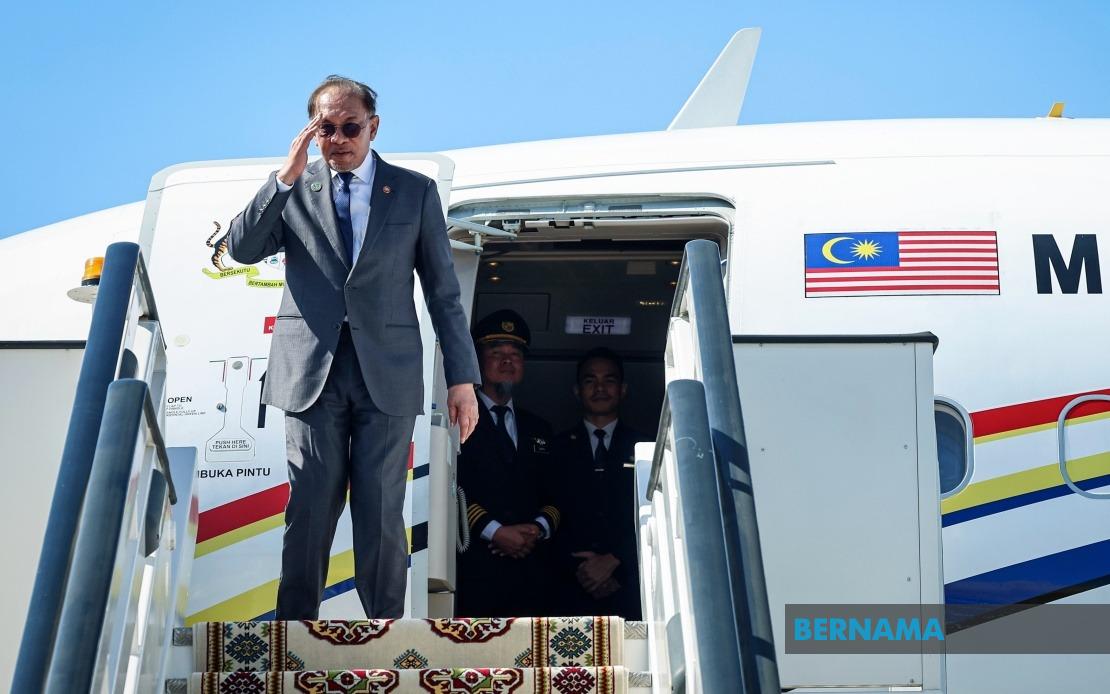
Prime Minister Datuk Seri Anwar Ibrahim transitioned directly from his inaugural official visit to Turkmenistan into a strategically packed working day in Penang on June 20, highlighting the government's dual focus on international diplomacy and domestic investment. His swift movement across Central Asia and back to Malaysia underscores the intensive tempo of contemporary high-level statecraft, where leaders are expected to juggle multiple portfolios and geographical commitments simultaneously. The transition also reflects how Malaysian leadership is positioning the country as an active participant in regional and international affairs while maintaining momentum on domestic economic initiatives.
Anwar's schedule in Penang began with the inauguration of MKS Instruments Malaysia Sdn Bhd at Bandar Cassia Technology Park in Batu Kawan at 11 am. This semiconductor and instrumentation facility represents the type of precision manufacturing venture that Malaysia has been cultivating as part of its broader industrial diversification strategy, particularly as the country seeks to move beyond traditional manufacturing and resource extraction. The establishment of such technology-focused enterprises in Penang, already home to numerous multinational tech and electronics firms, strengthens the state's identity as a regional innovation hub and creates employment for skilled workers in high-value sectors.
At 1 pm, Anwar proceeded to Bandar Setia Fontaines in Kepala Batas for the groundbreaking ceremony of the Setia Fontaines Industrial Park. This project is positioned as a major component of broader economic development in Penang and the Northern Corridor, a region that has historically received less investment attention compared to the Klang Valley and other peninsular hotspots. The industrial park announcement signals developer Setia's confidence in Northern Corridor growth potential and suggests that the government's regional development initiatives are succeeding in attracting private capital to less industrialised areas. The project also promises to generate construction employment, operational jobs, and supply chain opportunities for local businesses in the region.
Beyond the primary industrial park launch, Setia revealed two additional strategic partnerships within the broader Setia Fontaines township development. These collaborations, though not detailed in available accounts, likely involve infrastructure providers, logistics operators, or downstream manufacturing partners seeking to establish themselves in the emerging industrial ecosystem. Such clustering of related enterprises is economically valuable, as it reduces transaction costs, facilitates knowledge transfer, and creates opportunities for supply chain integration among residents of the park.
The centrepiece of Anwar's Penang agenda, however, was his attendance at the HAWANA 2026 Grand Finale at PICCA Convention Centre @ Butterworth Arena. The event, expecting approximately 1,000 media practitioners from Malaysia and internationally, represents one of the year's most significant gatherings of the journalism profession. As both Prime Minister and Finance Minister, Anwar's presence underscores government recognition of media's role in democratic institutions and public accountability. His participation signals that the administration views engagement with journalists as an investment rather than an obligation.
During the ceremony, Anwar presented the HAWANA Award and Special HAWANA Award to individuals judged to have made exceptional contributions to journalism and the development of informed public discourse in Malaysia. These awards serve a dual purpose: honouring individual excellence while establishing professional benchmarks for the broader journalism community. In an era of declining trust in media institutions globally and the proliferation of misinformation, such recognition of quality journalism becomes particularly valuable. It sends a message that rigorous, ethical reporting remains essential to democratic functioning and deserves acknowledgment from the highest levels of government.
Additionally, Anwar distributed contributions from Tabung Kasih@HAWANA to media practitioners experiencing financial hardship. This welfare component of the ceremony addresses a persistent challenge within the journalism profession, where freelancers, senior reporters, and journalists from smaller outlets frequently experience income instability and limited access to retirement benefits. The assistance fund provides practical support while affirming collective professional responsibility for those facing economic difficulty.
HAWANA itself, organised by the Communications Ministry with Bernama (Malaysian National News Agency) as implementing agency, functions as Malaysia's premier platform for recognising media contributions and professionalism. The annual programme has evolved into a comprehensive platform that celebrates journalists across various specialisations and media formats, from print and broadcast to digital platforms. By institutionalising recognition of media excellence, the government is implicitly endorsing the journalism profession's importance to Malaysian society and encouraging young people to consider careers in journalism despite industry challenges.
Anwar's Turkmenistan visit, from which he had just returned, constituted his first official trip to that Central Asian nation since becoming Malaysia's 10th Prime Minister in November 2022. He travelled at the invitation of President Serdar Berdimuhamedov, reflecting Malaysia's interest in broadening bilateral relationships beyond traditional Southeast Asian and East Asian partners. This engagement with Turkmenistan likely encompassed discussions on energy cooperation, given Turkmenistan's position as a significant gas exporter, and possibly explored opportunities for Malaysian businesses in the region.
The Turkmenistan visit itself was preceded by Anwar's participation in the 35th ASEAN-Russia Commemorative Summit in Kazan, where he was accompanied by Investment, Trade and Industry Minister Datuk Seri Johari Abdul Ghani and Economy Minister Akmal Nasrullah Mohd Nasir. This Russia engagement reflects Malaysia's hedged approach to great power relations and its commitment to maintaining dialogue channels with all major powers, a diplomatic posture particularly important for a middle-power nation navigating geopolitical complexities.
Following his Penang commitments, Anwar's schedule continued into the evening with attendance at the Himpunan Pertubuhan Lima Generasi (PLG) Malaysia dinner in Negeri Sembilan. This back-to-back scheduling across three states in a single day illustrates the demanding nature of contemporary political leadership in Malaysia, where the Prime Minister must balance international travel, domestic economic promotion, recognition of professional communities, and engagement with civil society organisations.
The compressed itinerary reflects broader patterns in Malaysian governance where leaders maintain simultaneous involvement across foreign policy, economic development promotion, and domestic stakeholder management. For Malaysian readers and regional observers, these activities demonstrate the government's multifaceted agenda: strengthening international relationships, attracting investment to develop regional economies, recognising professional excellence, and maintaining visible engagement with various constituencies. The successful execution of such packed schedules requires sophisticated coordination among multiple ministries and agencies.