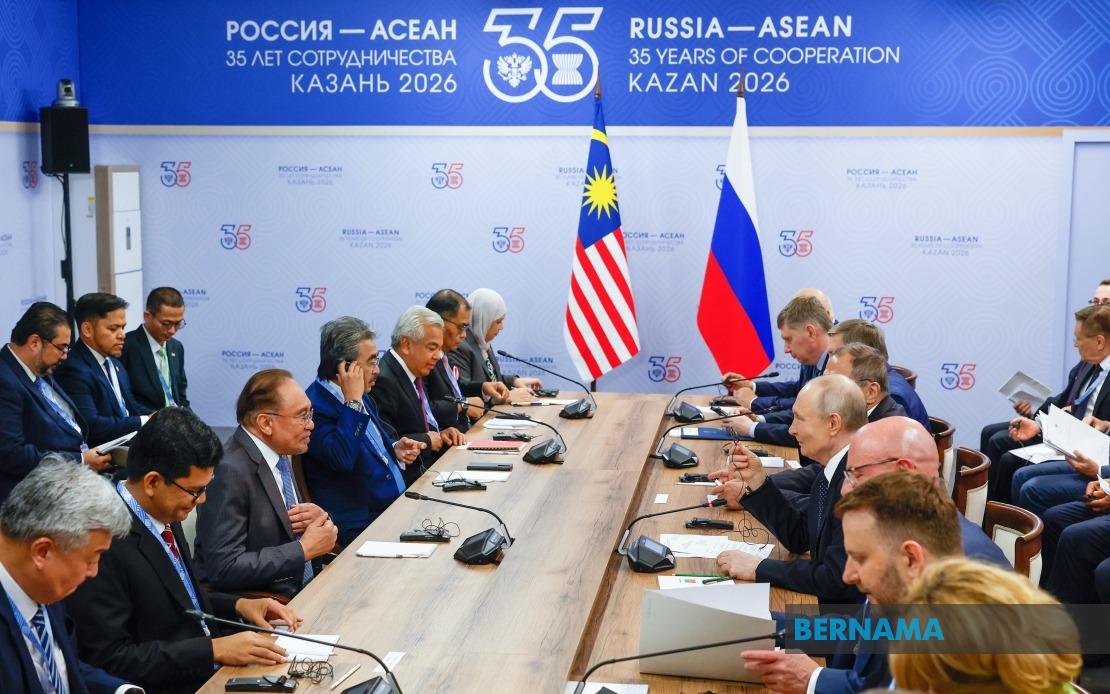
Prime Minister Datuk Seri Anwar Ibrahim has publicly acknowledged Russian President Vladimir Putin and Chinese President Xi Jinping for their advocacy of peace and their condemnation of atrocities affecting civilians in Gaza, Iran, and Lebanon. These remarks, delivered during an exclusive interview with Russian state television network RT, reflect Malaysia's diplomatic positioning on one of the world's most volatile geopolitical flashpoints and underscore Kuala Lumpur's commitment to maintaining an independent foreign policy stance amid great power competition.
Anwar made these statements while attending the Commemorative Summit in Kazan, Russia, which marked the 35th anniversary of ASEAN-Russia diplomatic relations. The timing and venue of his comments carry significance, signalling Malaysia's willingness to engage constructively with both Russia and China while navigating the complex web of Middle Eastern conflicts. The Prime Minister emphasised that Malaysia has consistently adopted a principled position against what he termed attacks by the Zionist regime, with parliamentary support that transcended partisan political divisions.
Central to Anwar's remarks was his articulation of Malaysia's diplomatic philosophy, which he framed around the concept of centrality rather than neutrality. This distinction carries profound implications for understanding how Kuala Lumpur approaches controversial international issues. According to Anwar, Malaysia and ASEAN deliberately eschew the terminology of neutrality precisely because adopting such a stance would imply indifference to human rights violations and mass atrocities. Instead, the principle of centrality allows Malaysia to take principled positions on humanitarian concerns while remaining unaligned to any particular superpower's ideological camp or strategic interests.
The Prime Minister elaborated that this approach has guided Malaysia's engagement with diverse stakeholders in the region. He disclosed that he had maintained dialogue with leaders from the Gulf states, Pakistan, Turkey, and Iran as part of broader efforts to secure a just resolution to the ongoing conflicts. These varied engagements reflect a strategic effort to remain connected to multiple power centres and regional players, thereby preserving Malaysia's capacity to exercise independent judgment on critical issues affecting international peace and security.
A striking element of Anwar's commentary was his pointed criticism of what he characterised as Western hypocrisy in its handling of Middle Eastern conflicts. He questioned the logical consistency of international powers that condemn aggression in principle while simultaneously supporting or condoning actions by Israel, particularly when backed by United States military and diplomatic support. This critique extends beyond mere rhetorical objection; it touches on fundamental principles of international law and the rules-based order that Malaysia and other developing nations argue should govern state behaviour uniformly.
Anwar's remarks also addressed the asymmetrical international response to different actors in the Middle East. He drew attention to what he perceived as a glaring contradiction: while some commentators scrutinise Iran's military responses, there exists what he termed complete silence regarding alleged aggression against Iran itself. This observation highlights a persistent grievance among non-aligned nations that international media and diplomatic institutions apply double standards when evaluating the conduct of Western-aligned versus non-aligned states. For Malaysia, articulating this perceived disparity publicly serves both domestic political purposes and signals to regional audiences that Kuala Lumpur will not reflexively align with Western geopolitical narratives.
The Prime Minister acknowledged that navigating these complex geopolitical crosscurrents remains challenging, even as Malaysia endeavours to maintain its principled independence. This candid admission reflects the genuine difficulty faced by middle-power nations attempting to uphold their stated values while managing relationships with much larger powers upon which they depend economically and strategically. Malaysia's economic ties with China, its security relationships with the United States, and its cultural connections with the Islamic world create competing pressures that require careful diplomatic balancing.
Anwar's commendation of Putin and Xi specifically for their peace advocacy carries strategic significance beyond symbolic gesture-making. By publicly acknowledging the positions of Russia and China on Middle Eastern issues, Anwar signals that Malaysia appreciates these nations' willingness to challenge what it views as Western-centric interpretations of international crises. This approach serves multiple purposes: it demonstrates to domestic audiences that Anwar's government prioritises principles over expedience, it validates the concerns of Malaysia's Muslim-majority population regarding Palestinian and broader Muslim rights, and it subtly reinforces Malaysia's claim to a seat at the table in discussions about regional and global order.
The broader context of Anwar's statements involves Malaysia's historical commitment to non-alignment and its role within ASEAN, which has consistently sought to maintain strategic autonomy from major power blocs. Malaysia's voting patterns at the United Nations on Middle Eastern issues, its participation in Islamic solidarity forums, and its domestic political sensitivities regarding the Palestinian cause all converge to explain why the Prime Minister chose to articulate these positions during his Russia visit. The decision to use RT as the platform for these remarks, rather than domestic Malaysian media, signals an intention to communicate with international audiences while maintaining a posture of careful diplomacy.
For Southeast Asian observers, Anwar's statements reflect broader tensions within the region regarding how ASEAN member states should respond to major power competition and international crises that do not directly involve Southeast Asia. While ASEAN maintains an official position of non-interference in affairs outside the region, individual member states have increasingly felt compelled to take positions on issues such as the Ukraine conflict, Taiwan, and Middle Eastern security. Anwar's emphasis on centrality as distinct from neutrality provides one framework through which ASEAN nations attempt to reconcile these competing imperatives.
The implications of these remarks extend to Malaysia's domestic politics as well. By publicly aligning Malaysia's position with peace advocacy and humanitarian concerns, Anwar appeals to constituencies within Malaysia that place high importance on Islamic solidarity and anti-Western sentiment. Simultaneously, by framing Malaysia's approach in terms of universal principles rather than religious solidarity, he attempts to communicate to international partners that Malaysia remains a rational actor pursuing legitimate national interests rather than a state captured by ideological rigidity.
Looking forward, Anwar's commentary suggests that Malaysia will continue pursuing its independent foreign policy approach despite pressures from multiple directions. The Prime Minister's emphasis on engaging with diverse actors—from Russia and China to the Gulf states and Iran—indicates Malaysia's determination to preserve its freedom of manoeuvre in an increasingly polarised international environment. This strategy carries risks, as it may occasionally invite criticism from powers expecting greater alignment, but it also reflects Malaysia's assessment that long-term national interests are best served by maintaining principled independence rather than locking into rigid alliances that could constrain future policy options.

