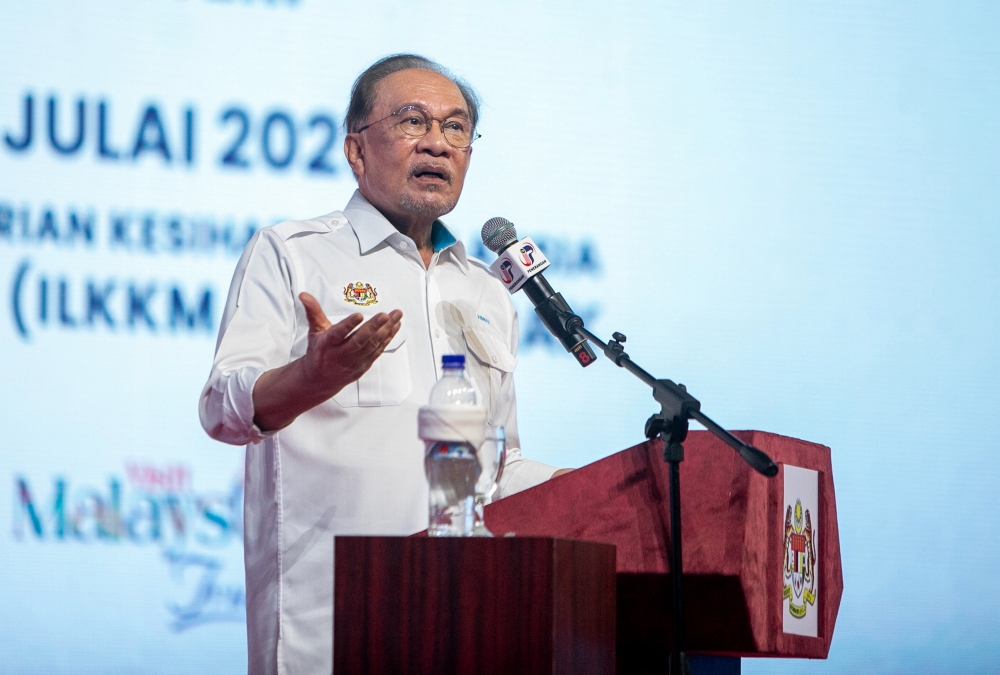
Prime Minister Datuk Seri Anwar Ibrahim has moved to defend the government's approach to fuel pricing, framing the issue as a matter of fiscal prudence rather than populism. Speaking in Kajang, Anwar articulated a position that balances immediate consumer relief against longer-term macroeconomic stability, a tension that has defined Malaysia's energy policy debates for decades. His remarks underscore the administration's struggle to reconcile social welfare commitments with budget constraints in an environment of volatile global commodity prices and persistent inflation.
The fuel subsidy question remains one of Malaysia's thorniest policy dilemmas. Previous governments have grappled with the mathematics of energy support, ultimately concluding that maintaining blanket subsidies creates unsustainable fiscal burdens. When international crude prices spike, as they periodically do, the government must either drain reserves or accumulate deficits to maintain fixed domestic prices. Anwar's intervention signals that his cabinet has adopted a deliberate strategy of communicating the tradeoffs involved, rather than simply announcing policy shifts without explanation. This pedagogical approach reflects recognition that public acceptance of subsidy adjustments depends partly on understanding the broader fiscal narrative.
The Prime Minister's framing places particular emphasis on avoiding debt accumulation as the path to financing fuel support. Malaysia's debt-to-GDP ratio has been a concern for policymakers and credit rating agencies alike, and Anwar appears determined to distinguish his government's fiscal management from previous periods when deficits expanded. By posing the question "Who will pay for it?", Anwar redirects focus from immediate consumer complaint to intergenerational equity and long-term solvency. This rhetorical strategy acknowledges that subsidies do not vanish; rather, they represent costs transferred to future taxpayers or to other budget priorities such as healthcare and education.
The current fuel pricing architecture incorporates elements of both subsidy and market responsiveness. The government has introduced mechanisms such as targeted support for specific groups while allowing prices to adjust within bands that reflect global benchmarks. This hybrid model attempts to protect vulnerable populations without creating the fiscal black hole that fixed subsidies would generate. However, the system remains complex and vulnerable to criticism from multiple angles—those demanding cheaper fuel argue prices are still too high, while fiscal conservatives contend that any support represents inefficient spending.
Anwar's comments arrive as Malaysia confronts broader inflationary pressures that extend far beyond petroleum products. The cost of living crisis has emerged as a major political concern, with households across income levels reporting financial strain. Citizens have grown accustomed to viewing fuel prices as a barometer of government care, a perception that predates the current administration by decades. When fuel prices rise, public dissatisfaction typically intensifies regardless of underlying economic rationale, creating a political penalty that leaders must calculate. Anwar's explicit articulation of the debt constraint suggests the government believes transparency about fiscal limits may prove more politically resilient than silent acceptance of subsidy pressures.
The regional context matters significantly here. Neighbouring countries have pursued different approaches to fuel subsidies with varying degrees of success. Indonesia, which maintains larger energy reserves, has historically sustained more generous fuel support, though even that government eventually had to implement controversial increases. Thailand and the Philippines have implemented more market-oriented pricing while targeting cash transfers to low-income households. Malaysia's positioning between these models reflects its particular circumstances as an oil exporter with modest reserves and substantial fiscal commitments.
From an economic perspective, fuel subsidies create several distortions that extend beyond the immediate budget impact. They encourage consumption patterns that do not reflect true resource costs, leading to inefficient energy use. Subsidy regimes also create opportunities for smuggling across borders where price differentials exceed transport costs, a reality that has affected Malaysia historically. Moreover, targeted subsidy systems require administrative machinery to verify eligibility, introducing complexity and potential for leakage. Anwar's emphasis on fiscal sustainability implicitly acknowledges these broader concerns even if he does not articulate them directly.
The political economy of energy pricing in Malaysia contains historical lessons that remain relevant. Previous governments that shifted suddenly toward market pricing faced public backlash and, in some cases, contributed to political instability. The administration of Abdullah Ahmad Badawi, for instance, encountered significant opposition when fuel prices rose notably in 2008. Conversely, governments that failed to adjust pricing as international costs soared faced mounting deficits and budget crises. Anwar's approach appears calibrated to navigate this history, communicating constraints while implementing incremental rather than shock adjustments.
The question of who bears the ultimate cost of energy support resonates particularly in Malaysian society, where concerns about wealth inequality and fairness occupy considerable political space. If fuel subsidies primarily benefit vehicle owners and industrial consumers rather than the poorest households, the equity case for maintaining blanket support weakens considerably. This observation has prompted some economists and policymakers to argue for replacing price controls with more precisely targeted cash transfers to vulnerable populations. Anwar's framing of the debt question may signal receptivity to such arguments, though the political difficulties of such transitions remain substantial.
Looking forward, Malaysia's fuel policy will likely continue evolving in response to three key pressures: the volatility of global energy markets, the fiscal constraints that limit government borrowing capacity, and the political demands of an electorate sensitive to energy costs. Anwar's defence of current arrangements does not preclude future adjustments, but it establishes an intellectual framework within which those changes might be presented and potentially accepted. By highlighting the debt question, the Prime Minister stakes out a position that distinguishes his administration's approach while maintaining flexibility for policy adaptation. Whether this strategy proves politically durable will become clearer as global conditions and domestic circumstances evolve over coming months.

