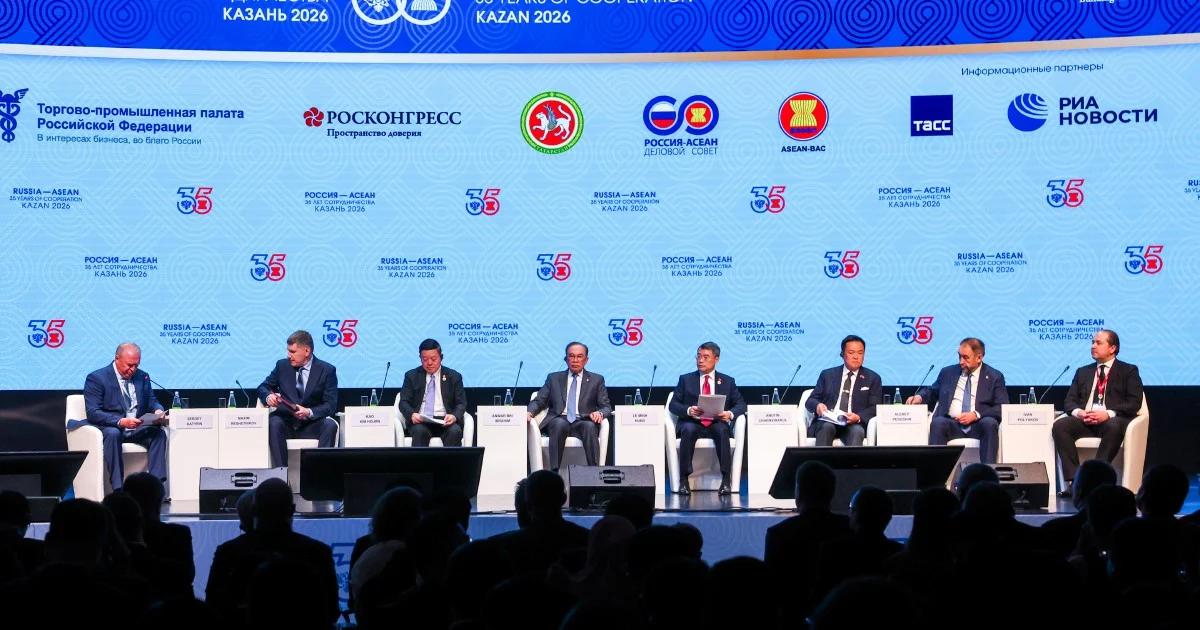
Prime Minister Datuk Seri Anwar Ibrahim has urged Asean and Russia to significantly expand their multilateral partnership, particularly in addressing shared challenges around food security and energy resilience. Speaking during recent engagements in Kazan, Anwar outlined an ambitious agenda that extends beyond traditional diplomatic frameworks to encompass transformative collaboration across several strategic domains essential to both regions' development.
The Malaysian premier's call reflects growing recognition within Southeast Asian capitals that Asean's future prosperity depends on diversifying partnerships and securing supply chains in crucial areas where geopolitical fragmentation threatens stability. Russia, as a global supplier of energy commodities and agricultural products, represents a natural counterpart to Asean's expanding economic footprint and developing consumer markets. For Asean member states already grappling with volatile energy prices and food inflation, deeper engagement with Moscow offers potential avenues for price stabilisation and long-term procurement agreements that could shield the region from external shocks.
Food security has emerged as perhaps the most pressing concern across Southeast Asia, where rising populations and climate vulnerabilities have created structural dependence on imports. Anwar's emphasis on this sector acknowledges the harsh reality that many Asean nations cannot achieve complete self-sufficiency in staple grains and protein sources. Russia's substantial agricultural export capacity, particularly in wheat and fertilisers, could provide Asean members with more reliable alternatives to traditional suppliers whilst reducing exposure to single-source dependencies that historically create price volatility and diplomatic complications.
Energy cooperation forms another cornerstone of the proposed expanded partnership. Southeast Asia's rapid industrialisation and growing electricity demand require sustained investment in infrastructure and fuel supplies. Russian gas and oil continue to attract serious interest despite Western sanctions, and several Asean governments have maintained pragmatic engagement with Russian energy suppliers. Establishing formal frameworks for energy cooperation, whether through long-term contracts, joint ventures in renewable technology development, or infrastructure financing, could reduce Asean's vulnerability to price manipulation whilst providing Russian producers with stable export destinations.
Beyond these traditional sectors, Anwar's proposal encompasses advanced manufacturing, a field where both regions possess complementary strengths. Asean has developed significant manufacturing capabilities and hosts substantial Chinese and Japanese industrial bases, whilst Russia possesses technical expertise, rare materials, and industrial know-how. Collaborative ventures in aerospace, automotive components, or precision engineering could create value chains resilient to geopolitical pressures whilst generating employment across multiple economies.
Digital technologies represent perhaps the highest-growth opportunity within Anwar's proposed framework. Russia maintains competitive advantages in software development, artificial intelligence, and cybersecurity, whilst Asean increasingly recognises digital transformation as essential to remaining globally competitive. Partnerships in e-commerce infrastructure, digital payments, agricultural technology platforms, and smart city solutions could accelerate Asean's technological catch-up whilst benefiting from Russian technical expertise at prices lower than Western alternatives.
Educational exchange assumes particular importance in this broader context, as it builds people-to-people connections that sustain diplomatic relationships through political cycles. Malaysian universities already host Russian students, and expanding scholarship programmes, academic research collaborations, and professional training initiatives could create generations of Southeast Asian leaders comfortable with Russian counterparts and capable of managing bilateral relations during periods of international tension.
Anwar's initiative also reflects Malaysia's distinctive position within Asean as a relatively neutral, non-aligned voice comfortable engaging with diverse powers. Unlike some Western-aligned members potentially constrained by alliance obligations, Malaysia has maintained consistent engagement with Russia even as Western nations imposed sanctions. This positioning allows Malaysian leadership to broker Asean consensus around pragmatic partnerships that serve member states' economic interests whilst avoiding entanglement in great-power conflicts.
The timing of these proposals carries significance, arriving amid global rebalancing where Western economic dominance faces sustained challenge from Asian ascendancy. Asean's own pivot towards diversification reflects sober calculation that overdependence on any single power—whether Western, Chinese, or Indian—creates vulnerabilities incompatible with sustainable development. Structured cooperation with Russia across multiple sectors fits squarely within this strategic framework, offering Asean greater manoeuvre room in navigating great-power competition.
Implementing Anwar's vision will require establishing formal institutional mechanisms rather than relying on ad-hoc bilateral relationships. Creating joint commissions in specific sectors, establishing preferential trade arrangements, and developing dispute-resolution mechanisms would translate political intent into economic reality. Such arrangements demand careful negotiation, particularly where Asean members hold divergent strategic preferences or face pressure from other partners.
For Malaysia specifically, deeper Asean-Russia engagement offers opportunities to position itself as a connectivity hub within Southeast Asia, potentially attracting investment in logistics, finance, and technology sectors supporting regional trade flows. Malaysian enterprises in palm oil, petrochemicals, and electronics manufacturing could benefit from preferential access to Russian markets and Russian technology partnerships.
Looking forward, success depends on Asean's ability to formulate collective positions despite internal divisions, and Russia's willingness to offer Asean members genuine economic benefits rather than merely seeking allies for geopolitical purposes. When both conditions align, the Anwar proposal could reshape regional architecture and demonstrate that Southeast Asian nations can actively shape their futures rather than remaining passive subjects of great-power competition.

