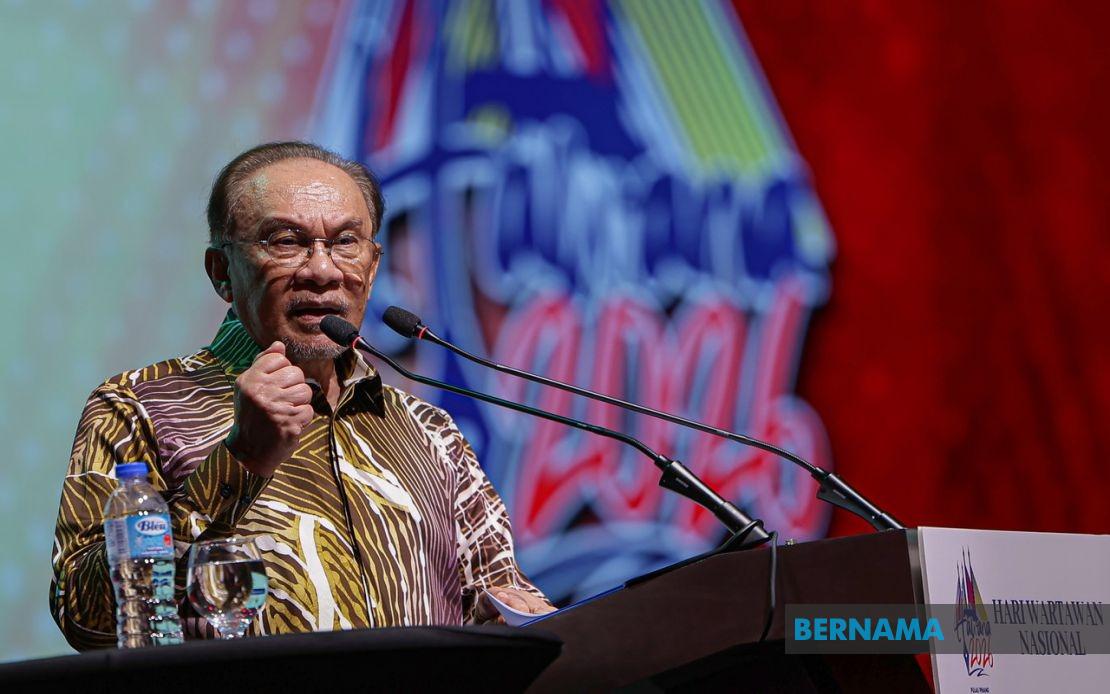
Prime Minister Datuk Seri Anwar Ibrahim has endorsed the appointment of former Federal Court judge Tan Sri Nallini Pathmanathan as the new chairman of the Malaysian Media Council (MMC), expressing confidence that her judicial background and personal standing will substantially elevate the organisation's reputation and restore public confidence in its work. Speaking at the National Journalists' Day (HAWANA) 2026 ceremony in Butterworth on June 20, Anwar highlighted how Nallini's selection represented a deliberate strategic choice, one made only after thorough vetting of her track record, professional credentials and commitment to ethical governance. The Prime Minister's public endorsement carries particular weight given the heightened scrutiny surrounding media regulation in Malaysia and the ongoing debate about how to balance press freedom with standards of professional conduct.
Nallini's appointment arrived following formal unanimous approval by the MMC board during a meeting held on May 26. The appointment itself reflects a broader institutional transition, as the MMC was only recently established under the Malaysian Media Council Act 2025 as an independent self-regulatory mechanism designed to manage the media industry's governance framework. The timing of her ascension to the chairmanship coincides with critical foundational work needed to establish the body's operational credibility and clarify its role in the broader media ecosystem.
The establishment of the MMC under new legislation represents a significant structural development in Malaysia's approach to media governance. Rather than relying primarily on government regulation, the self-regulatory model places responsibility for maintaining journalistic standards, investigating public complaints, and promoting ethical practices directly into the hands of industry figures and institutional leaders. This represents a shift toward collaborative governance where the media industry takes ownership of maintaining professional standards while the state creates the regulatory framework within which that self-regulation operates. For Southeast Asian observers, this approach reflects broader international trends toward media councils as alternatives to more coercive regulatory mechanisms.
Nallini's judicial background holds particular strategic value for the MMC's credibility-building mission. Her distinguished career on the Federal Court, the apex of Malaysia's judiciary, provides her with established credibility across political, legal and professional circles. This matters significantly because media regulation is inherently contentious, with stakeholders constantly questioning whether decisions favour particular political interests or respond to genuine editorial lapses. A chairperson with impeccable judicial credentials and a reputation for fairness can help insulate the body from accusations of bias or political capture, even as critics may always remain sceptical of its independence.
Anwar's specific emphasis on Nallini's integrity and credentials warrants examination within the current political context. The MMC operates against a backdrop of ongoing debate about media freedom in Malaysia, with international press freedom indices consistently highlighting concerns about editorial independence and political pressure on newsrooms. By placing leadership in the hands of someone with undisputed institutional standing outside the political sphere, the government signals an attempt to create space for genuine self-regulation while maintaining overall supervisory responsibility. This distinction matters: the MMC is self-regulatory within a government-created framework, not entirely autonomous, which critics view as a potential constraint on its independence.
The ceremony at which Anwar made his comments brought together significant figures from Malaysia's communications and media landscape. Penang Chief Minister Chow Kon Yeow, Communications Minister Datuk Fahmi Fadzil, senior communications ministry officials, and representatives from Malaysia's state news agency Bernama attended the event. This gathering underscores the institutional importance attached to the MMC's establishment and leadership transition. It also demonstrates how media governance intersects with broader communications policy, spanning print, broadcast, and digital platforms across the increasingly complex information landscape.
Nallini's appointment specifically addresses longstanding concerns about the MMC's public acceptance and perceived legitimacy. Self-regulatory bodies face inherent credibility challenges; journalists may view them as limiting professional autonomy, the public may question whether internal regulation genuinely holds the industry accountable, and politicians may question whether such bodies adequately address harmful misinformation or protect national interests. By appointing a former judge with no direct media industry background, the MMC potentially addresses all three constituencies simultaneously: demonstrating independence from media proprietors, showing commitment to principled standards enforcement, and reassuring government that oversight mechanisms are serious rather than performative.
The MMC's mandate encompasses multiple objectives that sometimes create tension. The council must simultaneously strengthen journalistic standards, manage public complaints against media outlets, promote ethical practices, and safeguard media freedom as essential to democracy. These goals are not automatically compatible; stringent complaint management could potentially chill editorial risk-taking, while prioritising media freedom might mean tolerating some behaviours that the public finds objectionable. Nallini's judicial background suggests she brings experience navigating precisely such tensions—balancing competing principles through reasoned interpretation of policy frameworks and professional codes. Her approach to interpreting the MMC's mandate in coming months will substantially shape the body's trajectory and its acceptance across stakeholder groups.
For Malaysian readers and regional observers, Nallini's appointment signals an institutional betting on credibility-based regulation rather than coercive enforcement. This contrasts with earlier regulatory models that relied more heavily on direct government intervention through broadcasting commissions or press acts. The self-regulatory approach theoretically allows the media industry greater autonomy while maintaining public accountability through mechanisms like complaint investigation and ethics enforcement. Whether this model succeeds depends largely on whether chairpersons like Nallini can maintain genuine independence, whether newsrooms actually cooperate with the regulatory process, and whether the public accepts the council as legitimate even when its decisions conflict with powerful interests.
Anwar's enthusiastic public backing of Nallini differs noticeably from typical political communications around regulatory bodies, where governments often maintain formal distance to preserve the appearance of independence. His explicit endorsement of her credentials suggests the government views public confidence in the MMC as sufficiently important to justify direct prime ministerial advocacy. This approach carries both benefits and risks: it may enhance the council's standing initially, but it could also create perceptions that the Prime Minister's office actively shaped the appointment, potentially undermining future assertions of independence when controversial decisions arise.