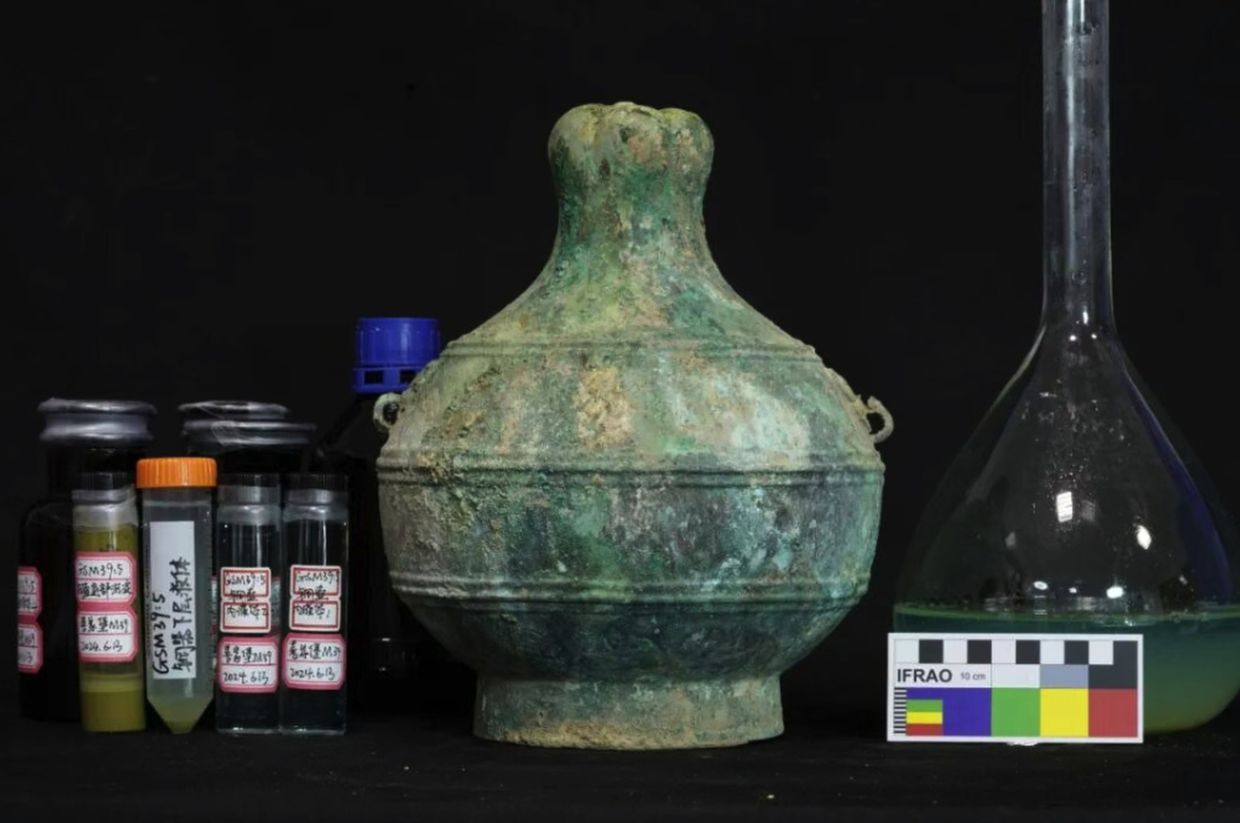
A bronze wine jar unearthed near China's ancient Great Wall has provided researchers with an unprecedented window into Qin Dynasty brewing practices, with chemical analysis confirming the liquid inside remains the most well-preserved alcoholic beverage relic from that era ever publicly documented in China. The discovery at Shanjiabao cemetery, situated just 2 kilometres from the Warring States Qin Great Wall in the Guyuan area of Gansu province, represents a significant archaeological breakthrough that challenges conventional understanding of northern Chinese winemaking during antiquity.
The garlic-head-shaped bronze vessel emerged from Tomb No 39 during systematic excavation of 183 burial sites at what researchers believe served as a garrison cemetery for soldiers and their families stationed along the 170-kilometre defensive wall. The tomb itself belonged to the Qin cultural tradition, with 179 of the 183 excavated tombs sharing these characteristics, suggesting the site functioned as a communal burial ground for frontier military personnel and their dependents. The strategic location of the cemetery, adjacent to forts and barrier outposts dotting the wall's length, indicates that border communities maintained distinct social structures and burial customs separate from inland populations.
What distinguishes this discovery from previous archaeological finds is the exceptional preservation condition of the contents. Researchers at the Ningxia Institute of Cultural Relics and Archaeology identified an ingenious double-layer sealing mechanism combining textile lining with an organic clay outer coating, a technique that maintained the integrity of approximately 3,740 millilitres of liquid inside the vessel for more than two millennia. Wang Xiaoyang, directing the Shanjiabao cemetery project, emphasised that this represents the most information-rich wine relic from the Qin state period yet recovered, allowing scientists unprecedented access to ancient fermentation practices and ingredient composition.
Detailed chemical analysis conducted at Northwest University identified 24 distinct compounds within the ancient liquid, including organic acids, amino acids, and carbohydrates that provided crucial evidence about the fermentation process. The distribution pattern of organic acids closely matched contemporary yellow wine, definitively establishing that the beverage represented grain-based fermentation rather than fruit wine production. This distinction carries particular significance because it clarifies regional brewing traditions during the Warring States period, when northern and southern China developed fundamentally different approaches to alcoholic beverage production based on available agricultural resources.
Starch residue examination proved particularly illuminating, revealing that over 92 per cent of the analysable starch originated from broomcorn millet, a hardy grain well-suited to the semi-arid climate of the Qin frontier. This finding resolves longstanding questions about crop utilisation in border garrison communities and demonstrates that frontier populations accessed reliable grain supplies sufficient not only for subsistence but also for surplus production dedicated to fermentation. The reliance on millet rather than the rice-based brewing common in southern regions reflects the distinct ecological conditions and agricultural specialisation of the northern frontier.
For regional scholars and food historians, this discovery illuminates the technological sophistication of ancient breweries operating under challenging frontier conditions. Modern understanding of early Chinese winemaking has predominantly centred on elite court production and wealthy southern regions, leaving substantial gaps in knowledge about how military communities managed food processing and preservation. The Shanjiabao findings indicate that garrison personnel possessed advanced knowledge of fermentation chemistry and vessel engineering, suggesting that brewing expertise circulated widely through frontier military structures rather than remaining concentrated in administrative centres.
The broader context of early Chinese alcoholic beverage consumption positions China among the world's earliest civilisations to systematically produce and consume fermented drinks. An expanding body of archaeological evidence from sites across the country has sparked renewed scholarly interest in tracking how brewing techniques evolved and diversified across different regions and time periods. However, the historical record previously contained frustratingly little information about how frontier communities participated in these developments, making the Shanjiabao cemetery particularly valuable for understanding the geographic distribution of brewing knowledge.
The poignant narrative suggested by the tomb's contents deserves consideration alongside the technical findings. The presence of fine wine deliberately placed in the burial vessel implies that the deceased possessed sufficient status or wealth to command quality alcoholic beverages and that family members attached significant importance to provisioning their relative's afterlife. Whether the buried individual served as a military officer, skilled craftsperson, or simply a person of means, the decision to interment a carefully sealed vessel of quality wine alongside the body reflects cultural values around hospitality, sustenance, and continuity between the living and deceased.
This discovery also carries implications for understanding daily life along the ancient frontier wall. Contemporary historical accounts often emphasise military functionality and defensive architecture while overlooking the material culture of garrison communities. The Shanjiabao cemetery demonstrates that soldiers and their families maintained sophisticated food preparation practices, consumed specialised products beyond basic rations, and preserved cultural traditions despite geographic isolation. The wine vessel itself, with its distinctive Qin design and advanced sealing technology, reveals that frontier outposts received manufactured goods reflecting broader state production standards and aesthetics.
Moving forward, the Shanjiabao findings are likely to stimulate comparative research examining how different frontier garrison systems across ancient Eurasia managed food security and morale. Scholars investigating Roman military camps, Mongol trading posts, and other garrison settlements may find parallels in how state authorities provisioned isolated communities and how those communities maintained cultural practices under challenging conditions. The chemical preservation techniques employed by Qin craftspeople also interest modern conservation specialists studying how ancient peoples protected perishable goods without refrigeration technology.
The research contributes to broader narratives about regional identity within ancient China, where the Ningxia frontier occupied a peripheral yet strategically crucial position in the emerging Qin state. As archaeological work continues along the Great Wall's extensive length, each discovery of this calibre pushes back the boundaries of what is known about frontier economic systems, trade networks, and cultural continuities. The wine from Tomb No 39 thus represents far more than a chemical curiosity; it embodies the daily realities, values, and capabilities of border communities whose stories remain largely absent from conventional historical accounts.

