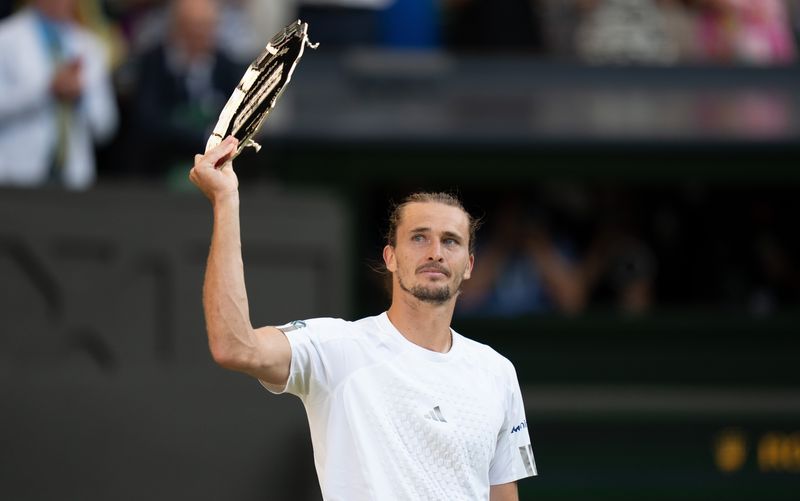
Alexander Zverev will claim the second spot in the ATP world rankings on Monday, marking a significant milestone in his career trajectory. Yet despite this achievement, the German has his sights set considerably higher, convinced that his evolving tactical approach can narrow the chasm separating him from the sport's undisputed elite. World number one Jannik Sinner and seven-time Grand Slam champion Carlos Alcaraz currently dominate men's tennis, but Zverev's performance at Wimbledon suggests he may finally possess the formula to challenge their supremacy.
The 29-year-old came achingly close to breaking through at the All England Club, pushing Sinner to a decisive four-set victory in Sunday's final. Despite falling 6-7(7) 7-6(2) 6-3 6-4, Zverev demonstrated a quality of tennis rarely seen in his previous encounters with the Italian. This represented his tenth consecutive loss to Sinner, yet the manner of defeat told a vastly different story than the nine that preceded it. Had circumstances aligned differently—specifically had he not fallen at a crucial moment when holding break point at 3-3 in the third set—Zverev could have become the first German man to claim the Wimbledon singles crown since Michael Stich's triumph in 1991.
Zverev's recent trajectory has been marked by a fundamental shift in philosophy. His maiden Grand Slam victory at Roland Garros last month, achieved at his 41st attempt, injected newfound confidence that manifested powerfully on grass. What made this success particularly meaningful was the emergence of a more aggressive playing style, characterized by devastating forehand execution and risk-taking that had previously eluded his repertoire. The contrast between his earlier career approach and his current methodology became strikingly apparent throughout his Wimbledon campaign, where he reached his best-ever performance at the grasscourt major.
When discussing his tactical evolution, Zverev demonstrated the conviction of someone who has finally discovered his true competitive identity. He explained that he established his gameplan intentions at the beginning of the year and has remained committed to its execution. Though early-season matches occasionally proved challenging as he refined this new approach, consistency proved the key to gradual improvement. The twin achievements of capturing Paris and reaching the Wimbledon final provide tangible evidence that his philosophy shift is producing concrete results.
The statistical evidence from Sunday's final illustrated precisely where Zverev's newfound strength resides. Throughout the match against Sinner, his first serve percentage maintained a remarkable consistency around 80%, providing him with the foundation necessary for aggressive play. More significantly, his forehand—historically viewed as a liability that lacked sufficient aggression—became a weapon of genuine destructive potential. Rather than employing the forehand as a defensive tool or rally-continuation device, Zverev now deploys it offensively whenever the opportunity presents itself, irrespective of the outcome on any given day.
Zverev articulated his competitive ambitions with clarity, stating that whenever an opening emerges, he seizes it without hesitation. This approach represents a complete philosophical repositioning from his earlier career, where defensive solidity formed the foundation of his game. He framed this aggressive mindset not merely as a tactical preference but as the cornerstone of his aspirations for the remainder of the current season and indeed his entire career going forward. This represents a level of clarity about his identity that often eluded him during previous years when he appeared caught between conflicting playing styles.
Despite acknowledging the formidable challenge posed by Sinner and Alcaraz, who collectively hold twelve Grand Slam titles, Zverev expressed genuine conviction that he possesses the capability to challenge these rivals for major championships. He noted that while he failed to defeat either player this year, he has consistently pushed them toward their competitive limits. His confrontation with Alcaraz at the Australian Open and his performance against Sinner at Wimbledon demonstrated that these were not one-sided affairs but closely contested matches that could feasibly have extended to five sets.
The conversation surrounding a potential "third man" in elite tennis has dominated discourse for several years, with Zverev consistently occupying that slot. However, he emphasized that this designation carried little meaning when substantial distance separated him from the top two. The significance of his recent achievements lies not merely in tournament victories but in demonstrating that he can remain competitive within the same sphere as Sinner and Alcaraz. Should Zverev continue narrowing this gap through consistent tournament performance, he could emerge as a genuine contender for major titles rather than merely a challenger who stretches the elite but ultimately falls short.
Zverev acknowledged that a fall sustained during the third set against Sinner, which proved consequential for his break point opportunity at 3-3, subsequently affected his performance. The tumble resulted in knee strain reminiscent of a serious injury incurred two years prior, forcing him to compensate on serve and consequently reducing his serving velocity. He attributed a noticeable dip in his overall level to this physical setback, though he recovered sufficiently in the fourth set to suggest that the injury itself may have been less severe than initially apparent.
Despite the Wimbledon heartbreak, Zverev's body of work this summer demonstrates a player in the midst of genuine transformation. The combination of a first Grand Slam title and a maiden Grand Slam final appearance within consecutive months suggests he has cracked a code that previously frustrated him. His commitment to an attacking philosophy, sustained across multiple tournaments despite occasional ineffectiveness, has finally yielded the returns required to challenge the established hierarchy. As he settles into his new ranking position and contemplates the remainder of the season, Zverev appears genuinely positioned to evolve from perpetual challenger to legitimate threat to Sinner and Alcaraz's dominance.

